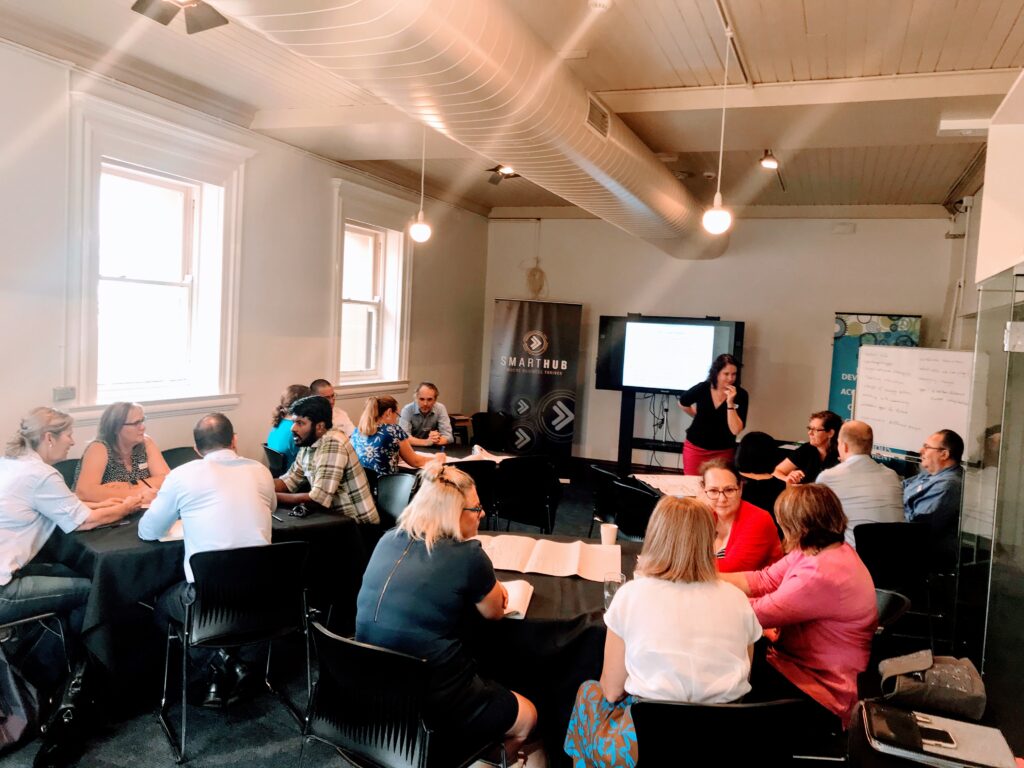
Regional Councils play a critical role in ensuring renewable energy development is fair, well managed and delivers lasting local value. Drawing on our work with regions, The Next Economy is mapping how Councils contribute at each stage of the development pathway to secure long-term community benefits.
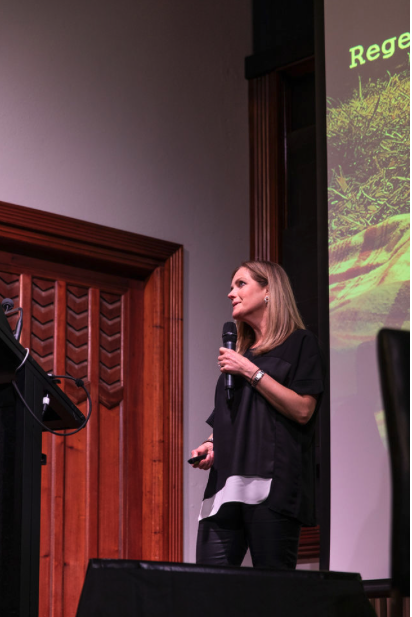
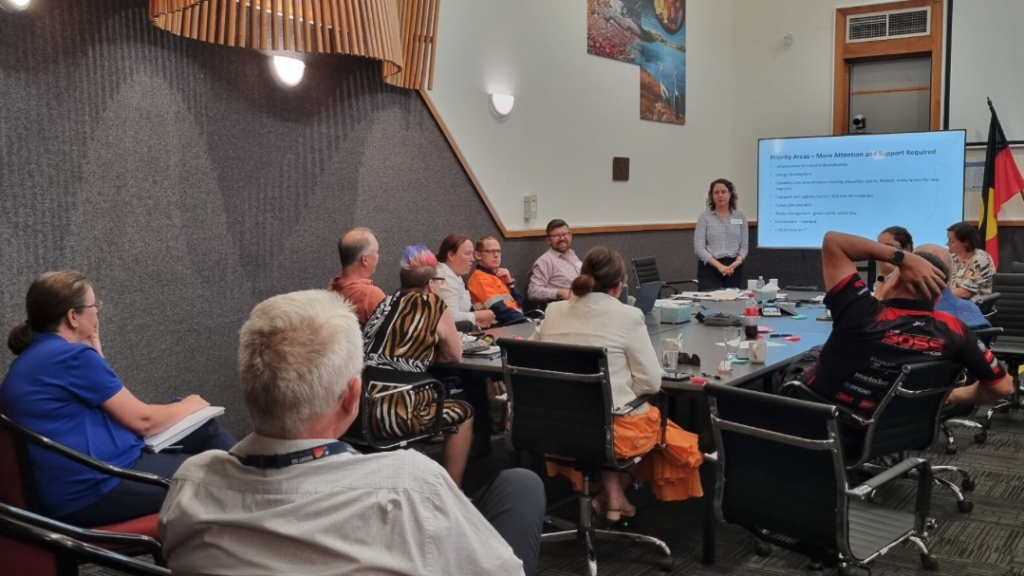
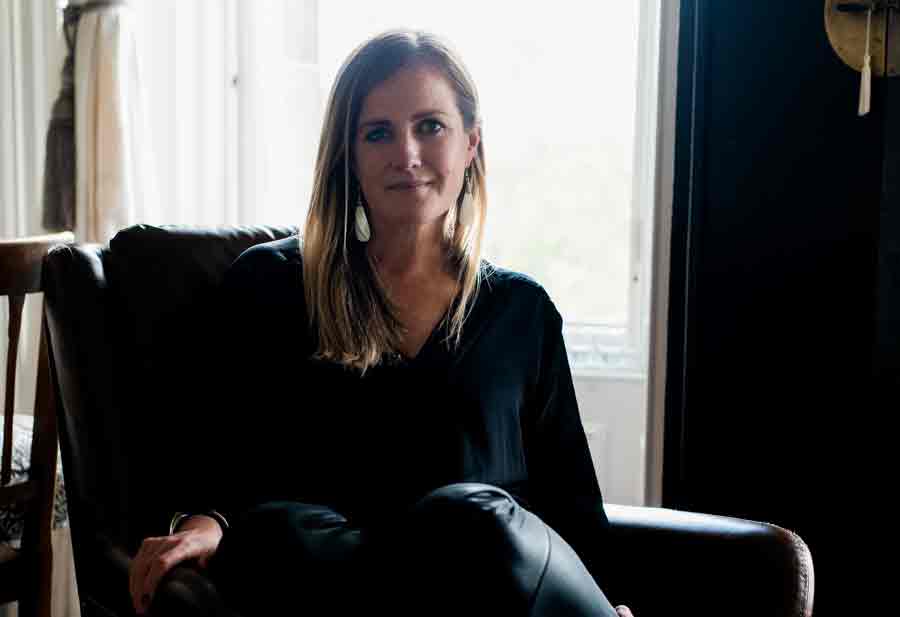
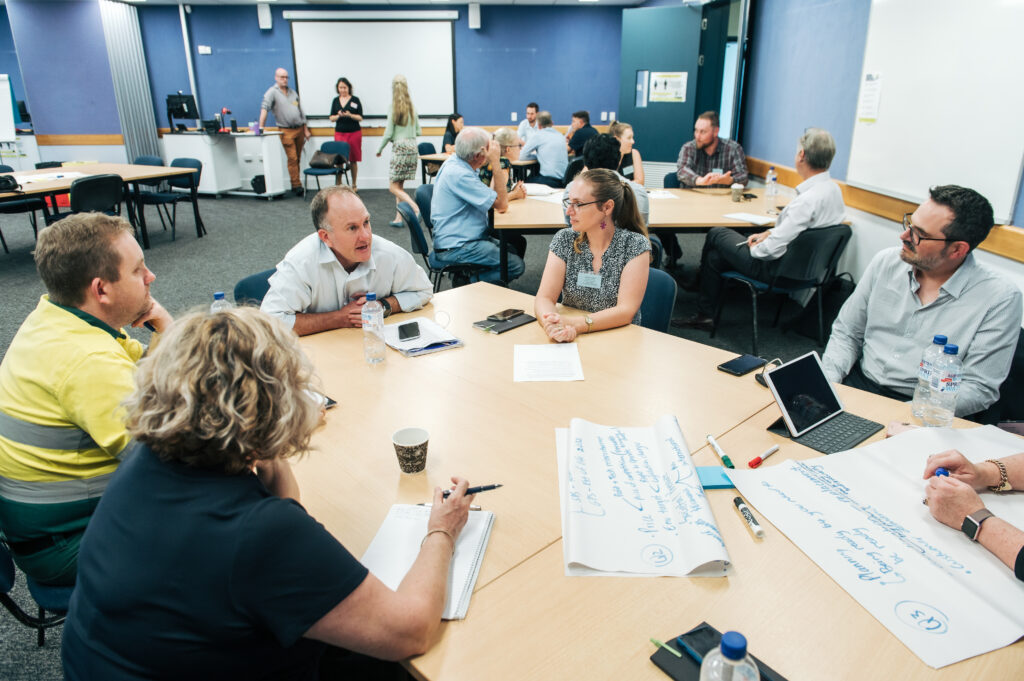
Lisa Lumsden, Senior Project Officer facilitating group discussion with local government leaders at the Regional Leaders Summit, Newcastle August 2025.
We know our place really well and we put our communities at the forefront of our decisions
Council participant at the inaugural Regional Leaders Summit, August 2025, Newcastle
Councils across Australia are being pragmatic and strategic about renewable energy development in their region – focussing on what they can do to make the most of the situation, to minimise impacts and leverage the potential for the long-term local outcomes they want.
So, what is involved in achieving that?
In short – A lot.
Drawing on work in regions such as Uralla and Hay as well as recent workshops at the Regional Leaders Summit and Gippsland New Energy Conference, The Next Economy has developed insights into the activities Councils are implementing to improve the outcomes of renewable energy development and create shared strategic value across Australia.
In mapping these over the last few months the following two groups of Council activities have emerged:
1. Development Pathway Activities: These capture the types of actions Councils can take at different stages of the renewable energy project development pathway to:
ensure community participation and development that is shaped by local knowledge and priorities;
manage unwanted impacts on the community, local infrastructure, environment and local economy, and;
facilitate development in a way that creates lasting value.
The development pathway mapping helps to answer questions such as:
What community engagement activities, plans and documents help Councils demonstrate they are representing their region, and at what stage of the renewable energy development pathway should that work happen?
What service and infrastructure upgrades – from roads and housing to water and waste – need to be prioritised to minimise local disruptions, development delays, and to leverage improved long term infrastructure outcomes for the community?
Timing is a critical factor for these activities, with many needing to be addressed, at or before, different points along the renewable energy development pathway (spanning pre-feasibility, through to construction, operation and end of life).
2. Foundational Council Activities – These arethe essential, ongoing work that underpins the Development Pathway Activities and help to form part of the enabling environment for strong regional partnerships through development. The foundations include:
Capacity and capability building
Leadership, coordination and collaboration
Advocacy and inclusion
Regular, clear and honest communication and engagement with the community
Lisa Lumsden, Senior Project Officer, notes:
Councils can and are contributing to local outcomes from renewable energy development…these insights highlight how critical it is to resource Councils and regional leaders appropriately.
The Next Economy is continuing to bring these insights together, working with regional leaders and Councils to get feedback and explore how best to share them – both to highlight the solutions being pioneered locally and to inspire and support other regions across Australia grappling with similar changes and opportunities.
The Next Economy and Hay Shire Council have been working side by side with the local community to better understand how Hay’s economy works today and what it will take to secure a stronger future. Over the past year, more than 240 residents, businesses and stakeholders have shared their perspectives through workshops, interviews and conversations.
The result is the newly published Early Insights Paper, which explores Hay’s unique economy, the challenges it faces, and the opportunities already emerging.
A deeply connected local economy
What makes Hay distinctive is not just its agricultural base or strategic location on trade and tourism routes, but the way economic and social life is deeply interconnected. From local producers sharing transport runs, to volunteers stepping in where services are scarce, Hay’s resilience depends on people and relationships as much as dollars and cents.
Turning pressure into opportunity
The final Roadmap will highlight clear areas where focused action can turn pressure into opportunity. Housing, for example, has emerged as one of the most urgent challenges. Council and partners are already exploring innovative approaches such as transitioning worker accommodation into permanent housing – a practical step that can help meet short-term needs while leaving a lasting benefit for the region.
Grounded in local identity
Alison McLean, Executive Manager for Economic Development and Tourism at Hay Shire Council, puts it simply:
Without this groundwork, there’s a risk of defaulting to what everyone else does. We are not Wagga, we are not Griffith – we have our very own unique economy, threats and opportunities.
From insights to action
This paper is an important milestone, but it is also part of a broader process of engagement and real-time action being taken to manage change across the region. Over the coming months, Council and The Next Economy will continue to work with the community to refine priorities, test solutions and activate partnerships across housing, primary production innovation, workforce development and industry diversification.
The new Striking a New Deal report highlights what regional areas need from renewable energy development. Our engagement in Uralla Shire shows how these national issues are playing out locally.
The big picture
Across Australia’s regions hosting large scale renewable energy, you will hear a mix of pride, frustration and worry. Pride in helping power the country’s clean energy future, mixed with annoyance of the little recognition from the big cities of the heavy lift they are doing to supply the nation’s power. Frustration that so much about wind, solar and battery projects feel unclear. And Worry about the pressure they could put on housing, already stretched services, and the character of local towns.
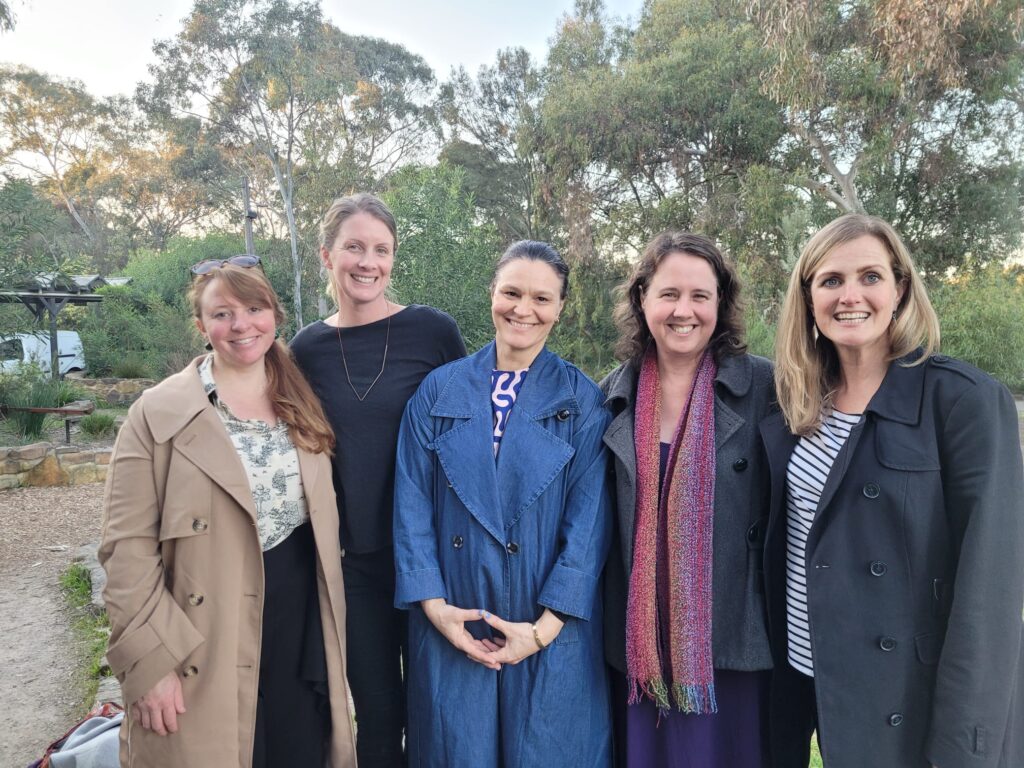
SaND project leads (ProjectsJSA, TNE, RE-Alliance, FRRR) at the Regional Leaders Forum in Newcastle
These realities are at the heart of a recent report, Striking a New Deal for Renewables in Regions, written under the Striking a New Deal collaboration. It draws on insights from leaders in communities already experiencing significant renewable energy investment and spells out what people say they need to feel confident about the shift: clear and accessible information, honest conversations about risks as well as opportunities, investment in housing, services and infrastructure before the impacts hit, and binding agreements so benefits arrive and last.
Zooming in on Uralla Shire
Much of this will sound familiar to anyone living in a renewable energy hotspot, but it is important to continue to highlight these issues so policymakers and industry can respond.
In June 2025, we ran community workshops and conversations with around 150 residents in Uralla Shire, which sits in the New England Renewable Energy Zone. We heard from a wide range of locals, and what we heard echoed the SaND report almost point for point.
One of five SaND community workshops carried out in Uralla Shire
Uncertainty and trust
How do we beat all the misinformation going around?
Uralla Shire resident
People told us they do not know what will be built, when, or how projects will fit together. This lack of clarity fuels anxiety and leaves room for rumours to grow. We have collected a long list of community questions which shows that most residents know little about the details of development and are not sure where to turn for reliable answers.
When people are not given timely and accurate information, they fill the gaps themselves, and the risk of misinformation rises. People told us they want developers and government to be proactive in explaining what is and is not yet known, rather than letting people find out in fragments over time.
Balancing benefits and risks
The report calls for “risk and opportunity accounts” which are plain language summaries of what is promised, what is at risk and how it will be managed. People in Uralla want exactly that. They also want to see the full picture, including cumulative impacts. Many asked how multiple projects together will affect local water supplies, road networks, housing, and biodiversity.
Housing was the most urgent concern. Residents fear rising rents and fewer homes for locals as temporary workforces move in. Health and aged care services are already under strain. Roads, water and waste systems are under similar pressures.
At the same time, people see opportunities such as upgrading infrastructure, training local young people for good jobs, revitalising community spaces and restoring nature.
I can see things have got to change. But my concern is the soul of Uralla.
Uralla Shire resident
Some of our younger participants at another community workshop
Securing a fair deal
Both the SaND report and Uralla locals are calling for certainty in agreements between developers and communities, not just handshake promises. People want commitments that survive a change of project ownership. They want these commitments to cover things like job pathways for local youth, healthcare investment, housing solutions, and protection of farmland, biodiversity and the Shire’s heritage.
If we cannot fight it, make it better.
Uralla Shire resident
Building from strengths
In Uralla, we have taken a strengths-based approach. This means starting with what works and what people value. The active volunteer networks, the character and creativity of main street Uralla, the entrepreneurial spirit in its many independent shops, and the strong sense of neighbours looking out for one another as seen during the recent snow event. Building on these assets is essential if renewable energy development is to enhance the community rather than erode it.
Legacy is the name of the game, no two ways about that.
Uralla Shire resident
And what came out clearly is that residents do not want business as usual planning if benefit funds flow in. They want legacy projects that make life better for all residents, not just a few.
Watch this space for the full output of our engagement work with Uralla Shire Council in the spring.
TNE SaND project delivery team in Uralla: Saideh and Lyndsay
What is Striking a New Deal (SaND)?
Striking a New Deal is a collaboration between The Next Economy, RE-Alliance, Projects JSA and the Foundation for Rural and Regional Renewal. It brings together local voices, regional leaders and national policy discussions to make sure communities hosting renewable energy get a fair deal.
SaND has three interconnected strands:
Regional Leaders Network: bringing together leaders from across renewable energy regions to share experiences, challenges and solutions.
Place-based work: partnering with Uralla Shire Council to test ways of engaging communities and planning for long-term benefits from renewable energy investment.
Policy influencing: sharing insights from communities and leaders to inform governments, industry and the public. The Striking a New Deal for Renewables in Regions report was released under this strand.
The Next Economy is proud to partner with Great Barrier Reef Legacy on the Forever Reef Project. Our contribution will support the co-design, launch and operation of the project’s First Nations Living Coral Biobank Hub Network—an ambitious initiative to protect coral biodiversity and strengthen regional economies through First Peoples leadership and innovation.
A New Chapter in Reef Conservation
As the climate crisis intensifies, the need for bold, collaborative action to protect the Great Barrier Reef has never been more urgent. Coral reefs are among the most biodiverse ecosystems on Earth, yet they are also among the most vulnerable. The Forever Reef Project, led by Great Barrier Reef Legacy (GBR Legacy), offers a powerful response: a living “Coral Ark” of coral species, safeguarded for future generations.
There is a clear window of opportunity to act immediately to secure the biodiversity of corals for all reefs, now and into the future. The Forever Reef Project will preserve the genetic biodiversity of hard coral species by collecting and maintaining living samples of over 400 species from the Great Barrier Reef and supporting reef-dependent communities to care for their corals around the world.
Dr Dean Miller, Founder and Managing Director, GBRL Legacy
At the heart of this effort is a commitment to First Peoples leadership. The Forever Reef Hub Network will be a series of purpose-built coral care facilities, managed by Reef Traditional Custodians across
the Reef’s expanse — from Bundaberg to the Torres Strait. These hubs will not only preserve coral biodiversity but also create jobs, support cultural knowledge sharing and education initiatives, and strengthen Sea Country stewardship.
The Next Economy’s Role
The Next Economy (TNE) is proud to support the delivery of Stage 2 of the Forever Reef First Nations Living Coral Biobank Hub Network. Our role focuses on supporting the establishment of the pilot Hub in partnership with Dawul Wuru Aboriginal Corporation (DWAC); and laying the groundwork for development the broader network.
This work builds on the successful completion of Stage 1, which developed the business model for the Hub Network. Stage 2 is now underway, transitioning the project from concept to reality.
We’re excited to be making a difference by preserving and nurturing the coral biodiversity of Yirrganydji Sea Country through our cultural lens for our current and future generations.
DWAC Team
Project Phases and Outcomes
The Forever Reef Hub Network is being developed in three key stages:
Stage 1: Design (Complete)
Development of the First Nations Living Coral Biobank Hub Network Business Model
Engagement, planning, and analysis (Sept 2022 – June 2023)
Stage 2: Demonstration (Underway)
Establishment of the Pilot Hub with Dawul Wuru Aboriginal Corporation
Collection and preservation of hard coral species from Yirrganydji Country
Creation of new jobs in aquaculture, facility management, and education
Generation of new revenue from biodiversity conservation and education
Demonstration of education and engagement experiences
GBR Legacy and Dawul Wuru have completed site planning, ranger training has commenced, educational material is being developed, and revenue raising options are being scoped. Construction is due to commence in August and operations shortly afterwards.
TNE is supporting the project team to develop opportunities for sustainable revenue generation like access to biodiversity markets and assisting with the co-design of collaboration and agreement making protocols that are culturally appropriate and reflect the team’s aspiration for strong, long-term collaboration and knowledge sharing.
Stage 3: Scaling (Future)
Establishment of multiple First Nations Living Coral Biobank Hubs across the Reef
Preservation of all 400+ hard coral species from the Great Barrier Reef
Creation of sustainable jobs and regional economic opportunities
Deepened cultural connection and stewardship of sea country
More About GBR Legacy and Forever Reef
GBR Legacy is a not-for-profit social enterprise with over 35 years of experience in reef expeditions, science, and education. The Forever Reef Project is their flagship initiative to preserve the genetic diversity of hard coral species—starting with the Great Barrier Reef and expanding globally.
Their parent facility in Port Douglas already houses over one third of the Great Barrier Reef’s hard coral species making it the most biodiverse collection of living corals in the world. The goal is to collect and care for all remaining species in collaboration with Traditional Owners, ensuring their survival in the face of climate change.
For the next five years, The Next Economy will prioritise partnerships within critical regions: those that hold the key to Australia achieving net zero by 2035. This includes regions with significant levels of First Nations land and sea stewardship, particularly across Northern Australia.
TNE’s role working with GBR Legacy aims to support First Nations leadership and participation in coral biodiversity conservation along the Great Barrier Reef, within a model that facilitates economic sovereignty. This project will generate new insights into how First Nations communities can be better resourced to protect and regenerate nature and achieve Australia’s biodiversity and climate goals.
4 August 2025: As Australia undergoes the shift to renewables, rural and regional communities are demonstrating new ways of securing a good deal from large-scale solar, wind and battery projects.
This is the conclusion of a new report – Striking a New Deal for Renewables in Regions – authored by FRRR and Projects JSA, as part of the Striking a New Deal collaboration. It comes ahead of a first-of-its-kind national gathering of local government and regional development leaders at a Summit hosted by RE-Alliance in Newcastle this week.
The report draws on insights from leaders in regions with significant renewable energy investments around Australia and outlines the common risks and opportunities facing their communities.
While the majority of Australians living in regional communities generally support the nation’s shift to renewable energy (CSIRO, FCA, Porter Novelli), the report clearly shows that the first phase of this change has been challenging.
Leaders have been grappling with significant uncertainty about what will actually be built and when; the local risks and opportunities of these developments for their economy, environment and community; and limited local agency to influence the development process.
With the need to replace aging coal-fired power stations, state and federal governments have so far been ‘building the plane while flying it’. However, with clearer policies and more projects reaching the approval stage, solutions to common issues have emerged, creating more opportunities for regions to achieve meaningful and lasting benefits from investments.
Sarah Matthee, Climate Solutions Portfolio Lead at FRRR, noted, “Communities simply want a good deal in return for hosting this new energy infrastructure. They want certainty, more clarity on the opportunities and risks of these projects, more resourcing and more agency in the decisions being made that will impact their regions for decades to come.”
Lead author, Jack Archer, added, “Development at this scale will never be universally popular, but if locals can see they have been heard and clearly understand how their community will benefit, there can be enduring support for the energy shift in regions across Australia.”
The report recommends government and industry collaborate to produce risk and opportunity accounts, to act as living ledgers, to make the terms of the local deal clearer. Currently information is fragmented and buried in planning documents, and with misinformation on social media and in local networks, it’s difficult for locals to understand what’s going to happen, if they will be better off and what issues need further work as development progresses.
The report also recommends combining the transparency of these new accounts with upgrades to community services and housing, ongoing input from local leaders in the development process and genuine security that benefits will be delivered.
“This set of actions is the key to unlocking the local social licence governments and industry are seeking. It’s a practical approach that can be implemented quickly and it will change the game,” Jack Archer said.
Not-for-profit organisations the Foundation for Rural & Regional Renewal, RE Alliance and The Next Economy, and consultancy Projects JSA are working collaboratively on the Striking a New Deal project to support regional communities at the frontline of the energy transition. Striking a New Deal has worked with community leaders across Australia to share insights and supports initiatives that seek to find a better way to develop renewables in regions.
About FRRR FRRR (Foundation for Rural & Regional Renewal) is the only national foundation specifically focussed on ensuring the social and economic strength of Australia’s remote, rural and regional communities. FRRR’s unique model of support is more than money – it connects common purposes and investment from government, business and philanthropy with the genuine needs of rural people and places.
About RE-Alliance The Australian Renewable Energy Alliance, or RE-Alliance, is an independent not-for-profit working to secure a responsible and rapid shift to renewable energy that actively contributes to the strength and resilience of rural and regional Australia.
About The Next Economy The Next Economy, TNE is a not-for-profit economic development agency, working across all economic sectors to support communities manage the transition to a climate-safe, socially just and regenerative economy.
About Projects JSA Projects JSA – Regional Advisory, led by Jack Archer, provides specialised advice on regional development issues in Australia. Jack is one of Australia’s foremost experts on regional development, experienced in policy, strategy, stakeholder consultation and facilitation, leveraging extensive networks and detailed knowledge of each region in Australia.
At the end of May, The Next Economy visited Uralla Shire as part of our work on ‘Striking a New Deal’ (SaND)** – a place-based project delivered in partnership with Uralla Shire Council in NSW to support meaningful community engagement and develop a Renewable Energy Strategic Plan.
Uralla Shire sits within the New England Renewable Energy Zone, an area identified for major renewable energy development, and this plan will support Council to understand community priorities, surface early concerns, identify opportunities for investment and ensure accountability as the region grapples with change.
We spent the week speaking with landholders, business owners, and community leaders. It was clear from these early conversations that Uralla Shire is a place with a strong sense of identity shaped by collaboration, entrepreneurship, and care for their people and land.
Sheep grazing under the New England Solar Farm, located close to Uralla town centre. Credit: Saideh Kent
A Clear Sense of Place
We heard about Uralla’s deep volunteer culture – from the fire brigade to multiple active community interest groups – and about the pride people take in living a self-reliant, community-minded lifestyle. People spoke about looking after the land, farming in sustainable ways, and working together respectfully.
As Saideh Kent, Energy Lead at The Next Economy, noted: “Uralla has an incredible sense of place. People here are proud of what they’ve built together and want to protect that as the region changes.”
This strength is something to build on – not just preserve – as the community navigates the changes ahead.
Why Community Input Matters
Some people we spoke with were uncertain about the value of yet another consultation. That’s understandable, especially as timelines shift or information feels confusing.
“When people are involved early, it’s easier to identify concerns, make better plans, and ensure new development strengthens what’s already good,” Saideh said.
The reality is that council does not have the power to say yes or no to these large-scale renewable energy projects. But what council can do is play a key role in managing this wave of change well – by minimising potential disruptions, identifying shared benefits, and ensuring that development aligns with what the community values.
To do that, council needs to hear directly from people across the Shire. Upcoming community workshops in late June are designed to provide that opportunity -for residents to name priorities, raise concerns, and help shape how renewable energy projects contribute to Uralla’s future.
A sign showing different routes off Uralla main street, which is located on the New England Highway. Credit: Lyndsay Walsh
Choosing the Right Route
This is about more than managing change, it’s about collectively choosing the right route forward. From infrastructure and land use to investment priorities, now is the time to ask: what does good development look like for Uralla Shire? How do we make sure that new projects leave a lasting, positive legacy?
“This isn’t just about wind turbines or transmission lines,” Saideh said. “It’s about making sure Uralla stays a great place to live – with good jobs, healthy landscapes, and a vision for the future that people are excited about.”
How these projects are managed will determine the road ahead, but with the right planning and participation, that can lead where the community wants to go.
A shop front in Uralla saying ‘this is where the magic happens’. Credit: Lyndsay Walsh
Where the Magic Happens
Walking down Uralla’s main street, we spotted a sign in a shop window: ‘This is where the magic happens.’ It felt fitting. The real magic lies in the conversations we’re helping to plan and in the spirit of community that already runs strong in Uralla.
As one local we interviewed put it, “The only way I’m happy living where I am is if my community is happy and going well.” That’s exactly what this work is about, creating the space to support and grow that shared wellbeing.
The Next Economy is currently designing the next phase of engagement based on what we’ve heard so far. Community-wide workshops will run from 25–29 June 2025. You can read more about those and our work with Uralla Shire here: https://yoursay.uralla.nsw.gov.au/sand
**SaND supports regional communities as they navigate the development of renewable energy in their area. Together with Foundation for Rural and Regional Renewal, RE Alliance and Projects JSA, The Next Economy, supports a peer-to-peer network of regional leaders sharing insights with government and industry as part of the SaND project. You can read more about the partnership here: https://nexteconomy.com.au/work/driving-better-community-outcomes-from-renewable-projects/
This short paper introduces key ideas and real-world examples driving a shift toward a wellbeing economy in Australia.
The Next Economy is working with partners to secure a future where everyone can thrive and the natural world is cherished and protected. Achieving this vision requires more than isolated reforms — it calls for a fundamental transformation of our economic systems.
In 2024, with support from the Lord Mayor’s Charitable Foundation, TNE convened a two-day gathering of change agents from across Australia. Together, we explored the preconditions for systems change and examined the opportunities and barriers to reshaping our economy.
This short paper, Heading Upstream to Tackle the Economic Root Causes, distils key insights prepared for that gathering. It introduces foundational concepts that highlight the need for upstream economic change and illustrates how our current economic structures often fall short of serving people and planet.
We frame this transformation through the lens of the 4Ps:
Purpose: Reorienting the economy to serve wellbeing.
Prevention: Tackling root causes rather than symptoms.
Predistribution: Designing fairness into the system from the start.
People Powered: Ensuring communities have a voice in shaping their futures.
Dr Katherine Trebeck, Economy Change lead at The Next Economy, said: “Across Australia, inspiring examples of these shifts are emerging. “For example, the ACT’s wellbeing framework, the appointment of a Minister for Prevention in WA and efforts by businesses to make their production processes more circular. And even enterprises like Honorbread in Bermagui becoming employee-owned and communities working together to benefit from the rollout of renewable energy.”
“However, these examples remain the exception, not the norm. This paper serves as a primer for those curious about what upstream economic change looks like and why it matters.”
📢 Stay tuned: In the coming months, we’ll be releasing a broader research project that dives deeper into the state of the Australian economy and how we can reimagine it to support collective wellbeing.
In the heart of NSW’s Riverina region, the town of Hay is asking big questions about its future.
Over a week in April, The Next Economy met with more than 30 local landholders, business owners, and community leaders to explore how the regional economy works—and how it can adapt to the challenges and opportunities ahead.
“We’re working with the Hay community to build a rich picture of the local economy—how it operates, who’s involved, and what’s needed to make it more resilient and future-ready,” says Jacqui Bell, Project Lead at The Next Economy.
This work is part of a broader effort to co-develop a regional economic roadmap—a guide to help Hay navigate dynamic social, environmental, and economic change. The process is grounded in local knowledge and shaped by the lived experience of those who call the region home.
This work follows on from the development of a set of principles for successful renewable energy development in Hay (in partnership with Re-Alliance), and the Regional Resilience Plan (in partnership with TNE and the Australian Resilience Centre) in Hay over the past two years.
Asking the Right Questions
The conversations in Hay are centred around a series of powerful questions:
What does our economy look like, and why does it work the way it does?
What trends—local and global—are shaping our future?
What can we do together that we can’t do alone?
How do we ensure that the wealth generated here benefits the whole community?
These questions are helping to surface both the strengths and vulnerabilities of the region’s economy, and to identify opportunities for collective action.
A Sector Under Pressure
Hay, like many regional communities, is facing cascading pressures: rising costs of living, workforce shortages, climate impacts, and uncertainty around the energy transition. These challenges are compounded by confusing policy signals and complex market mechanisms—particularly in the agriculture and land sectors.
“There’s growing interest from global markets and investors in low-emissions, nature-positive products,” says Jacqui. “But those signals often aren’t reaching producers on the ground—or they’re too weak or confusing to drive meaningful change.”
This disconnect is contributing to scepticism and fatigue in communities already being asked to take on significant risk to address climate change and biodiversity loss.
No One-Size-Fits-All
The Next Economy’s work in Hay reinforces a key insight: context matters. A one-size-fits-all approach to agricultural transition won’t work in Australia. Each region has its own assets, challenges, and aspirations.
“How transitions are managed locally will shape the future of entire regions,” Jacqui explains. “Strategic planning and coordination are essential—not just to respond to change, but to shape it in ways that are fair, effective, and grounded in place.”
What’s Next
The roadmap being developed with the Hay community will help guide investment, policy, and local action. It’s part of a growing movement across regional Australia—where communities are stepping up to lead the transition to a climate-safe, regenerative, and socially just economy.
“This isn’t just about adapting to change,” says Jacqui. “It’s about creating the conditions for communities to thrive in the next economy.”
March 5 2025: Reimagining Diversity in Clean EnergyCareers launches today.
The rapid expansion of clean energy development is driving demand for hundreds of thousands of workers with diverse skills but right now many of those roles remain unfilled.
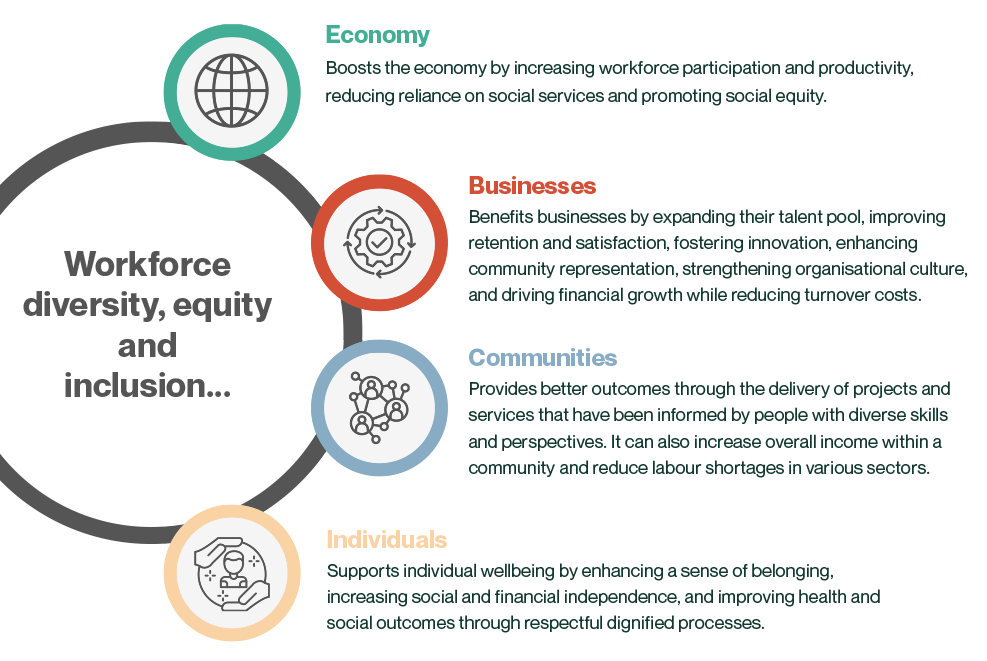
This shortfall presents an opportunity. The Next Economy’s Reimagining Diversity in Clean Energy Careers report shows that by removing barriers to workforce participation for people from marginalised groups and communities, Australia can achieve a faster and fairer energy transition.
It finds that fostering greater diversity and inclusion in the clean energy workforce can improve outcomes for individuals and communities, all while generating benefits for businesses and regional economies and helping Australia meet its renewable energy targets.
Fostering greater diversity, equity and inclusion (DEI) in the workforce can improve outcomes for individuals and communities, as well as generate benefits for businesses and the economy.
The task is significant, but there are practical actions that can be taken to remove barriers to participation and build a workforce that delivers a faster, fairer and more inclusive transition to net zero.
The report outlines several opportunity areas to help drive this change:
Foster a thriving workforce development ecosystem: connecting diverse stakeholders, creating the conditions for collaboration while supporting marginalised individuals and regional economies
Strengthen inclusive career development pathways: providing equitable access and opportunities for all learners and workers
Create supportive and inclusive workplaces: ensuring employees from diverse backgrounds feel welcome, valued and supported at work
The report shows these opportunity areas work best when underpinned by a core principle of putting people at the centre of all workforce development efforts.
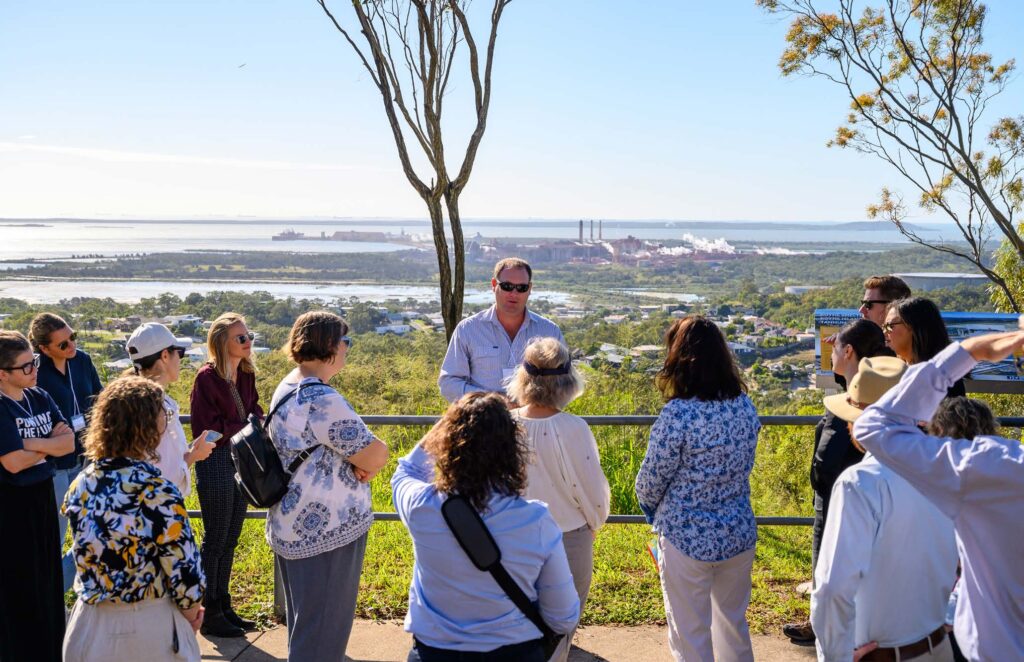
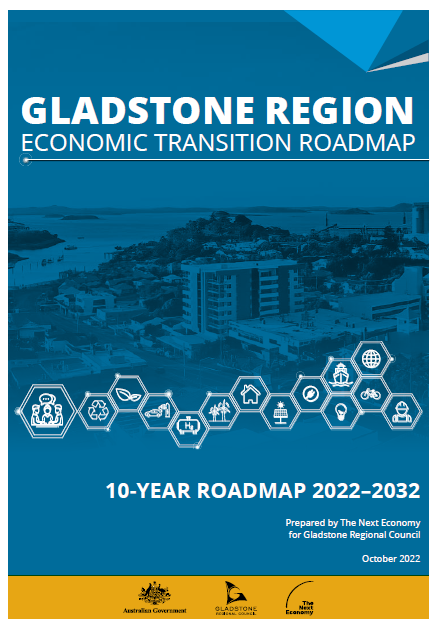
Stakeholders from different sectors across Gladstone have set directions for their future and are working together to manage the net zero transition. Pictured here is a representative of the Queensland Department of State Development and Infrastructure, explaining the history of Gladstone’s industrial transitions to visiting philanthropists and investors. Source: The Next Economy / William Debois.
Developed through research, interviews and workshops and drawing on insights from The Next Economy’s work with regional communities at the frontline of the energy transition, the Reimagining Diversity in Clean EnergyCareers report is a resource to support stakeholders take a broader view of what diversity, equity and inclusion in the workplace can look like. It highlights actions that leads to workforce development in the clean energy sector that benefit everyone.
Curious to learn more about the report? We’ll be hosting a briefing session in April 2025. Register your interest to be notified of upcoming dates by filling out this form:
The Next Economy, together with Mount Isa City Council and Climate-KIC Australia, is proud to launch the Mount Isa Future Ready Economy Roadmap.
Mount Isa, like many other industrial regions, is at the crossroads of major economic change. The region has a rich asset base, including the North West Minerals Province, but faces the imminent closure of the Mount Isa Mine’s underground copper mine operations and copper concentrator.
This closure will impact approximately 1,200 workers from mid-2025 and the future of the local copper industry, a change that needs to be managed alongside increasing demand for critical minerals, affordable and reliable energy generation and storage options, and innovative logistics solutions. Global trade uncertainty and climate impacts further complicate this picture.
Whether Mount Isa successfully navigates these changes will be critical to the success of Australia’s net zero ambitions, and global decarbonisation goals.
The Mount Isa Future Ready Economy Roadmap provides a clear and ambitious vision for the future of Mount Isa against this backdrop of regional change, global uncertainty, and new opportunities.
In this future, Mount Isa thrives. The regional economy enables Australia’s net zero transformation, contributing to the next generation of clean energy and critical minerals exports and processing . Local industry and the community lead innovative solutions to long-standing and emerging challenges, benefiting from a focus on circular economy approaches, decarbonisation, environmental sustainability and regeneration, and social wellbeing.
This vision is underpinned by the application of the Future Ready Economy Framework. This Framework has been designed by The Next Economy and Climate-KIC to assist decision-makers in regions like Mount Isa to assess economic opportunities against six key dimensions of positive and resilient development.
Along with regional stakeholder engagements and expert input, the Framework has informed the development of future ready development pathways, strategies and potential actions for Mount Isa’s five key economic sectors—energy, mining, transport, agriculture and tourism—and the foundations of a thriving community.
By adopting a future ready lens to regional economic development, Mount Isa is ensuring that today’s planning and investment decisions position the region for long-term success.
With the right planning and investment from key partners, including the Queensland Government and Australian Government, and industry, Mount Isa can pursue these pathways and become a global player in a decarbonising world.
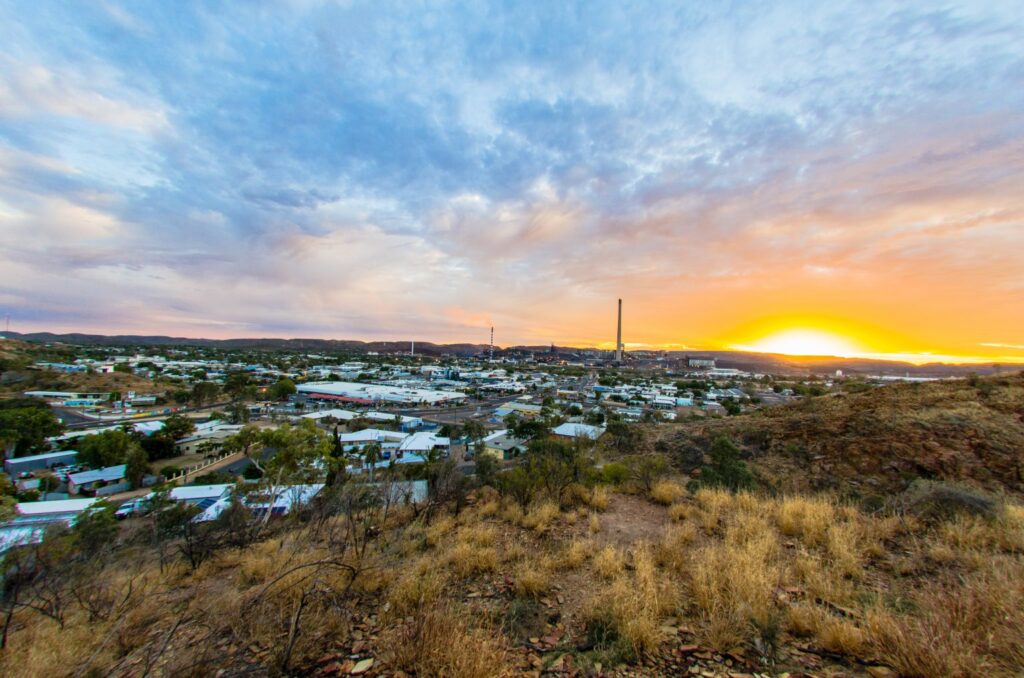
Mount Isa has a proud history of innovation and mining excellence which can continue to thrive with the right investment and collaboration between industry, government and the community. Photo: Chris Grose.
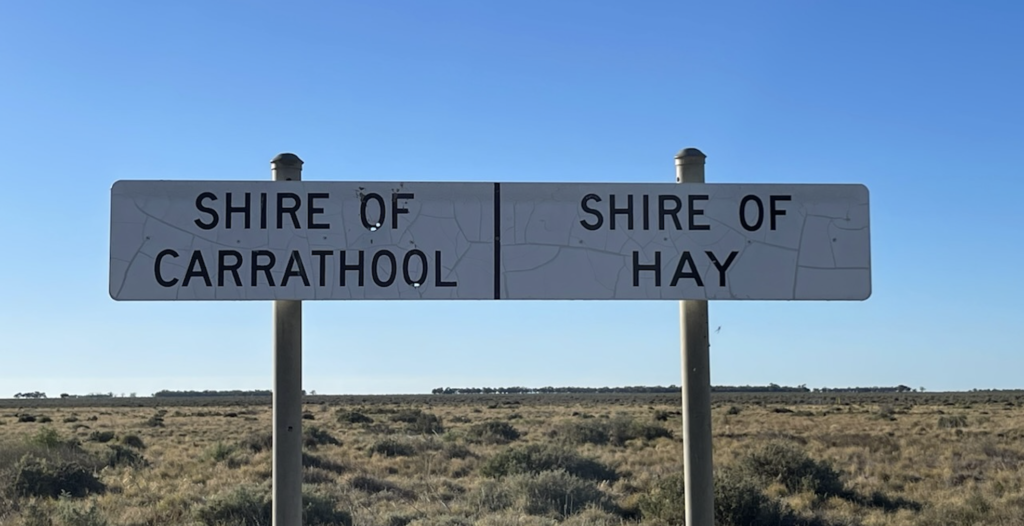
This week, the Hay and Carrathool Shire Councils launched the Hay and Carrathool Regional Drought Resilience Plan. The Plan is designed to identify strategic focus areas and priority actions to strengthen regional resilience. Convened by both councils, the Plan is the result of an extensive seven-month collaboration involving more than 300 community members, industry representatives, and government stakeholders.
The Plan envisions a future where, by 2035, the communities of Hay and Carrathool are equipped to navigate climate, environmental, social, and economic challenges while remaining strong, connected, and vibrant. It sets out a strategic path for ensuring safe and thriving places to live, work, and raise future generations.
Hay Shire Mayor, Carol Oataway, acknowledged the immense community effort behind the Plan and the commitment of local people to shaping their future.
“This level of community engagement reflects the leadership and strengths of this vibrant region and demonstrates the passion that local people have for its future,”
Carol Oataway, Mayor of Hay Shire
With five core strategies—Inclusive & Empowered Communities, Future Ready Businesses, Reimagined Care Economy, Placemaking with Purpose, and Coordinated Action for Climate Resilient Economic Development—the Plan identifies 26 priority actions, each with partners to lead and drive progress.
Key actions include setting up community hubs where people can connect, working groups so businesses can “share” employees, innovative ways to provide care to groups that need it, an initiative to collect and use environmental data, a housing strategy, and a roadmap to diversify and strengthen the regional economy.
Already, the Plan has sparked action across the community. To really bring its vision to life, collaboration between local government, businesses, and residents will be essential in addressing risks and capturing emerging opportunities.
“We’re the ones who know what our region needs… State and federal governments need to support regionally led solutions like ours.”
Carol Oataway, Mayor of Hay Shire
The Next Economy and the Australian Resilience Centre worked with the Hay and Carrathool Shire Councils and local communities to deliver the Plan. It has been developed as part of the Regional Drought Resilience Planning Program, which is jointly funded by the Australian Government and NSW Government under the Future Drought Fund.
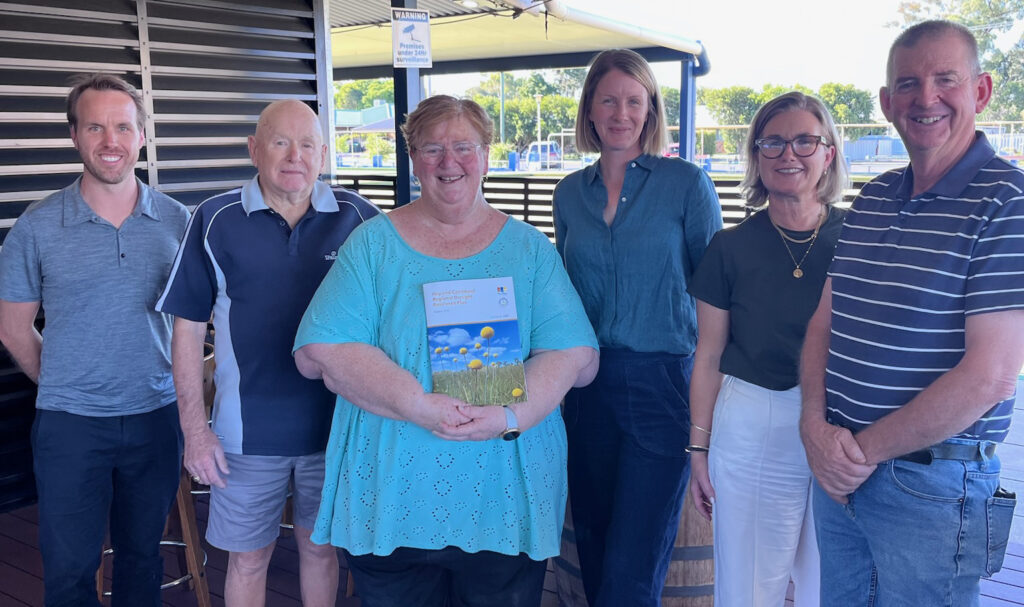
Hay Shire Councillors John Perry and Geoff Chapman, along with Mayor Carol Oataway and Alison McLean, Executive Manager for Economic Development and Tourism, are pictured with Jacqui Bell and Doug Ruuska from The Next Economy.
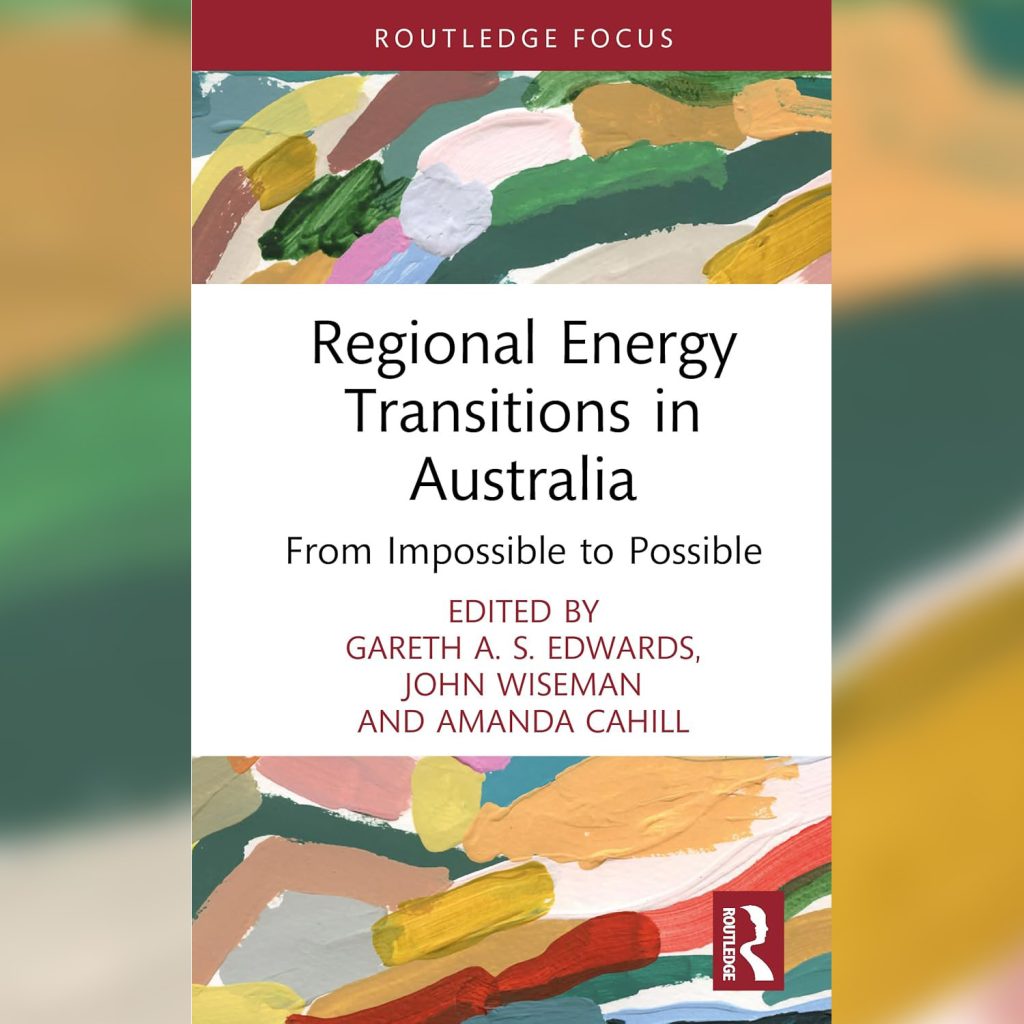
Regional Energy Transitions in Australia: From Impossible to Possible is out now. Join us at one of the many launches happening across the country from 5 March 2025.
It’s time for an honest conversation on the state of the energy transition, the remaining challenges, and what regions need to manage impacts and capture long-term benefits.
Australia is at a critical juncture in the energy transition. Once deemed impossible, the shift from fossil fuels to renewable energy is now well underway. For the transition to be just and sustainable, it is vital that regional communities, those at the forefront of change, are listened to.
The newly released book, Regional Energy Transitions in Australia: From Impossible to Possible, provides an in-depth look at the challenges and successes of energy transitions in five key Australian coal regions: Port Augusta, the Latrobe Valley, Collie, the Hunter Valley, and Central Queensland.
With insights from over 20 contributors—including government officials, academics, industry experts, and community leaders—this book is an essential read for anyone invested in Australia’s energy future. It was co-edited by Dr Gareth Edwards, Professor John Wiseman, and Dr. Amanda Cahill, CEO of The Next Economy.
Recent events
Gladstone, Central Queensland – Date change to 7 May 2025
📅 Date: Wednesday 7 May 5pm – 7pm AEST 📍 Location: Rex Metcalfe Theatre, Leo Zussino Building (Building 3), CQUniversity, Gladstone Campus 🎟 Tickets: Get tickets here
🎤 Speakers: An honest conversation with Mayor Matt Burnett (Mayor of Gladstone Regional Council), Dr Amanda Cahill (book editor and CEO of The Next Economy), Kristy Marks, Economic Development Manager for Gladstone Regional Council and Craig Jones (Chief Financial Officer at Alpha HPA).
Melbourne, Victoria
📅 Date: Wednesday, 5 March, 5pm – 7pm AEDT 📍 Location: Forum 3, Melbourne Connect, 700 Swanston St, Carlton, VIC 3053, Australia 🌍 Host: Melbourne Climate Futures with The Next Economy 🎟 Tickets:Get tickets here
🎤 Speakers: An honest conversation chaired by Professor John Wiseman alongside fellow book editors Dr Gareth Edwards and Dr Amanda Cahill, Sharan Burrow (Former General Secretary of the International Trade Union Confederation) and Dan Musil (Book contributor and Secretary, Earthworker Cooperative).
Latrobe Valley, Victoria
📅 Date: Tuesday 11 March, 6pm – 7.30pm AEDT 📍 Location: Morwell Innovation Centre, 1 Monash Way, Morwell 🎟 Tickets: Get tickets here
🎤 Speakers: An honest conversation with Dan Musil (Latrobe Valley chapter contributor), Chris Buckingham (CEO, Latrobe Valley Authority), Josie Hess (Environment Victoria, award-winning filmmaker) and Jeffrey Jacquet (Global Director, Global Coal Transitions Research Network).
Hunter Valley, New South Wales
📅 Date: Wednesday, 12th March, 6pm – 7.45pm AEDT 📍 Location: NUspace, The University of Newcastle (Room TBC), Newcastle 🌍 Host: Institute for Regional Futures 🎟 Tickets: Get tickets here
🎤 Speakers: An honest conversation with Amanda Cahill (book editor and CEO of The Next Economy), Associate Professor Liam Phelan (book contributor, University of Newcastle), Warrick Jordan (book contributor and Policy Specialist, the Australian Climate and Biodiversity Foundation), and Professor Kate Senior (Acting Director, the Institute for Regional Futures).
Sydney, New South Wales
📅 Date: Thursday, 13th March, 5pm – 6pm AEDT 📍 Location: Seminar Room 203, RD Watt Building, Camperdown 🌍 Host: Sydney Environment Institute with The Next Economy 🎟 Tickets: Get tickets here
🎤 Speakers: An honest conversation chaired by Professor Susan Park (Professor of Global Governance, University of Sydney), with Dr Gareth Edwards (book editor, Visiting Associate Professor, University of East Anglia), Kimberley Crofts (book contributor, Researcher and Service Designer), and Dr Elianor Gerrard (book contributor, Institute for Sustainable Futures).
Brisbane, Queensland
📅 Date: Tuesday, 1st April, 5.15pm – 6.30pm AEST 📍 Location: Room 0M08 (enter via lift in Atrium), UQ City, 308 Queen Street 🎟 Tickets: Get tickets here
🎤 Speakers: An honest conversation with Trevor Gauld (Deputy Commissioner of Jobs and Skills Australia), Dr Amanda Cahill (book editor and CEO of The Next Economy), Liz Young (Research Director of the Queensland Decarbonisation Hub at Centre for Policy Futures, UQ), and Carly Quinn (General Manager People and Strategy at Gladstone Regional Council).
Canberra, Australian Capital Territory
📅 Date: Thursday, 10th April, 5pm – 7pm AEST 📍 Location: Law Link Theatre, Fellows Lane, Australian National University, Canberra 🎟 Tickets: Get tickets here
🎤 Speakers: An honest conversation hosted by Professor Frank Jotzo with David Shankey (CEO of Net Zero Economy Authority), Dr Amanda Cahill (co-editor and author, CEO of The Next Economy), Associate Professor Bec Colvin (researcher on energy transition at ANU), and Jo Evans (former Deputy Secretary of the Department of Climate Change, Energy, the Environment and Water).
What you’ll learn from the book
Regional Energy Transitions in Australia captures vital insights from communities that have navigated the transition away from fossil fuels over the past decade. It shows that:
All energy transitions are local. They must be shaped by the histories, cultures, and needs of the communities most affected.
Justice is key. A just transition means supporting workers and communities, including through re-employment, retraining, and early retirement options.
Leadership and coordination matters. Strong governance, inclusive participation, and long-term policy stability are essential.
Regional case studies
Five coal regions featured in the book offer a powerful story about energy transitions in practice:
Port Augusta, SA tells a story of community optimism and renewable investment tempered by inadequate support by state and federal governments.
The Latrobe Valley, VIC grappled with unplanned coal-fired power station closures and built resilience through rapid community and government collaboration.
Collie, WA provides a powerful example of inclusive participation in transition planning, championed by First Nations Elders.
The Hunter Valley, NSW has shown the importance of local coalitions working together to put community needs on the agenda during a complex regional economic transition.
Gladstone, Central QLD demonstrates the importance of inclusive and locally driven engagement to shift from fossil fuels to renewable industries.
Praise for the book
This collection presents a unique set of insights into how energy transition can be achieved at the regional level.
Prof. Frank Jotzo, ANU
“From ‘impossible to possible’ is a testament to hope and tenacity. The lessons learned from these regions demonstrate that the support of and co-creation with workers and community, along with government support, make the difference.”
Sharan Burrow, Former General Secretary International Trade Union Confederation (ITUC)
Get your copy
Purchase Regional Energy Transitions in Australia: From Impossible to Possible now via Routledge.
📖 Order here: Routledge or Amazon. 🎟 Use the code 25AFLY1 for a 20% discount on hard copies via Routledge. 🛒 Available soon in paperback and electronic formats.
Join the conversation and be part of Australia’s just and sustainable energy transition.
About the editors
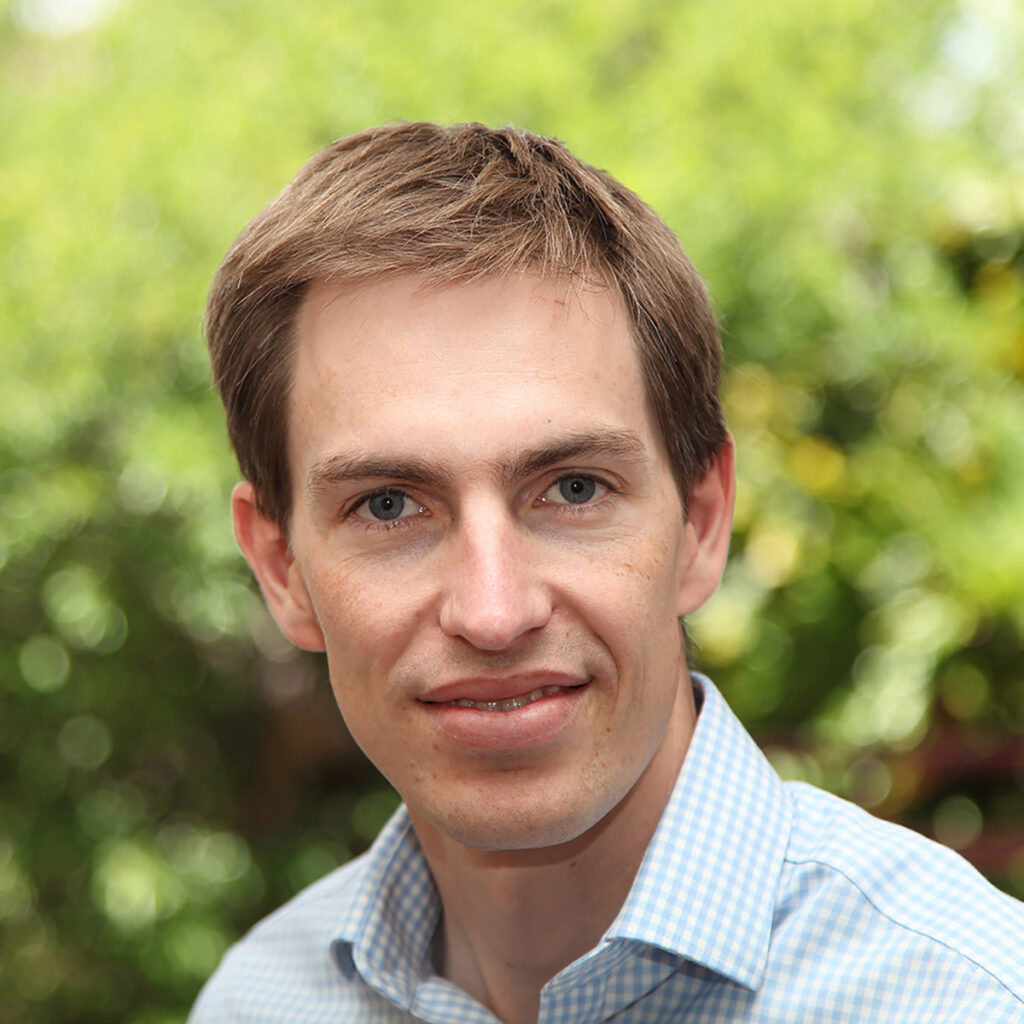
Dr Gareth A.S. Edwards Dr Edwards is Visiting Associate Professor at the University of East Anglia and Visiting Fellow at the Sydney Environment Institute. His research focuses on environmental governance, climate justice, and the socio-political dimensions of environmental change.
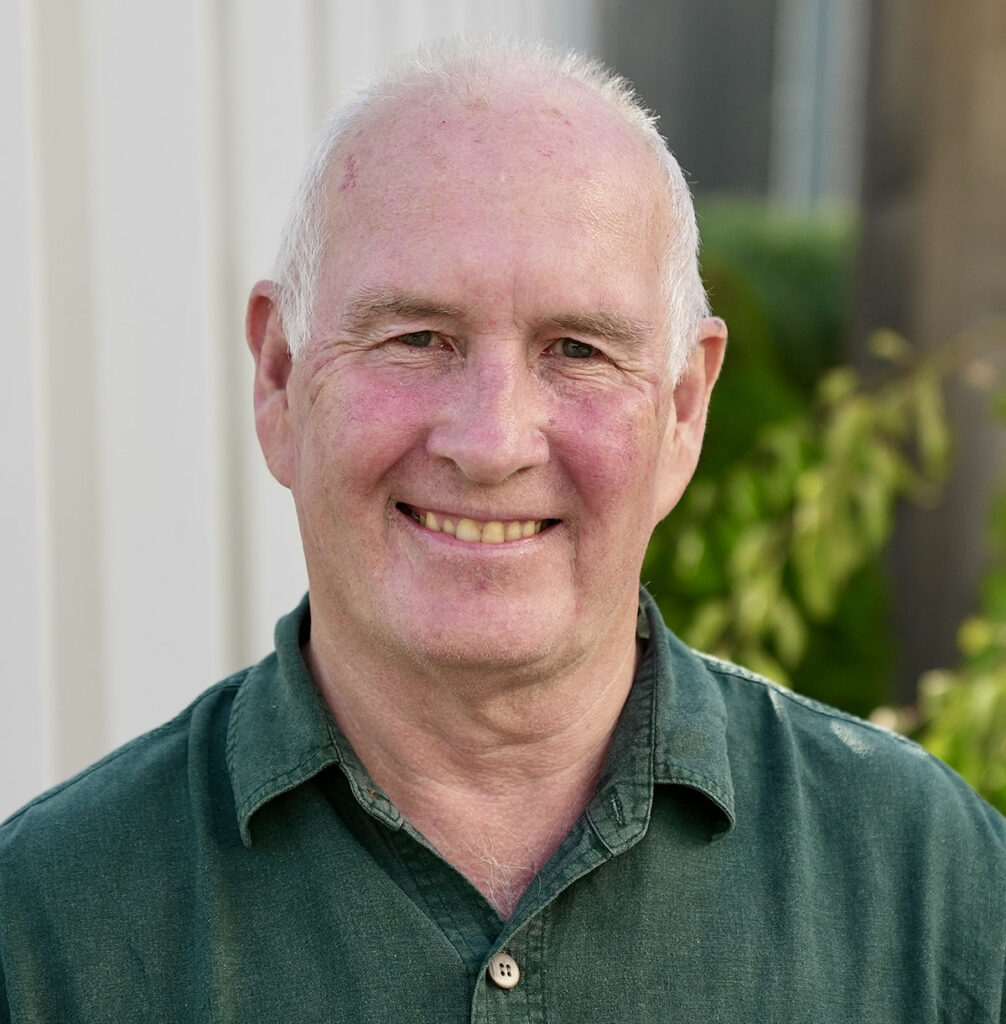
Professor John Wiseman Professor Wiseman is a Professorial Fellow at the University of Melbourne’s Climate and Energy College and Chair of The Next Economy. He has extensive experience in public policy research, particularly in the areas of climate change, sustainability transitions, and social justice.
Dr Amanda Cahill Dr Cahill is the CEO of The Next Economy, supporting communities in building resilient and sustainable economies. She has worked across Australia and internationally on projects related to economic development, energy transition, and social change.
(October 2024) Across Australia, communities are leading the transition to net zero – navigating multiple, compounding disruptions along the way – after years of minimal action or even discussion on climate change at a national level.
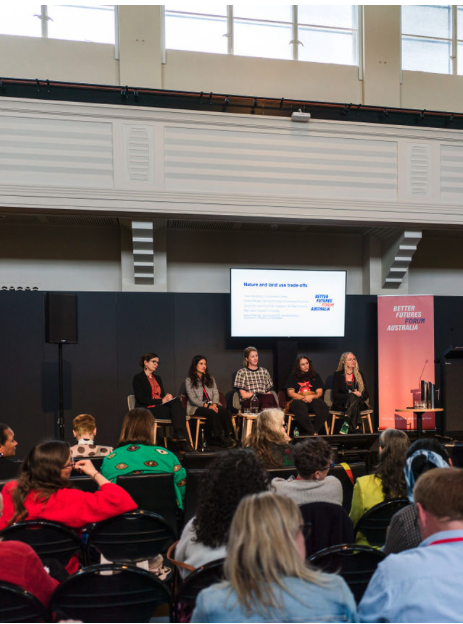
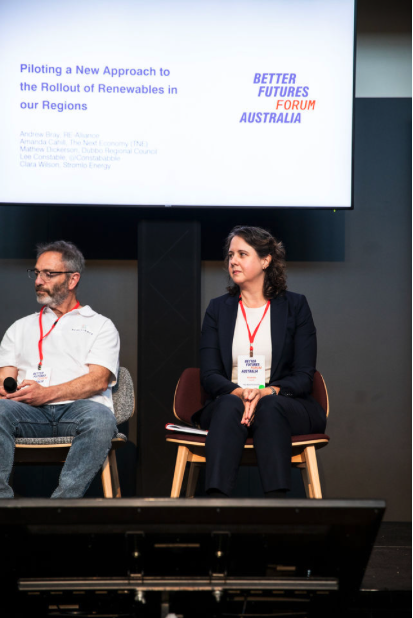
TNE’s Jacqui Bell, Dr Katherine Trebeck and Dr Amanda Cahill share key insights, ranging on topics from regional transition trends to nature and land use trade-offs to wellbeing economy principles, at the 2024 Better Futures Forum in September 2024. Photo credits: BFF/Gab Connolle
Here are five key trends or themes Dr Amanda Cahill, CEO of The Next Economy, and the team has observed in recent months:
Missing champions: The lived experiences of communities actively navigating the transition—experimenting, innovating, and addressing local needs—are often missing from the national conversation. From a community group in Gympie installing solar panels on local infrastructure to support vulnerable populations, including domestic violence shelters, to energy companies focused on creating long-term community benefits like housing, there are so many people getting on with it. We should be celebrating and learning from them.
Mixed signals: Regional communities are largely committed to the transition, but mixed signals from state and federal governments are not only frustrating they’re also undermining confidence to move forward with the real work. While there’s more investment in renewables and policies for net zero today than even a few years ago, new fossil fuel projects are still being approved even when expert bodies like the International Energy Agency say fossil fuel use must peak by 2025.
Models questioned: One of the most striking trends is the growing shift in how people think about the economy. For example, beyond day-to-day concerns like the cost of living, more communities are questioning the broader purpose of the economic system itself. The key question being asked is: if the economy isn’t directly benefiting local communities, what is its real value? Another question that keeps coming up is why development proponents decide whether their project will have social and environmental impacts on a community instead of a single, independent process and regulator. This shift in perspective signals a deeper rethinking of what good economic development really looks like. Read more: Rethinking economic responses: tackling the root causes of today’s challenges
Moving forward: We are now in the implementation phase of the net zero transition. It’s going to be challenging for a while, but we need to stay on course and remember that the decisions we make now really do matter. Right now, the infrastructure we invest in, the industries we promote and support, and how we build the capacity and mechanisms to ensure enduring community benefits, are all going to determine whether we reach our 2050 net zero goals – let alone the more ambitious ones that the science tells us we should be striving for. We can find a way forward that works for people and the planet.
The good news is, we have the knowledge, technology, skills and resources to draw from, we just need to get on with it.
TNE staff at Heading Upstream Lab in August 2024, where leaders driving change across Australia convened to explore ways to put people and the planet first when it comes to the economy.
The Australian Government can play a key role in helping regional communities prepare for the economic changes brought on by the clean energy transition.
As many clean energy jobs will be concentrated in regional renewable energy zones, building the capacity of regional communities to manage development, attract investment for enabling services and infrastructure, and address workforce challenges is essential.
With effective resources and support, local stakeholders can lead efforts to create training programs, support services, and initiatives that ensure a skilled and diverse workforce while fostering sustainable regional development.
In September, The Next Economy provided a submission for the National Energy Workforce Strategy Public Consultation process. In it, we identified a range of insights on increasing inclusivity in the clean energy workforce (read more here), as well as five examples of actions that already are or have to potential to empower regions in clean energy workforce development:
Coordinate planning and development of clean energy projects, associated infrastructure and other industries within a region. Regional coordination and phased planning can manage workforce demand and support worker mobility. Co-locating new manufacturing and industry precincts within renewable energy zones also have the potential to stabilise clean energy workforce demand and create lasting careers. Developers and industry benefit from these approaches with clear roles, responsibilities, and timelines, along with cost certainty and transparent infrastructure investment programs.
For example: the Victorian Planning Authority (VPA) works with councils, government departments and the community to provide employment, transport, public space and housing planning in the context of an increasing population. The VPA has identified the staged development of housing lots and required infrastructure such as roads and utilities.
Develop place-based training and education initiatives and partnerships: that aggregate skill and expertise demand from across sectors and co-designs and delivers courses with industry in a region.
For example: in the Upper Spencer Gulf, Uni Hub is working with local industries to ensure their needs are connected with training providers and potential students.
Support local businesses to adapt and scale up their operations for greater participation in the sector. In many regional areas where new energy development is proposed, the scale of workers required outstrips the local labour market. In addition, the essential services and infrastructure required to support workforce and population growth are limited or non-existent.
Currently, local content requirements from state governments are aimed to drive regional economic benefits. However, often insufficient existing workforce capacity, the cost to prepare businesses to be ready to tender for clean energy development contracts, and uncertainty around long-term work security all limit the capacity of local businesses to scale their operations and bring on new workers.
For example: TNE’s work with Hay and Carrathool shire councils on climate adaptation and economic transition this year has shown that local businesses are interested in tendering for large renewables projects but lack the capacity and resources to adapt. Uncertainty around work pipelines, contracts, timing, and qualifications prevents businesses from scaling, investing in workforce development, or hiring. Early engagement and ongoing support are crucial for scaling regional workforce development. Accessible, up-to-date local data is needed to improve transparency, workforce planning, and equitable recruitment strategies.
Provide resources for local government and local stakeholders: to carry out the feasibility and business planning activities necessary to develop the case for investment in local services, coordination activities and infrastructure.
For example: in the Cradle Coast Region, developers are working together to address housing shortage as they understand it is a key constraint to renewable energy development. In Gladstone, the economic roadmap process delivered by the local council identified the lack of birthing facilities as a key barrier to retaining workers once they are married and look to start families. Improving access to health services in Gladstone is seen a core strategy to retain the workforce. In NSW, the Murrumbidgee Council has negotiated to improve health services through the community benefit agreement.
Embed additional capacity within local governments: to manage and coordinate regional clean energy related activities. Regional local governments play a key role in coordinating clean energy activities, managing community benefits, and supporting the infrastructure and workforce needs of the energy transition. In Renewable Energy Zones, local governments are dedicating significant resources to these tasks, often diverting attention from regular operations due to limited funding and staff. Many are handling large, complex projects unseen in their region for decades, requiring new expertise to manage the technical, legal, and managerial aspects of energy development.
For example: An NSW Government initiative is providing $250,000 of funding for local governments to carry out planning over the next 3 years is an example of the type of support required; however additional and enduring funding (for the duration of the energy infrastructure development in the region) is necessary to cover the true cost that local governments will bear to manage the energy transformation effectively in their region.
New research from UTS Institute for Sustainable Futures (ISF) and the Australian Energy Market Operator (AEMO) shows the electricity workforce alone needs to double within five years to meet Australia’s 2030 renewable energy target. More than 80 per cent of these roles will be in renewables, with energy storage jobs soon surpassing domestic coal and gas sectors.
This research highlights the big opportunity to address workforce shortages, especially in regional areas, by fostering inclusive policies that ensure equitable benefits and meaningful employment across all communities. Prioritising inclusion and equity in workforce development is key to a just and fair transition toward a net-zero future for all Australians.
In September, The Next Economy provided a submission for the National Energy Workforce Strategy Consultation Paper. We identified five examples of actions that already are or have to potential to empower regions in clean energy workforce development (read more here) alongside the following key insights:
The benefits of enhancing diverse participation and meaningful employment
Every Australian should benefit from clean energy development, including the opportunity to access and meaningfully participate in the workforce. Research shows Australia’s clean energy workforce, like many other industries, has room to improve in diversity, equity, and inclusion. Factors like competition with other industries and projects, lack of training, the characteristics of clean energy jobs, and insufficient regional consultation contribute to workforce shortages in the sector overall.
Greater attention to diversity, equity and inclusion in workforce development carries broad benefits. Companies who have engaged in inclusive hiring processes have reported benefits such as access to a larger talent pool, higher retention and satisfaction rates, improved workplace culture and greater performance and productivity. In turn, inclusive and equitable workforce development practices facilitate pathways into jobs for people who often face systemic barriers to employment. It also promotes greater workforce diversity, fosters a workers’ sense of belonging and inclusion, enhances health and social outcomes and ensures workers are treated with respect and dignity and more likely to be retained.
An opportunity to power First Nations Jobs
The clean energy transformation is an opportunity to increase workforce participation of First Nations Peoples. The Powering First Nations Jobs in Clean Energyreport, by the First Nations Clean Energy Network, is a detailed resource that identifies pathways and options for First Nations Peoples to be supported to enter the clean energy workforce and access quality job opportunities and career pathways as they emerge.
Consistent, long-term Government investment in job readiness and business support programs that are led and codesigned by and for First Nations Peoples is needed. Such investment can support the scaling of efforts underway by the private sector in implementing partnerships and employment pathway programs tailored to First Nations Peoples. For example, in the Department of Defence’s Shoalwater Bay Training Area, Downer Defence worked with a range of partners to deliver training programs and initiatives that support small and medium sized Indigenous businesses to enter and thrive in the defence industry.
Support for migrants, refugees, people with a disability and those recently out of prison
Our research has found that affordability of training, lack of awareness around the need for workforce equity and inclusion, misconceptions about abilities, procurement requirements, development speed, and the culture of clean energy workplaces, all impede on the diverse participation in the clean energy workforce.
Strategies tailored to people and their unique context can drive greater participation in the clean energy workforce for different groups. These include building awareness, inspiration and attraction to clean energy careers across diverse populations, improving access to affordable higher education, ensuring ‘wrap around support’ is available for people transitioning into work, cross sectoral collaborations and partnerships, and fostering a workforce culture that is inclusive and values the abilities and contributions of all.
The rapidly growing clean energy sector is well poised to develop a diverse, equitable and inclusive workforce at the scale and pace required to achieve national targets. Other related sectors have experienced the benefits of a diverse and inclusive workforce over the years and developed significant body of knowledge on how to support workforce development in an inclusive and equitable way. The clean energy sector has the advantage of drawing on this existing knowledge and ensure that opportunities in the clean energy workforce benefits all Australians.
Mount Isa in Queensland’s Gulf Country region is preparing for a critical decade with the development of its Future Ready Economy Roadmap.
Mount Isa is preparing for a critical decade with the development of its Future Ready Economy Roadmap. Stakeholders across government, industry, and the community have already contributed to shaping this crucial work, highlighting its significance to the region’s future. The Roadmap, set for release in February 2025, will outline simple and practical steps to diversify and decarbonise the local economy, build resilience, and improve social wellbeing.
The Roadmap is an initiative between the Mount Isa City Council, who commissioned and funded the project, and The Next Economy with support from Climate-KIC.
Mount Isa Mayor Peta MacRae said:“This initiative unites the voices of the community, industry, and government to create a strategy that addresses current challenges as well as harnesses new opportunities. As Mount Isa looks ahead, the Roadmap will serve as a vital guide, ensuring the region remains a vibrant, resilient place to live and work for years to come.”
A region facing increasing challenges and emerging opportunities
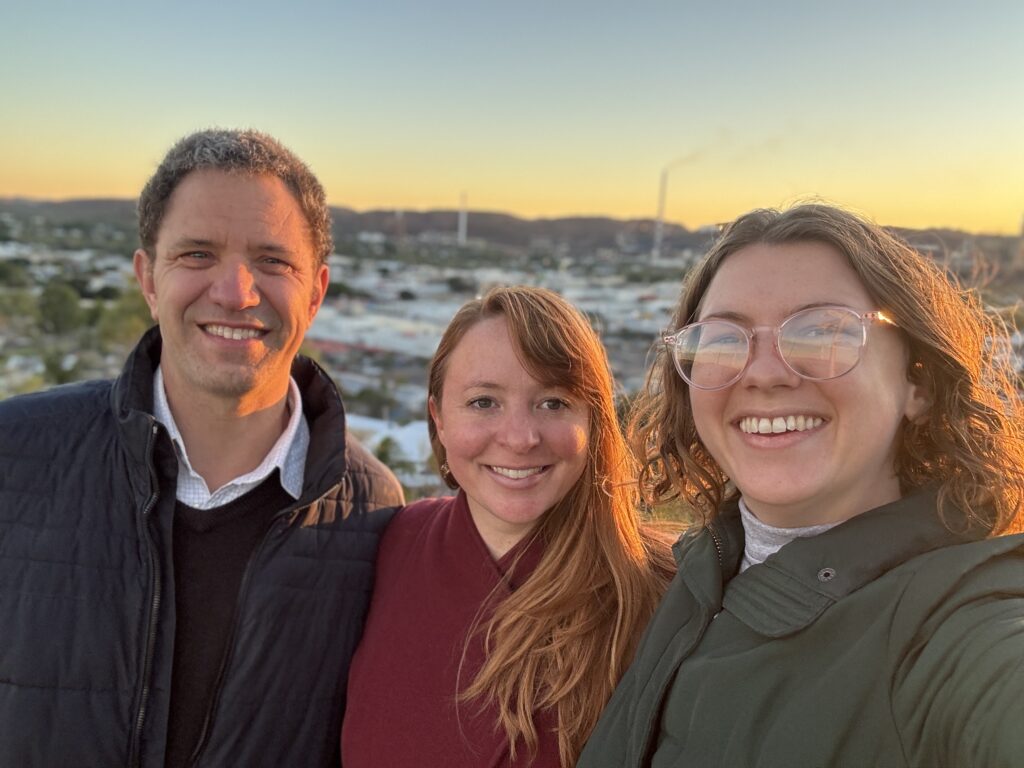
Climate-KIC’s Jason Nielsen with The Next Economy’s Reanna Willis and Kate Donnelly enjoying a Mount Isa sunset in-between workshops earlier this year.
Reanna Willis, senior project officer at The Next Economy, said: “Mount Isa is facing growing challenges, from mass job losses to regional connectivity to access to childcare and health services. It’s a critical time for the region to be exploring how to strengthen and diversify the region’s economy in ways that work for the community into the future.
“The people of Mount Isa get it. They know that, if this change is managed well, there will be more opportunities to improve the liveability, attractiveness and viability here. The region is well-positioned to capitalise on emerging opportunities including in critical minerals and renewables as well as strengthen existing industries like tourism. Realising this vision will require significant coordination, collaboration and strong investment from industry, government and the community.”
Council’s efforts towards economic diversification
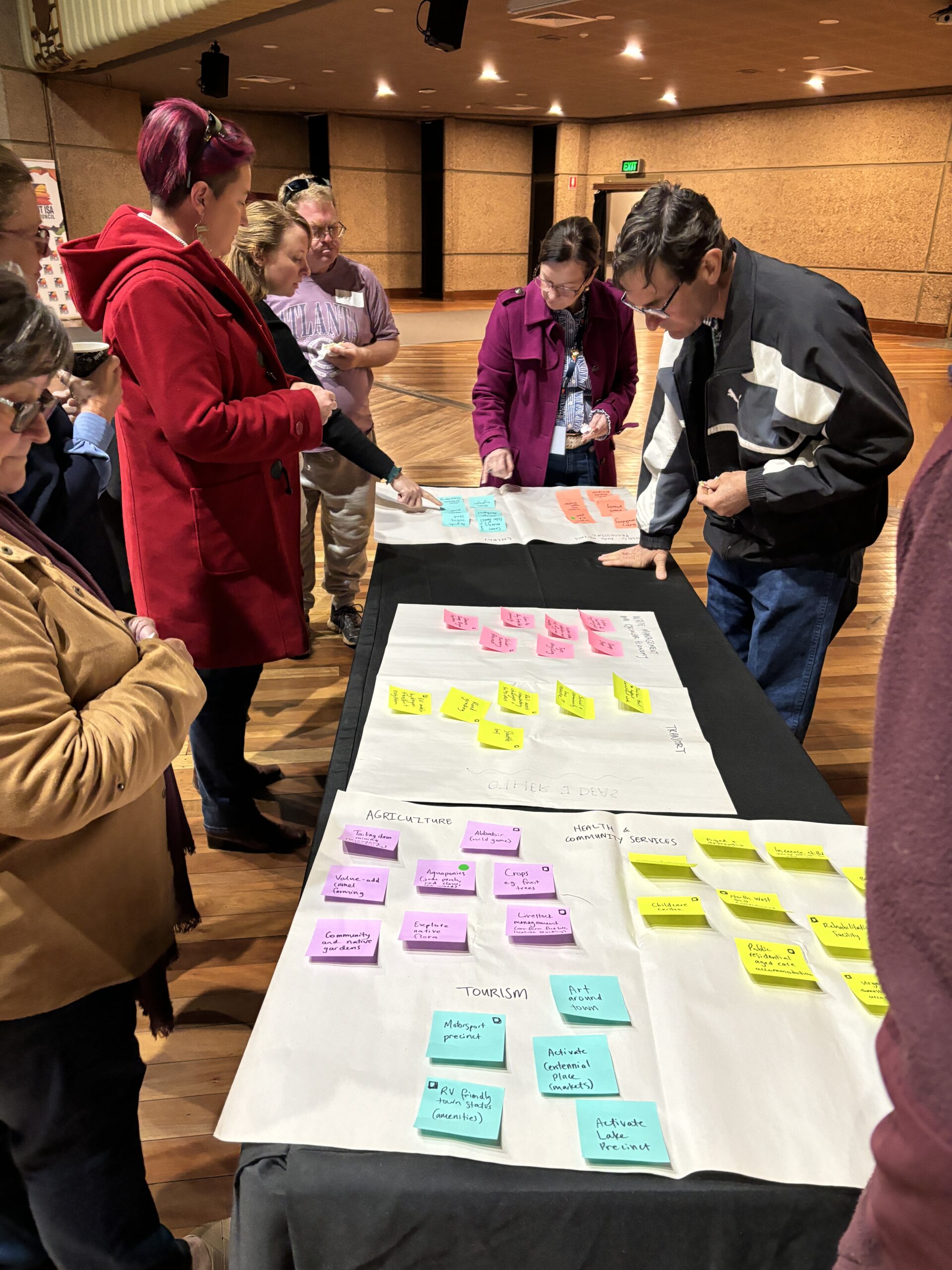
Mount Isa City Council discuss priority areas where support is needed to build a stronger, more resilient future at a The Next Economy workshop in October 2024.
Mount Isa City Council is already taking proactive measures to drive economic diversification. Through detailed economic analysis, the Council has identified 60 stimulus projects designed to retain skilled workers and strengthen the local economy.
In October, in an Australian first, Council signed a memorandum of understanding with French-Canadian aeronautic company FLYING WHALES to establish a base for large capacity airships to transport heavy or bulky loads such as wind turbine parts.A technical feasibility study and business case is underway. (Read more in this ABC article)
Another notable initiative is the development of a Materials Recovery Facility (MRF), supported by $6.06 million from the Federal Government’s Building Better Regions Fund. Expected to be operational by 2025, the MRF will establish Mount Isa as a recycling hub for the North West.
Engaging with the community
A series of workshops with stakeholders across government, industry and community in 2024 will help shape the Roadmap.
In September, The Next Economy held a series of meetings to gather feedback from First Nations people and community service organisations, ensuring the Roadmap reflects the needs and aspirations of the entire community. The Next Economy hosted a further workshop in October with Council to develop pathways to attracting the right attention and support behind local opportunities and priorities.
Michelle Paulsen, Remote Operations Manager at Centacare North Queensland, was among those who participated in a series of community workshops earlier this year. She highlighted the importance of staying informed about the local economy’s changes and their impact on the community:
“From emergency relief to supporting families and children, the demand for Centacare’s services is being affected by changes in the local economy and resources industry. Staying informed, sharing what we are witnessing on the ground, and engaging in new ideas helps us better support Mount Isa families and individuals in need.
“The workshops were a valuable opportunity to contribute to Mount Isa’s growth and future. Expanding my understanding of circular economy opportunities has given me greater insight into new areas of economic growth. I encourage anyone who cares about Mount Isa’s future and wants to support our local community to get involved.”
Get in touch to find out more about the initiative
MORE than 85 passionate community members have come together to explore ways to future-proof communities as part of Hay and Carrathool Shire Council’s Resilient Economy Roadmap Project.
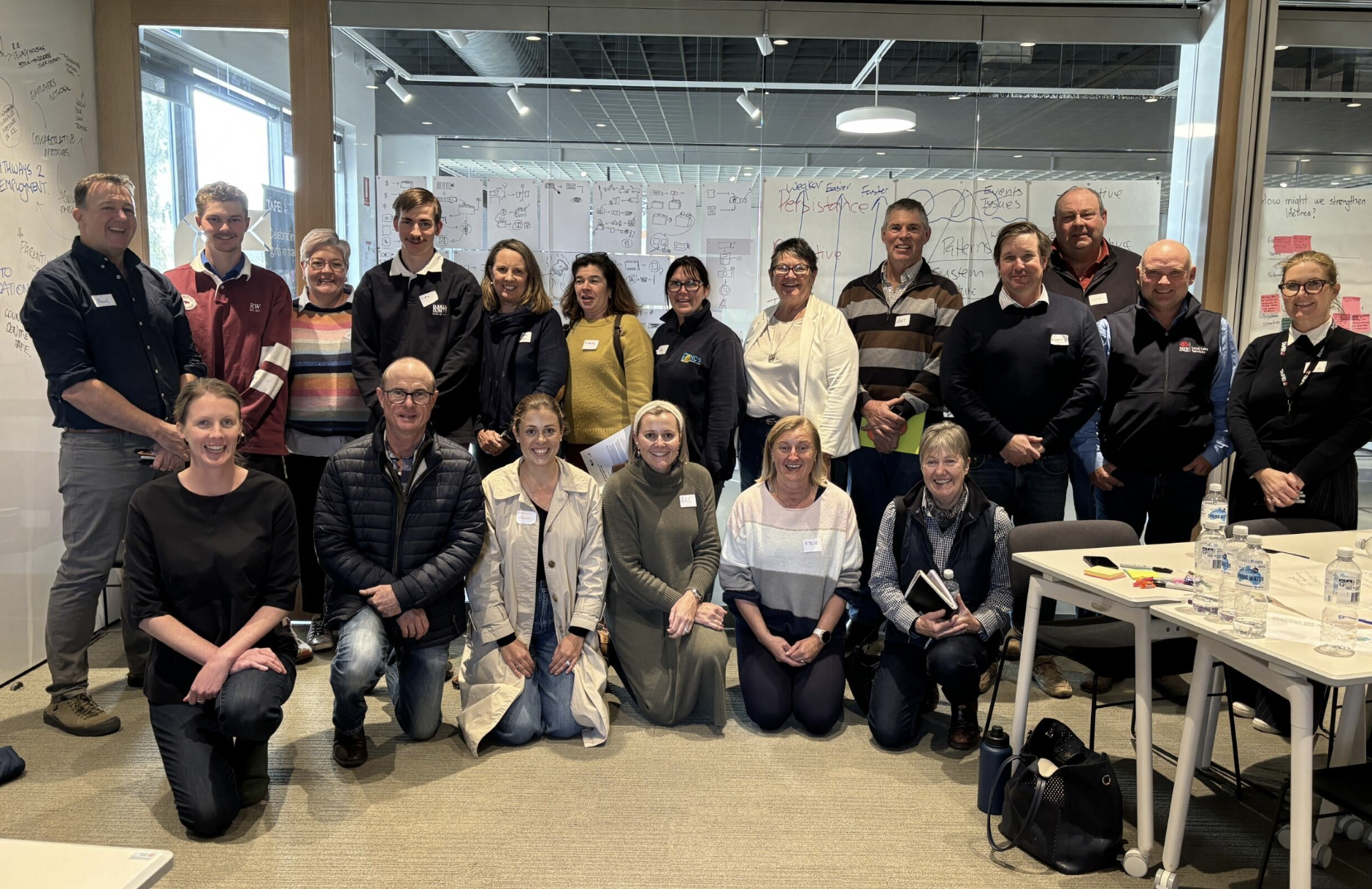
The workshops – held in Hay, Rankins Springs, Hillston, Carrathool, Goolgowi and Merriwagga in late June – built on the picture of the region in NSW’s Riverina painted through earlier discussions, workshops and a community survey under the Roadmap project.
Alison McLean, Executive Manager – Economic Development and Tourism at Hay Shire Council said: “From farmers to business owners, grandparents to students, it was great to see such a diverse, passionate range of people show up with a wealth of knowledge and skills and ready to connect with one another and help bring about positive change.
“Together, they worked to identify common challenges, such as strengthening pathways into local employment, as well as opportunities that have the greatest potential to strengthen resilience across the region like diversifying our regional economy and continuing to grow the next generation of community leaders.”
Participants also identified strategies and actions councils, businesses, industries and communities can take over the next decade to leverage new opportunities, address current and emerging challenges and prepare for any future disruptions or change.
Of the experience, one participant noted: “The genuine buy in and contribution from the community members was invaluable”. Another said: “Our region has an optimistic ability to accept change and drive opportunities”.
Insights from the workshops will directly inform the development of the Resilient Economy Roadmap to be delivered in late 2024. Feedback on a draft Roadmap will be sought from the community in the coming months.
McLean added: “I can’t thank participants enough for their time and invaluable knowledge and insights. The voices of the community are vital in the success of this project – and the future of our region.”
The Resilient Economy Roadmap initiative is a collaboration between Hay and Carrathool Shire councils, The Next Economy, The Australian Resilience Centre, and communities across the region. Running from March to October 2024, it is funded jointly by the Australian Government and NSW’s Future Drought Fund and is part of the Regional Drought Resilience Planning Program.
To stay up to date on the project, follow the Resilient Economy Roadmap Facebook page. For further project information, please contact j.bell@nexteconomy.com.au
Have you ever wondered how inclusive the clean energy workforce is – or could be?
Australia is now firmly in the implementation phase of the energy transition, with more and more employment opportunities in the clean energy workforce. In fact, nearly half a million workers are projected to be needed to reach Australia’s 2030 renewable energy target alone.
The Next Economy is working with a range of stakeholders to explore how to expand the renewable energy workforce to include people who often face systemic barriers to employment. Specifically, in regions with growing demands for workers in clean energy.
The Inclusive Clean Energy Workforce (ICEW) project aims to ignite discussion about how we can work together to enhance diversity, equity and inclusion.
Our current discussion paper captures pivotal themes and insights drawn from a desktop review of literature and interviews with stakeholders across the clean energy sector, social services and employment sectors.
In mid-July 2024, we’re hosting a range of workshops to get feedback on this initial piece of work and to dive deeper into opportunities and practical strategies to enhance diversity, equity and inclusion in the clean energy workforce.
Opportunities and insights will be captured and shared in a series of sector resources and webinars in the second half of 2024.
Early findings and key points:
Every Australian deserves access to the benefits of clean energy development, including new and existing jobs required for the workforce
The current clean energy sector can improve on diversity, equity and inclusion despite already outperforming other energy sectors including coal and gas
Greater diversity, equity and inclusion not only improves outcomes for individuals, but also can for companies, communities, the sector and the economy
From access to training and education to workplace culture characteristics, there are several systemic, cultural and broader factors and barriers marginalised groups face accessing jobs in the clean energy workforce
Working together, stakeholders from industry, education and training, and civil society can enhance diversity, equity and inclusion in the clean energy workforce
If you’re interested in finding out more, or want to share your insights with us, please contact Jacqui Bell.
Partner with us! An exciting opportunity for one rural or regional community
The transformation of Australia’s energy system is underway, with regional communities playing a crucial role in hosting renewable energy and infrastructure projects. For communities to benefit and actively participate in this transformation, several challenges must first be addressed.
Striking a New Deal (SaND) is a new initiative working directly with community leaders and key stakeholders to drive better outcomes from the development of renewable and infrastructure projects in our regions.
We’re providing resources and support to one community partner for a whole year
SaND will partner with one rural or regional body – a local council, association or organisation – to help your community drive better social and economic outcomes from energy projects in your area.
Whether projects are yet to start, or right in the thick of it, we want to help you work with your community to build the capacity, find points of alignment and develop resources you need to advocate for your immediate and long-term needs.
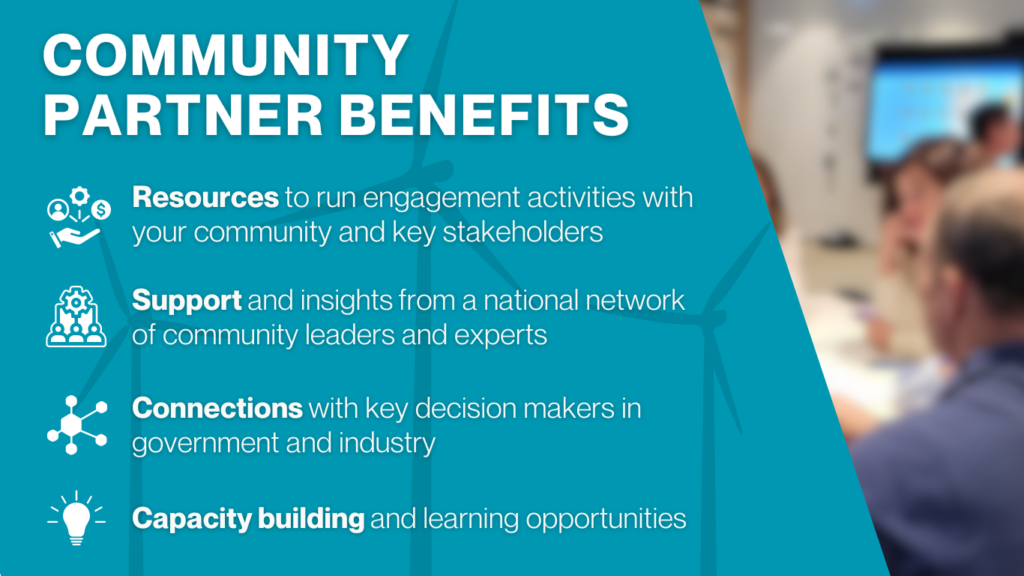
The one-year program, from August 2024 to August 2025, will be co-designed by you depending on your needs, and the needs of your community. Community benefits can include:
We get it’s not easy to navigate the arrival of renewable energy and negotiate better outcomes for your community. And, from housing shortages to divisions between residents to impacts to nature, there could be multiple important issues to unpack along the way. Let’s work it out together, your way!
What’s the selection process and project timeline?
Submit your Expression of Interest (EOI) form online by 19 July 2024(the earlier the better!).
On receipt of EOI, eligible hosts will be formally invited to apply by 26 July 2024.
Short-listed applicants will be interviewed in early August 2024.
The project will run to August 2025.
Who is eligible to host the project?
We welcome applications from potential partners in any Australian rural or regional community with renewable energy or infrastructure projects planned or underway in your area.
Strong ties to your community
Capacity to actively participate in a year-long process
An interest in addressing issues and maximising benefits from renewable or infrastructure projects in your community
What are the expectations and costs for the host council, organisation or association?
SaND will cover key costs associated with delivering the program, including:
Our time and expertise
Access to a national network of community leaders and experts
Basic costs of community engagement activities, including venue hire and catering
Engagement with industry and government and communication of project outcomes
The host will need a dedicated contact within their organisation to:
Work with us to design a program specific to their community
Provide links to key stakeholders and organisations within the region
Support the organisation of community workshops and meetings
Champion actions developed through the process
We estimate a two to three hour per week commitment from the contact over the 12-month period, with more time-intensive periods during engagement activities.
What are the benefits of hosting?
Hosting the project offers many benefits for you and your community. This includes:
Support and assistance to plan for and manage for projects in your region
Learn and apply key insights from across Australia to your region
Join a network of regional communities working towards best practices and positive outcomes nationwide.
How does this relate to other community engagement processes occurring in our region?
This project takes a regional approach and works with community groups within a region to: understand each other’s diverse perspectives, to recognise the challenges and identify the opportunities.
This work is important preparation for informed, constructive and productive participation in other community engagement processes occuring in the region and also in negotiations.
By taking a regional approach, this work is place-based, strategic and practical, and is applicable to individual renewable project engagements through to broader REZ or Statewide engagements.
Connect: A national network of regional leaders managing the rollout of large-scale renewables will share knowledge, experience and inform the development of a national, place-based approach adaptable for other communities.
Partner: For one year, we will support a selected regional or rural community partner with the resources, capacity and expertise to drive better outcomes from local projects.
Inform: With our community leaders, we will share our insights with industry and state and federal government to help inform future practices and policies.
We ask Dr Katherine Trebeck, Economic Change Lead at The Next Economy
In a nutshell, what is a wellbeing economy?
An economy designed deliberately to work for people and the planet, not the other way around as so often seems to be the case today. It’s about creating a context in which people thrive, first time around, rather than having to deploy loads of resources trying to fix and repair after damage has been done. This means initiatives that speak to the purpose of the economy, prevention, predistribtion (not just redistribution), and a people powered economy.
So, it requires thinking about what activities we need more of because they help create that context and finding ways to expand those activities: being selective about what is growing, rather than pursuit of any sort of growth.
Are there any examples of using this framework successfully? If so, how?
Think about the wellbeing economy not so much as a framework, but more as a paradigm. It requires a substantial shift in how the economy is thought about and approached. It is about seeing the economy as a mechanism to meet our real goals, and certainly not something to which all other goals are subservient. Not only are we seeing a growing conversation and emerging such as the Wellbeing Economy Alliance initiatives where people are coming together to promote the agenda or its component parts, but there are loads of examples of governments and enterprises making the sort of changes that are necessary. For example:
Multidimensional measurement dashboards (Australia’s Measuring What Matters statement is an example of this) and support for social enterprises (the recently announced Social Enterprise Development Initiative, for example)
Circular economy production and public transport systems
Community or worker owned businesses such as the Earth Worker Cooperative in Victoria
Considering the environmental cost of the things we buy.
The challenge is that while there is no shortage of examples, often they are the exception that proves the rule. One nice illustration of the potential for this is seen in the Community Wealth Building work happening in places like Cleveland in the US and in Preston in the UK (plus in various parts of Australia too). In Preston, there has been research which shows the council’s efforts to procure locally, to support local businesses and local employment has meant the local economy has been more resilient, but also people’s mental health and reported personal wellbeing has improved.
How might the principles of a wellbeing economy help address current challenges posed by high cost of living pressures?
A key feature of a wellbeing economy approach is to look at the root causes of an issue, and not just respond crisis to crisis, symptom to symptom.
So in terms of cost-of-living pressures and high housing costs as a key part of that, a wellbeing economy approach would entail examining the way the housing market operates – who owns the houses? What taxes and incentives encourage the sort of ownership patterns that are forcing up prices? Why aren’t there more community housing cooperatives and other modes of providing housing in Australia?
It would then step back and reflect on what the ultimate goal is – shelter for people in Australia’s towns and cities. It would then think about what needs to change in the economy for more people to have access to good quality shelter – perhaps that means shifting taxes to discourage people owning more and more homes as investment devices? Perhaps that means changing planning laws to enable more community groups to co-own housing? Perhaps that means ensuring homes are built with high energy efficiency standards so once people move into them, they aren’t spending huge amounts on heating and cooling them.
And speaking of energy efficiency, a wellbeing economy approach is also about being ambitious for flow-on benefits – so if housing is being built, can it help address environmental challenges by needing less carbon and using more recycled materials? Can it help address equity and inclusion by being built by companies employing local people, which have gender balance in their teams, and which pay living wages etc? And can it help roll out models of enterprise that have a social purpose at their heart, so could the houses be owned by a housing cooperative?
How might Australia adopt a wellbeing economy framework? What are the steps that need to happen?
There’s a precondition for government acting – that’s people talking about it, and being able to imagine an economy that serves them, not the other way around: an economy that doesn’t generate so much inequality and put so much pressure on the planet. That will be helped by learning about examples of this in practice, even in small scale. Then policy makers need to step in to design the rules of the game so those good examples are common place.
What would a state or federal budget for a wellbeing economy look like?
It would use things like taxes and subsidies to support the sort of activities which are good for people and planet, and to discourage those that aren’t. In other words, it would ask what we need more of and how can mechanisms in the budget help cultivate them?
With the support of the Lord Mayor’s Charitable Foundation, The Next Economy is convening an ‘Upstream Lab’ to explore the economic root causes of many of today’s challenges, including how to take action where there is scope to prevent harm happening in the first place. More details to come as we roll out this exciting initiative.
On Tuesday 23 April 2024, The Next Economy’s CEO Dr Amanda Cahill addressed a Senate Committee Public Hearing in Canberra on the Net Zero Economy Authority Bill 2024 and the Net Zero Economy Authority (Transitional Provisions) Bill 2024.
Dr Cahill recognised the importance of a national independent authority to support workers, industries, and regional communities to manage the transition to net zero.
She also highlighted the need for a broadening of the scope of the Authority to ensure it is fit for purpose long into the future. TNE’s four key recommendations were to:
Expand the Authority’s role to support coal mining and gas regions not tied to domestic energy generation (fossil fuel exports) and other regions and economic sectors beyond fossil fuels (e.g. agricultural and critical mineral regions)
Provide direct support to regions to build capacity to enable them to undertake place-based planning and coordination to better manage the complex range of tasks required over time (e.g. from investment and support to long-term community benefits)
For the Authority to have independent funding to distribute at its own discretion to support regional planning, decision making, and economic development activities related to the transition.
Have at least one NZEA board member with substantial experience in regional development, community development and/or the social sector.
Between February and June 2023, The Next Economy explored a range of perspectives among Latrobe Valley community leaders with regards to the energy transition.
The project involved hosting a series of interviews and workshops that engaged 31 community members, including First Nations people and young people, people from the multicultural community, grassroots environment groups, small businesses and the social service sector.
The report makes visible the wealth of experiences, insights and knowledge that exists in communities across the region and demonstrates how the local community can be a valuable partner in working towards good transition outcomes for the Latrobe Valley region.
The main project finding is that community members see a range of potential benefits from the energy transition, beyond job creation and Australia’s national decarbonisation agenda. If managed well, the transition could provide opportunities to transform the systems that underpin society, the regional economy, and people’s relationship with the local environment.
The key themes presented in the report are:
Socio-economic disadvantage, equity issues and liveability
Community Participation
Institutional capacity and good governance
Environmental protection, remediation and rehabilitation
First Nations leadership
New energy development
Regional economic development
Workforce development
To find out more, download a copy of the What Next? Community Perspectives on the Energy Transition in the Latrobe Valley.
Gladstone Regional Council launched its 10-year economic transition roadmap to support and guide Queensland’s industrial capital to becoming a renewable energy superpower in 2022.
The roadmap sees the region in prime position to respond to once-in-a-generation changes in the energy sector.
The Next Economy collaborated with Gladstone Regional Council to develop the detailed roadmap, which is the result of two years of research and extensive engagement involving 220 community, government and industry stakeholders. This included industry representatives, First Nations people, energy workers, environment groups and education and training institutions.
The Gladstone Region Economic Transition Roadmap guides Council on what is required to adapt to a rapidly changing energy sector and support a positive economic transition for its community over the next 10 years. Key themes of the roadmap include:
The Hay and Carrathool Regional Drought Resilience Plan (‘The Plan’) is a strategic framework shaping the future of the region through 2035. It is due for official release later this year.
This summary paper outlines the key elements of The Plan we are currently seeking feedback on, including our 2035 vision, resilience strategies, and priority actions.
The summary paper can be downloaded in PDF format below:
Communities in Australia’s coal and gas heartlands say they need greater federal support and policy to mange the energy transition and make the most of economic opportunities.
A major new report from The Next Economy released today has found that regional Australia is undergoing an economic transformation, with historical coal and gas heartlands like Central Queensland, The Hunter Valley and the Latrobe Valley in pole position to capitalise on the global shift to net zero emissions – with appropriate Federal Government leadership, investment and support.
For‘What regions need on the path to net zero’,The Next Economy engaged with over 500 people and organisations across regional Queensland, NSW, Victoria, WA and the NT to assess the support communities with close ties to fossil fuels need to manage the inevitable and accelerating transition to net zero emissions.
Participants included representatives of government, the energy sector, diverse industries, unions, economic development agencies, social services, universities and training institutions, Traditional Owners and First Nations groups, community members and environment organisations.
The research revealed a high level of consensus on a key theme – greater leadership is needed from the Federal Government, revolving around three key calls to action:
An honest conversation: The Federal Government must be open and honest about what the changing energy system means for regional Australia.
A clear, well resourced plan: The Federal Government needs to put in place the appropriate targets, policies and regulatory frameworks to guide investment, and to ensure that regional workers and communities are not left behind – such as a national transition authority.
A strong democracy: The Federal Government must put in place measures to improve the health of our democracy – such as protection of public servants and decision-making from political interference, banning political donations, and a national corruption watchdog.
Dr Amanda Cahill, CEO of The Next Economy, said “The discussion about energy futures in regional Australia has changed dramatically since the federal election in 2019.
“When we started our consultations two and a half years ago, most people were questioning the whole concept of the energy transition. Now people see that things are changing quickly, with early closure announcements for coal plants, our trading partners increasing their climate ambitions and the rapid expansion of renewable energy projects across the country. They want to see a clear plan and support so they can manage these changes.
“If we want to take advantage of the wide range of new economic opportunities available – in renewable energy generation and storage, the mining and processing of critical minerals needed for renewable energy, and the manufacturing of projects like green hydrogen, batteries, renewable energy components, biofuels and other products – we need to act now.
“Business has been leading the way in terms of investing in the new industries we need to develop to reduce our dependence on coal and gas export revenue. But it’s not enough and even industry players are now calling on the Federal Government for greater policy certainty and new regulatory frameworks to ensure that development is done well and actually benefits regions over the long term.”
“The new federal government has a lot of work to do”, Dr Cahill said. “I hope it shows the leadership and vision to grasp this once-in-a-generation opportunity, and to step up to the task of supporting our regions as the energy system changes.”
To view our presentation of the report, click below to watch our webinar on Wednesday, 11 May where we were joined by Professor John Wiseman and Dr Gareth Edwards, followed by a Q&A session with participants.
Have your say in online survey about ‘Energising the Future Economy of the Gladstone Region’.
Locals across the Gladstone Region are invited to participate in an online survey to share their thoughts on the future changes to the energy sector and how the region can take advantage of emerging changes to generate new economic opportunities.
The survey content has been generated following a series of in-depth community and industry forums involving people from across the region.
Acting Gladstone Region Mayor Kahn Goodluck says Council would like to know if other residents share these views.
“Council recognises that the unfolding changes in the energy sector pose both challenges and opportunities for the Gladstone Region and people working in industry,” Councillor Goodluck said.
“This online survey is part of our joint initiative with The Next Economy – Energising the Gladstone Region Future Economy.
“Feedback from community, government, industry and other stakeholder groups will guide us on what is required to adapt to a changing energy sector and to support our region over the next 10 years.”
The Queensland economy is being transformed as the world embraces the challenge to phase out fossil fuels and rapidly expand renewable energy generation in pursuit of net zero emissions goals. As one of the world’s biggest exporters of coal and gas, and with an ongoing reliance on coal fired electricity generation, these changes pose huge risks to the Queensland economy. They also present us with massive economic opportunities, given the state’s abundance of solar, wind and mineral resources.
The experiences of other regions and countries demonstrates that change can be managed well, but it requires a high degree of leadership, resourcing and coordination from government. Transition authorities have proven a successful vehicle to support governments in this task by bringing together stakeholders from across government, industry and the community to plan and coordinate efforts to proactively manage the phase out of fossil fuels and expansion of renewable energy.
We recently made a submission to the senate enquiry into the closure of the Hazelwood and Yallourn power stations in Victoria. This submission responds to the three points listed in the inquiry Terms of Reference, outlined below:
(a) impact of the closure of the Hazelwood Power Station on the economy and jobs of the Latrobe Valley, and the success or otherwise of economic recovery efforts to date;
(b) expected economic impacts of the proposed closure of Yallourn Power Station in 2028 and options the State Government can pursue to offset the loss of more than 1,000 direct jobs from the plant, as well as associated contractors;
(c) success or otherwise of the Latrobe Valley Authority (LVA) to help the region transition, in light of the decline of funding made available to the LVA over successive State Budgets.
We worked with the Queensland government’s Just Transitions Group to develop transition related policies and programs, including the Energy Transition Roadshow (in Rockhampton, Gladstone, Townsville and Cairns) funded by the Queensland Government in 2019/20. The TNE team brought together all levels of government, industry, unions, universities, environment and community groups together to explore how the energy transition was impacting on regions and how it could generate new economic opportunities.