Building the economy we could have: Predistribution

To build the better economy we could have in Australia, we need to think differently. Dr Katherine Trebeck, economist and Economic Change lead, is a big fan of predistribution. Here she explains why. 

I often use a ‘jigsaw puzzle’ as a metaphor to explain the array of shifts in policy and practice needed to build an economy in service of people and planet. No single piece is sufficient on its own, but together, enough changes have potential to build towards to an economic system that gets things right for people and planet first time around. 

To grapple with this array of actions, it can help to loosely cluster the pieces into the four corners of that jigsaw puzzle: the ‘4Ps’ of purpose, prevention, predistribution, and people power. 

Here, I want to offer a few notes on the predistribution corner as it is so often missing from the conversation about the economy, with focus instead on taxation and how to better fund programs for those who are impacted by the inequalities built into our current system (‘compensating the losers’ as a report from a US think tank rather bluntly puts it). 

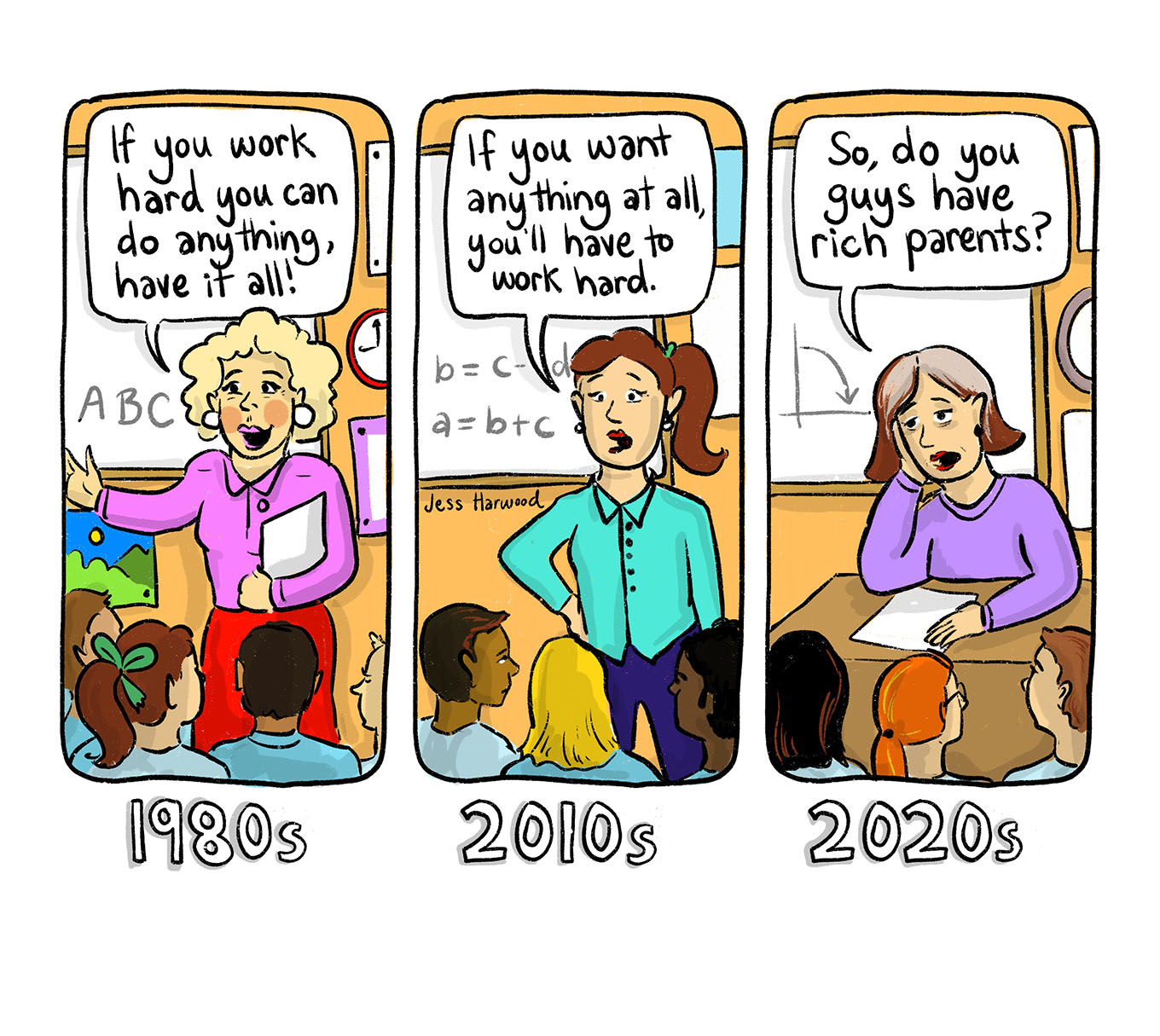
Australia used to do fairly well in terms of predistribution (that is, for white, able-bodied males). But no longer; we’ve become an ‘assetocracy’ where access to assets tends to be what shapes peoples’ life chances and life choices.

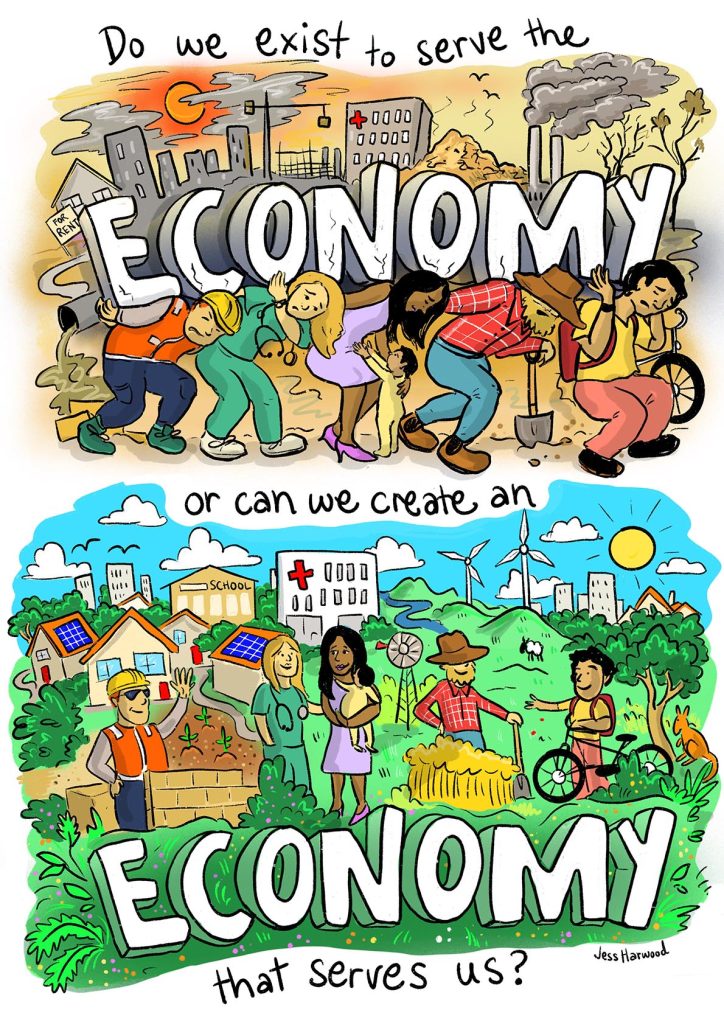
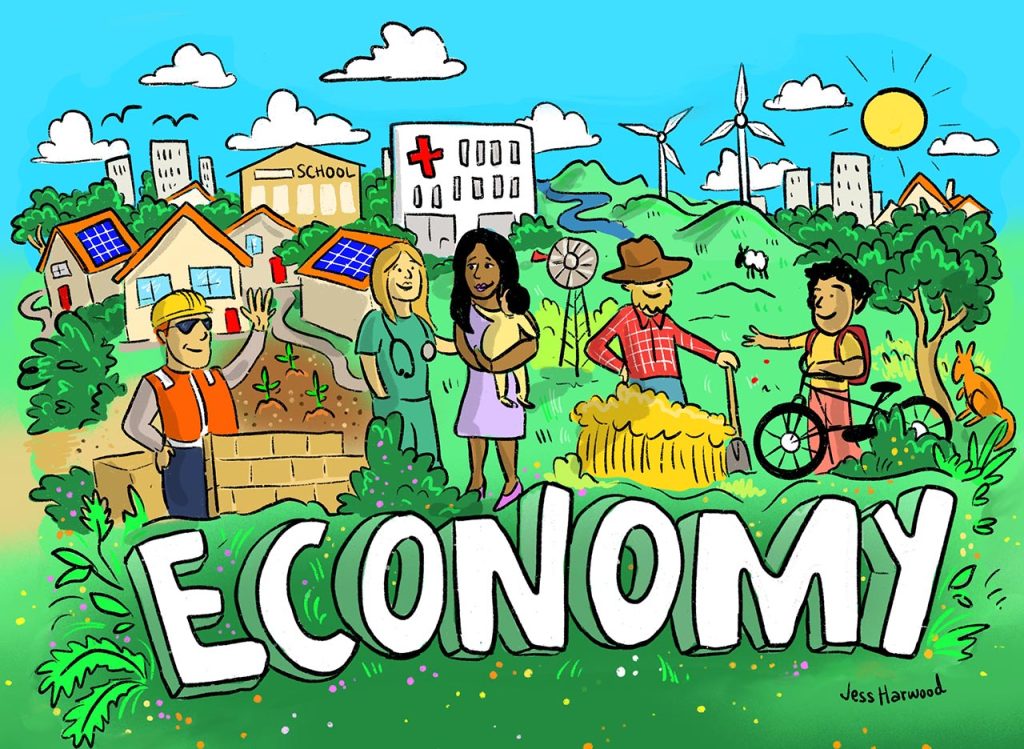
Credit: Jess Harwood, for The Next Economy

Predistribution is about pre-emption and prevention, and a critical element of upstream change that builds a better economy for all of us.  

‘It is not enough to…try to balance the inequalities generated in the market through retrospective tax and transfer. It is necessary to transform and democratise the institutional content of the market economy, rather than just compensate for its inequalities.’ – Gabriella Ramos et al 

Origin story 

The term predistribution was coined by the American scholar Jacob Hacker who describes it as ‘market reforms that encourage a more equal distribution of economic power and rewards even before government collects taxes or pays out benefits’.  

Predistribution’s political moment in the sun came in 2011 when Ed Miliband, then leader of the UK opposition Labour party, was in the audience for a speech that Hacker gave in Oslo. Miliband returned to the UK and – briefly – championed the idea. 

But predistribution is one of the most important ideas that should be high on the political agenda. Let’s look at why it matters, what it is, how it plays out in practice, and the implications for policy. 

What does predistribution mean? 

The essence of the idea of predistribution is ensuring that the market economy does more of the heavy lifting in delivering a more balanced divvying-up of resources. British scholar Martin O’Neill explains it as ‘the particular ways in which the economy can be shaped to disempower the privileged and to empower the disadvantaged’. Its focus is on market mechanisms that determine the distribution of wages, profits, and other flows and stocks of money.  

Government comes into the predistribution story via its role in creating and shaping markets so that the results are aligned with public goals: using rules, incentives and other levers to shape market outcomes. This includes boosting (or curtailing) the bargaining power of market players such as workers, employers, and wealth holders.  

Therefore, it differs from government using tax and benefits to shape the distribution of economic resources after market outcomes have emerged: this is redistribution.  

We’ll come to some specifics in a moment, but you could expect to see predistribution in the form of:  

  • Strong standards for workers (such as regulation, procurement, support for unions, and living wages). 
  • Regulation of the financial system and corporate governance; including provisions to stop harmful activities.  
  • Ensuring more people have a share of capital ownership, including owning businesses via worker or commubity cooperatives. 
  • Spending to bolster people’s opportunities and bargaining power in the labour market (think education and other public services: so they are not dependent on someone’s income) and groups like unions who can stand up for workers. 
  • Addressing how affordable certain goods and services are (for example, via price caps, subsidies, or direct provision): rather than only focusing on how much money is in people’s pockets; also being concerned with how far it stretches. 

Why it matters 

Inequality arises in and can be addressed via two realms. Firstly, what is sometimes called the ‘primary’ realm of work, wages and occupational pensions, and then in the secondary realm comprising taxes and benefits. Predistribution is about action in the primary realm. Here the wages that workers earn are the outcome of ‘a complex process of implicit and explicit bargaining between workers, employers, and (where they exist) unions’: the influence of each compared to the others matters, and is a function of various rules and regulations. 

This is of interest to anyone interested in economic inequality because this realm is where the bulk of the balance or imbalance of economic resources arises: the ‘biggest single factor in determining the distribution of market income is the relative shares going to wages on the one hand and to capital incomes (rent, interest, dividends, and capital gains) on the other’.  

In Australia, ‘capital gains arising from accumulated wealth have produced large increases in passive, unearned income that have added further to the wealth of the rich‘.  

Evidence from around the world bears this out too: in global terms, four fifths of inequality stems from what was going on prior to the government getting involved via tax and transfers, with only one fifth being the result of tax and transfers. The lower levels of inequality in Europe ‘cannot be explained by more equalizing tax and transfer systems… “Predistribution”, not “redistribution,” explains why Europe is less unequal than the United States’, according to Blanchet, Chancel and Gethin.  

So, there are a range of reasons which mean that predistribution is worth focusing when thinking about how to achieve a more balanced distribution of economic resources: 

  • Redistribution is not enough. As Hacker says, taxation and benefit payments ‘cannot do the work on their own’. 
  • Predistribution, in contrast, does not require government to spend substantial quantities of public money. Instead, in reducing inequality at source governments can generate fiscal savings by reducing the need for spending downstream (on benefits), thus freeing resources to spend elsewhere.  
  • There are a range of real politik reasons why redistribution is harder to pull off:  
  • Policies that are about spending (for example welfare payments) are challenging politically given concerns (reasonable or otherwise) about budget deficits and overall debt.  
  • Governments that do seek to be proactive on the redistribution front often face resistance and even backlash, as Hacker describes. He explains that the wealthiest have a tendency to complain – loudly – about increased taxes on their income and wealth.  
  • On the other hand, it is often easier to harness the ‘political space’ for action on predistribution measures than it is for taxing and benefits provision. 
  • Finally, although not noted by its original proponents, predistribution also matters because of the growing recognition that economic growth-based agendas are incompatible with keeping the world’s environment within planetary boundaries. Redistribution tends to rely on the economic growth: grow, tax, and spend back via welfare. So taking the science around the environmental limits to growth seriously compels consideration of mechanisms to ensure a good life for more people without having to rely on the grow and redistribute recipe

Implications for action  

Convinced that predistribution is worth getting behind? Superb. What might you want to think about encouraging – or, if you happen to work in the right place in government, actually implementing? 

Actions that policy makers need to be prepared to implement to promote predistribution include

  • Support for worker owned cooperatives (for example, via reduced taxes, simplified legislation, and education of ancillary services so they are more supportive of cooperatives). 
  • Legislation for worker rights and conditions (such as job security, being able to request flexible schedules and access to paid leave for family care). 
  • Regulations to strengthen the position of trade unions (what Hacker describes as a ‘countervailing power’) and corporate governance that puts workers on company boards. 
  • Enactment, and enforcement of minimum wages set at the level of living wages. 
  • Curbing extremes of high pay (for example, increased taxes when CEO to median pay exceeds a certain ratio). 
  • Broad based service provision that bolsters people’s endowment of human capital (such as decent education, vocational training, and health services). 
  • Addressing affordability of basic needs (for example, via provision of affordable housing, price caps on important services, and competition policy). 
  • Support for people who would otherwise struggle in the labour market to access good jobs (perhaps even a job guarantee). 
  • Regulation of financial markets and promotion of financial stability: for example, of how financial institutions behave (reducing high frequency trades, for instance); shifts in corporate governance; and ensuring capital flows to productive activities (rather than subsidising harmful activities and products). 
  • Promotion of fair trade. 
  • Public procurement with social goals in contracts. 

Conclusion  

Predistribution is a critical lever for generating a more balanced distribution of wealth. It’s an upstream mechanism that heads off inequality before it arises by shaping market outcomes to be fairer, rather than depending on government to even things up once inequality has emerged. There are a range of actions governments and other economic players can take to predistribute economic resources. Now it’s time to start talking about it more and putting the changes in place to make the most of its potential to create the economy we could have! 

NB A shorter version of this piece appeared in The Point: https://thepoint.com.au/opinions/260428-redistribution-or-predistribution-another-way-to-think-about-tackling-inequality  

Download our printable/shareable resource about Predistribution.

Read ‘The economy we could have’: https://nexteconomy.com.au/work/the-economy-we-could-have-new-paper-out-now/

Check out the series: https://nexteconomy.com.au/work/new-series-building-the-economy-we-could-have/

What if economic development starts with the wrong question?

TNE program director Jacqui Bell joined economic development practitioners from across NSW this week to explore what a wellbeing economy looks like in practice and what the Hay community’s approach to transition can teach the rest of us. 

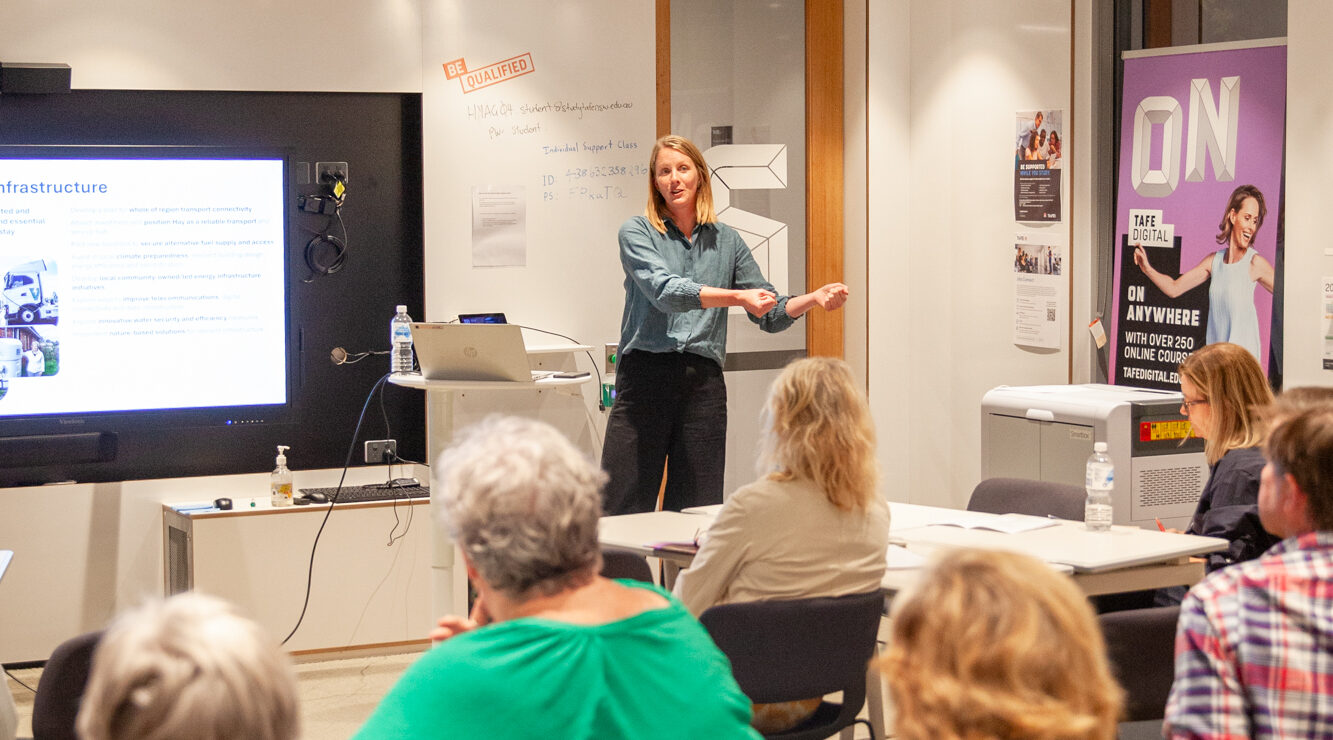
Earlier this week, TNE program director Jacqui Bell presented to economic development practitioners from across NSW local and state government at the Department of Primary Industries and Regional Development’s 2026 Regional Economic Development and Investment Attraction event. 

Her session took a slightly sideways look at the economy: exploring what a wellbeing economy looks like and grounding this big-picture conversation in the practical work Hay Shire Council and the Hay community have been doing to think differently about economic change.  

Across the broader event, a clear theme emerged: councils and regions are navigating increasingly complex conditions, from renewable energy development and industrial growth to shifting investment patterns, housing pressures, workforce demands, infrastructure constraints, planning system challenges and community cohesion. The scale, pace and constant state of flux are making it increasingly difficult for regions to manage change, plan strategically and act with confidence. 

Local government is deep in the trenches of this work – trying to govern and lead through overlapping economic transitions, often with limited resources, unreasonable timeframes and imperfect information. 

For us, this points to the need to rethink approaches to economic development: to redefine what “good” looks like, work with regions rather than doing development to them, and build from each place’s unique strengths, local economic system dynamics and advantages. 

As Jacqui noted: “For many regions, maybe the question is no longer ‘how do we get certainty?’ or ‘how do we attract investment?’ but instead: ‘how do we organise early enough to manage the downstream impacts of our current economic system, while addressing upstream drivers and shaping new opportunities to create value?’” 

“In a world where certainty is harder to come by, the challenge is not waiting for perfect conditions. It is building the local knowledge, capability and confidence to navigate uncertainty – and shape development in ways that leave regions stronger for the long term. 

“As we shared in our session, the economy is not fixed. It is shaped by decisions, values, institutions and power – and it can be redesigned.” 

There were many bright sparks and wonderful examples of “Lego wins” shared across the two days, says Jacqui. With the right support, local governments are well placed to do this reimagining and drive the change we need to see – building economies that better serve people, places and planet. 

Investing in regions to unlock the transition

Australia is currently navigating a fundamental transformation of its energy system, shifting from a fossil fuel past toward a renewable future. Our regional communities are at the frontline of this change, hosting the infrastructure, resources and workforce that will determine our national success. 

Our In Brief: Investing in regions, unlocking the transition series offers financial decision-makers across government, investment and philanthropy a high-level entry point into regional investment and its role in Australia’s transition to a climate-safe, regenerative and socially just economy. 

The series grew from an investor experience in Gladstone in 2024 and has since expanded – in geography and subject matter – drawing on work across regional Australia, desktop research and expert contributions. 

Each brief provides a bird’s-eye view of a focus area, including key barriers and where support is most needed. Current topics include: 

  • Decarbonising and increasing the capacity of the grid 
  • Developing green export industries 
  • Regional investor insights from Gladstone 

These briefs are a starting point – designed to spark conversation, build shared understanding and support deeper discovery. Because these topics are interconnected, effective progress requires a whole-of-system approach and close coordination across sectors. 

As this space evolves rapidly, we welcome your feedback to keep the series current and useful.

Decarbonising and increasing the capacity of the grid 

Australia’s electricity power system or “grid” is the vast transmission and distribution network that transports electricity from generators to consumers. Right now it is undergoing a fundamental transformation from its fossil fuel origins toward a renewable future.

Regional investor insights from Gladstone 

Industrial regions are central to Australia’s net zero ambitions. They host the resources, infrastructure and workforce that will determine whether the energy transition succeeds. Gladstone, an industrial heartland with exposure to emissions-intensive and trade-exposed industries, is on the frontline of the global energy transition. 

Developing green export industries 

The global shift to net zero emissions is the defining economic and industrial transition for Australia this century. While the value of Australia’s emissions-intensive exports will decline with global demand for fossil fuel, the global energy transition also creates enormous potential for new industrial growth. Early and coordinated investment can position Australia as a leading global supplier of green commodities and advanced manufacturing components. 

New series: ‘Building the economy we could have’

‘Building the economy we could have’ – A series of ideas, case studies and concepts exploring how we move to an economy that works for people and planet. 

Australia’s future depends on whether we can move beyond piecemeal reforms to embrace systemic change. 

Last year, we released The Economy We Could Have – a paper that looks under the bonnet of Australia’s economy: rising inequality, the erosion of the ‘fair go’, but also a story of hope. Of momentum growing across the country, and of enterprises and communities already leading the way. 

The response was one of excitement, speaking to a deep desire for transformative economic change rather than the same old, tired recipes. Now, with Australia facing new economic pressures including an oil crisis, the impetus to act is greater.  

Cartoon by Jess Harwood for The Next Economy

So, we are doubling down. The ideas that politicians and decision makers reach for in a crisis matter. We want those ideas to be the ones that put wellbeing at the centre: dignity, purpose, participation, fairness, and nature. As a foundation, rather than an afterthought.  

That’s where our new series comes in. 

Building The Economy We Could Have explores the ideas, case studies and concepts that show how we get there. Right now, there are many isolated or ‘Lego wins’, the examples that show what can be done better, yet scattered and disconnected. We are turning our focus to see these as building blocks: things worth doing more of, and connecting across the country. 

We’ll share examples that show another way is possible and outline the potential of wellbeing economic concepts in practice, with case studies, explainers, interviews, and of course drawing on our work in regional communities looking to build resilient and thriving communities through times of change. ‘ 

The series includes:  

  • Explainers on wellbeing economy concepts and how they are showing up in Australia 
  • Case studies of enterprises, communities and policy makers doing differently 
  • Australian history showing we have charted different approaches before 
  • Interviews with people bringing fresh ideas and approaches. 

We are excited to uplift the work that is steadily charting the way forward, drawing on Australian’s strengths as people who back their neighbours, champion local ideas, and have a long track record of showing the world what policies that work for people and planet can look like.  

This series is a starting point for deeper thinking and conversation. We’d love to hear what resonates, or what we are missing. Contact us here.

Read our first case study:

Read our first explainer:

Building the economy we could have: Earthworker Cooperative Network

Earthworker Cooperative Network gives us a glance into a wellbeing economy in action, where workers build the things we need in a worker-owned factory in Morwell. 

When writing ‘The economy we could have’, our Economic Change lead Dr Katherine Trebeck came across countless ‘Lego wins’. These were the examples of a wellbeing economy in action in Australia that we could look to for inspiration on the way forward, even if there aren’t enough of them yet to add up to complete system change.  

A great example is in Victoria’s Latrobe Valley, where Earthworker Cooperative, Australia’s first worker-owned factory, operates several enterprises. This includes the Earthworker Energy Manufacturing Coop, which produces heat pumps and solar hot water systems – its function first and foremost: to serve its worker owners. 

Earthworker has a vision that brings a wellbeing economy into practice: 

“…a world in which people everywhere are able to democratically determine the means of their existence, collectively meeting their needs while recognising our interconnection with each other, other species, and the environment in which we exist.” 

Earthworker has expanded to become a network of cooperatives that are committed to sustainability, both in social and environmental terms given the link between environmental harm and social injustice. 

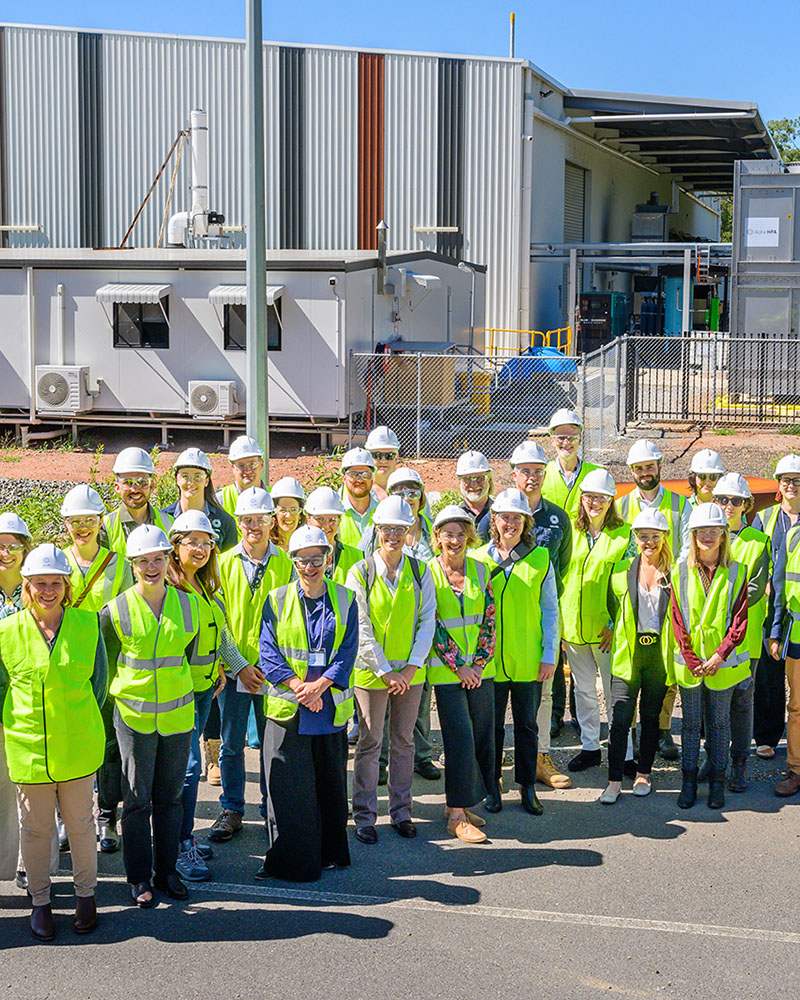
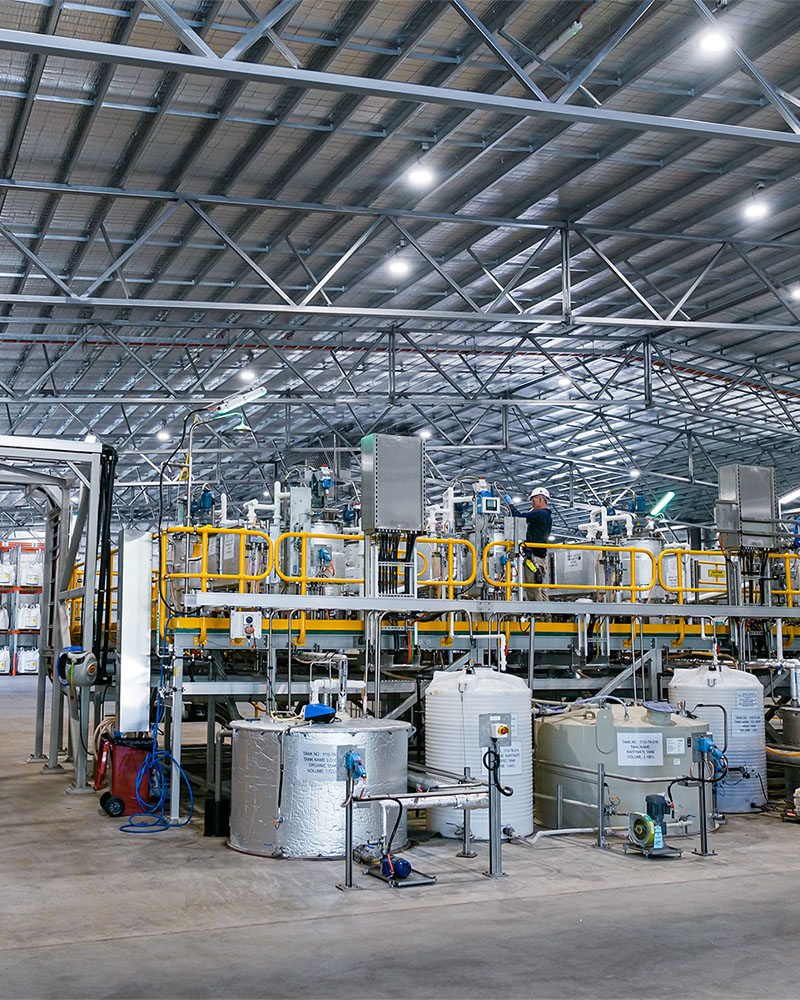
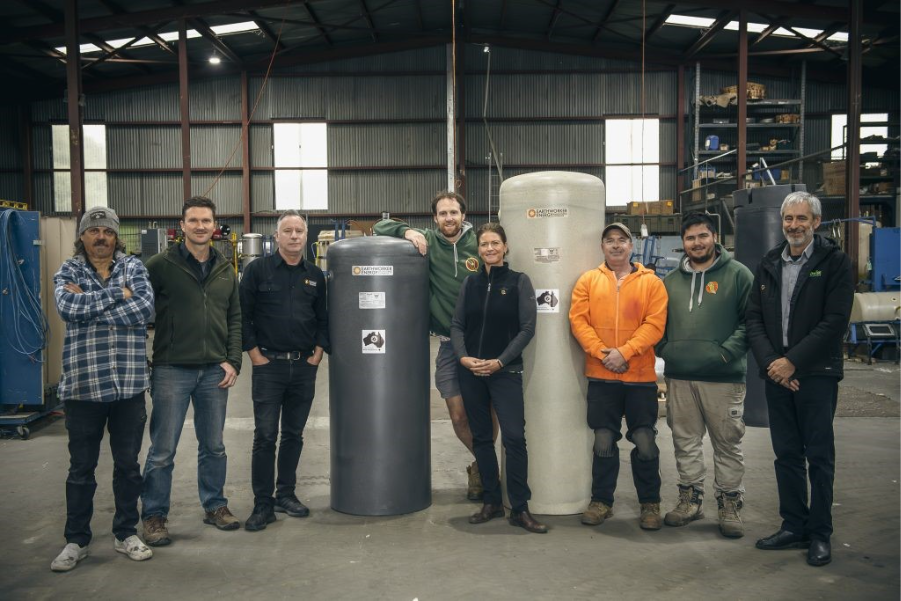
Inside the worker-owned Morwell Factory (Photo contributed by Earthworker for our report) 

What co-ops make up the Earthworker network? 

  • Earthworker Energy Manufacturing Coop: produces new energy technology in Australia’s first worker-owned and run factory in the Latrobe Valley. Based in the Earthworker Morwell factory, it manufactures quality and high-performing stainless steel storage tanks for heat pump and solar hot water systems. 
  • Earthworker Smart Energy Cooperative helps households improve their home’s thermal efficiency and so their family’s comfort through assessments and draught-proofing. This in turn helps households save money and have more control over their energy use. 
  • The Earthworker Construction Cooperative provides residential construction, landscaping and maintenance services such as cabinet making, plumbing, pergola building, decking and more. Their motto is ‘Another world is being built’!  

There is clearly purpose behind what is being delivered by these cooperatives. Worker ownership is a mechanism of predistribution (as financial wealth goes either to workers or to the enterprise) and of economic democracy that enhances people power. By enhancing energy efficiency and being part of the renewable energy roll out, Earthworker is also helping prevent environmental challenges getting worse. In providing job opportunities to those who might otherwise face unemployment, they prevent the harm of job loss. 

So Earthworker speaks to all the ‘4Ps’ of a wellbeing economy in practice: purpose, prevention, predistribution, and people power. It demonstrates what we need more of to build an economy that serves people and planet. 

Earthworker’s logo, showing symbols of the Australian environmental and labour movements. 

What makes Co-ops part of a wellbeing economy? 

A wellbeing economy requires a substantial shift in how the economy is thought about and approached, looking for ways to benefit people and planet rather than profit for the few. 

Cooperatives (whether worker-owned co-ops, consumer co-ops such as groceries, or agricultural co-ops) are a great way to do this as they are owned, controlled and run by and for their members, creating economic democracy and a people-powered economy. They are democratically managed by ‘one member, one vote’, meaning everyone has an equal vote.   

Co-ops enhance predistribution because surpluses go back to members or the enterprise, so community wealth that stays in the community.  

Why Latrobe Valley 

The Valley has largely powered Victoria with brown coal for a century. When the coal power stations and State Electricity Commission (SEC) were privatised* in the 1990s, thousands of people lost their jobs and Victorians lost ownership of this essential infrastructure. (*Although since 2024, the SEC has been partially revived as a government-owned renewable energy company, with legislation that specifically protects it from privatisation).

The number of people employed in the power industry dropped from about 11,000 in the late 1980s to about 2,600 in 2001, causing the population to shrink significantly with nine per cent of the region’s residents leaving between 1991 and 1996. (See also The Latrobe Valley, Victim of Industrial Restructuring by Bob Birrell) 

Since then, the Valley has experienced high rates of disadvantage. In 2017 French-owned corporation Engie, announced the closure of Hazelwood mine and power station and roughly another 750 jobs were lost. 

How did Earthworker seek to address this economic injustice? 

The founders of Earthworker could see that the apparent conflict around jobs versus the environment wasn’t the full story and reflected a narrow lens. They recognised that there was a need to work together for just transition in the La Trobe Valley, and there was a dire need to create jobs that were better for workers and jobs that could contribute positively to the local community. 

Latrobe is one region where this is necessary, many other regions are also on the frontlines of economic transition that must include solutions that put wellbeing at the core, and the principles of prevention, predistribution, people power and purpose.

Australians are dissatisfied with the status quo and open to rethinking economic priorities that put people first. Earthworker shows a different model of business that can build an economy that works for people and for planet as a foundation, rather than an afterthought.

Resources:

Read our full report: ‘The economy we could have.’

Check out more about Earthworker here.

Find out more about Co-ops at BCCM, the peak body in Australia for Co-ops and Mutuals.

Hay’s Economic Transition Roadmap is here -why this more than just a plan  

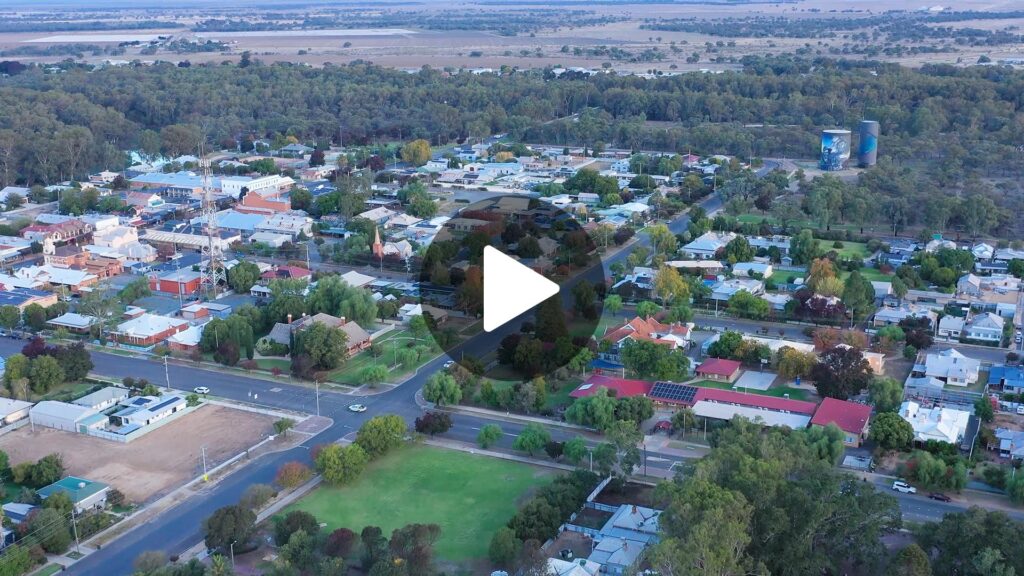
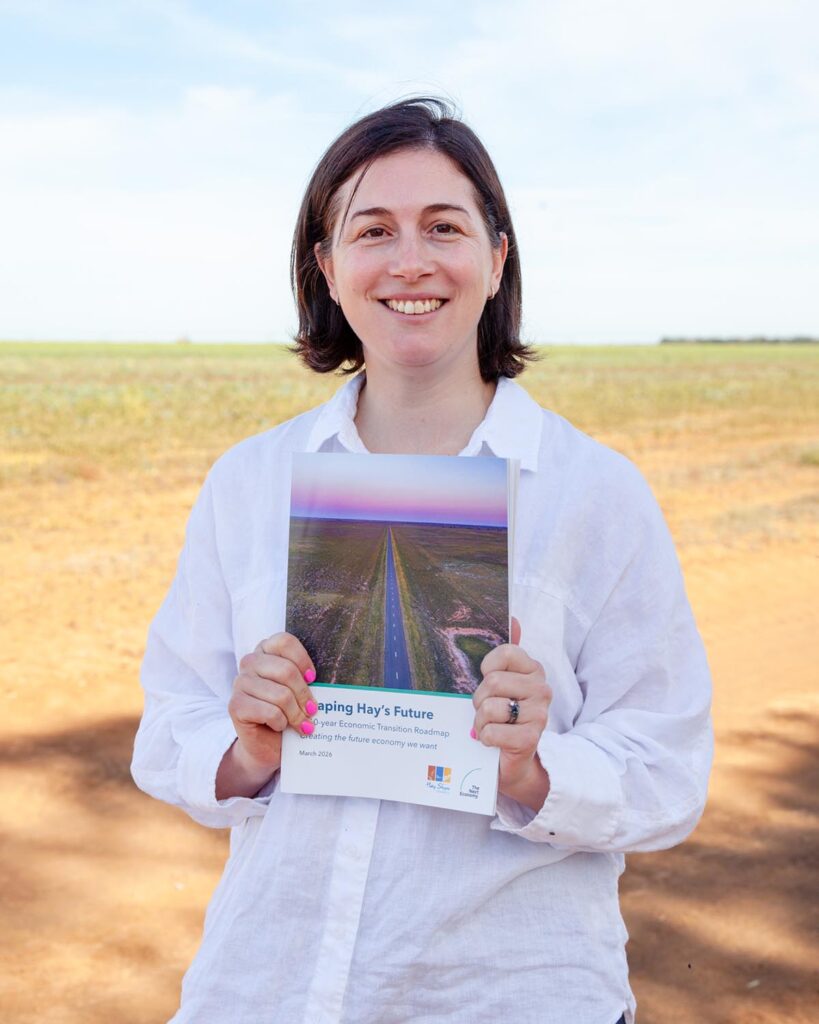
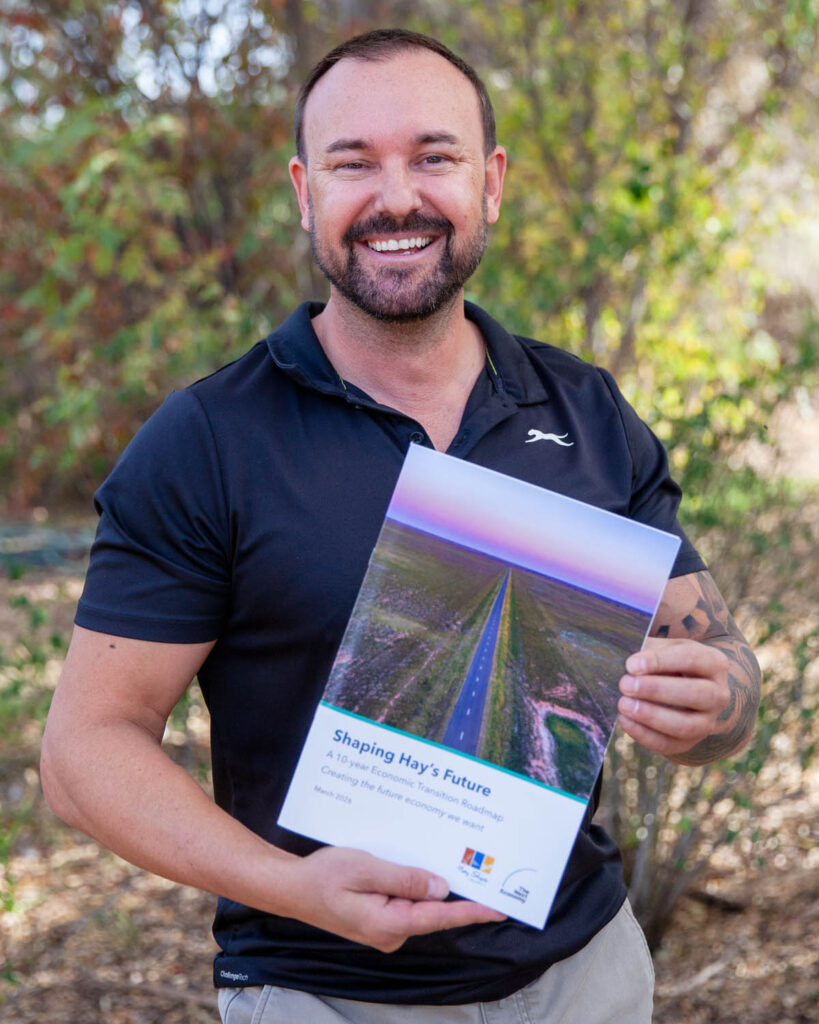
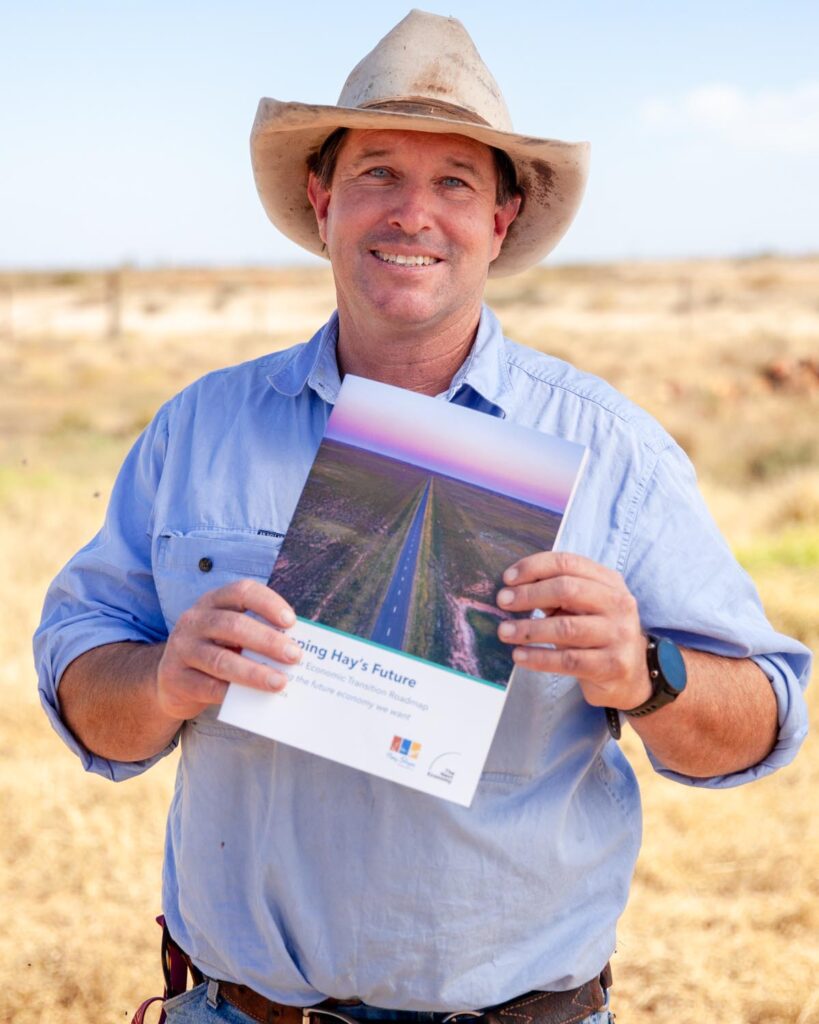
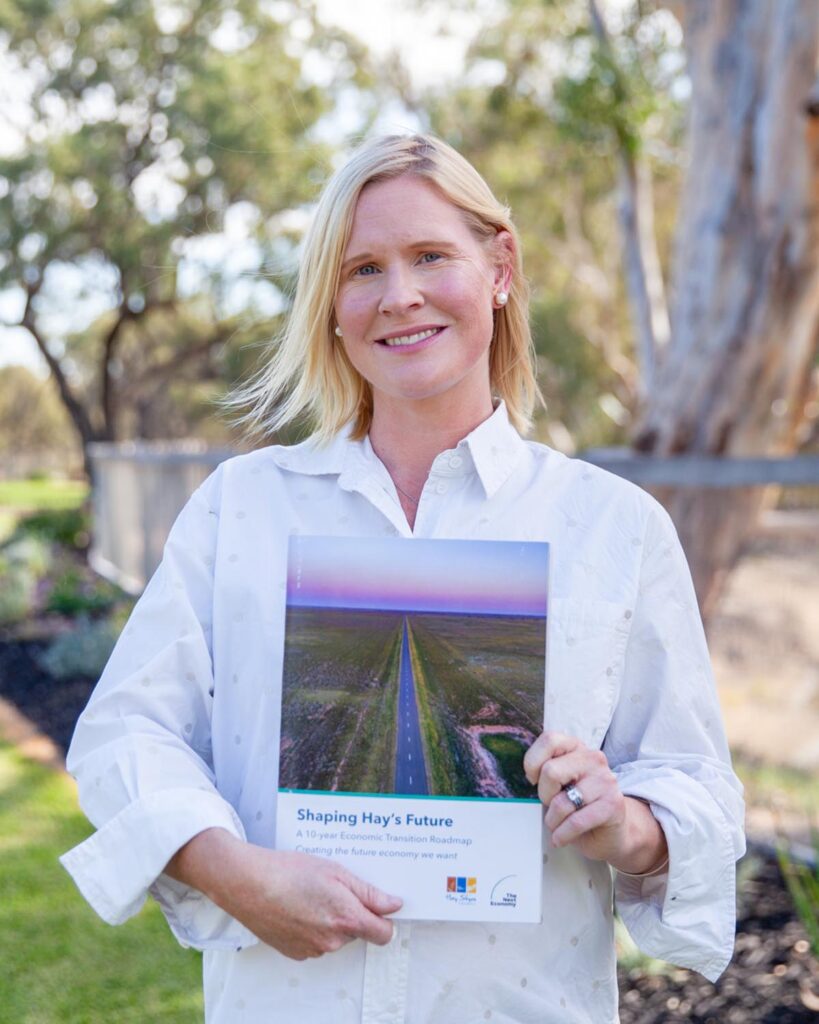
Last week the Hay Economic Transition Roadmap was launched in Hay with the people who brought it to life – Hay Shire Council and around 30 of the 250 community members who contributed in one way or another over three years of deep engagement. This roadmap isn’t just a document; it’s a genuine expression of what the community wants for its future, and we’re so excited to have supported its development and have it out in the world. 

Led by Hay Shire Council with support from The Next Economy, the Roadmap brings together local knowledge, priorities and practical actions to guide the next decade of economic change – building on Hay’s strengths and preparing for what’s coming. It is designed to align investment with community aspirations and catalyse coordinated, collective action for change – with the community in the driver’s seat.  

We sat down with our Land Program Director Jacqui Bell to talk about what she’s learned over the past couple of years and what this means for how we think about regional economic transitions.  

Why are region-wide economic transition plans needed?  

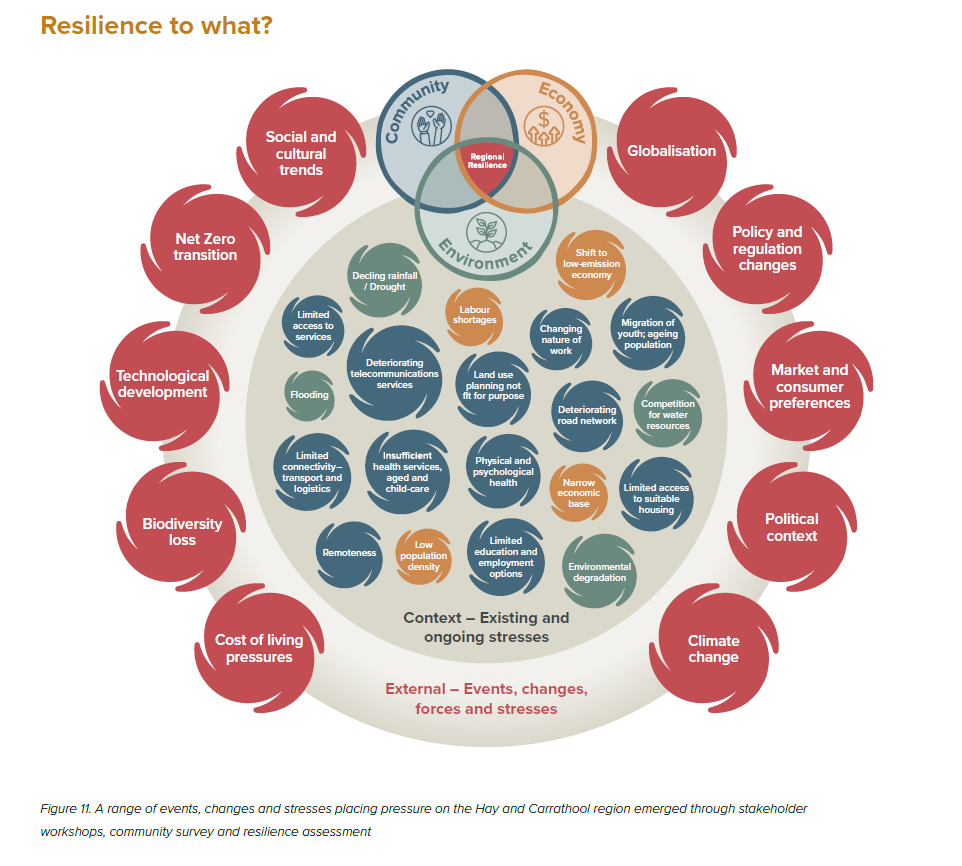
Communities like Hay are navigating compounding pressures all at once – things like housing shortages, workforce gaps, industry shifts and climate exposure. Band-aids on broken systems won’t cut it. We need upstream change that builds on local strengths and focuses on practical solutions that respond to the unique characteristics of a place. That is, change that generates value locally – not simply chasing narrow national targets or technology mandates. 

Working at the regional level connects the dots between sectors and industries to tackle challenges and create new opportunities in ways no single farm, business or government agency can do alone. In agricultural regions like Hay for example, regional planning and coordination creates the enabling environment for local businesses and farmers to ‘move’ and explore new partnerships, de-risk innovation and diversify on-farm income. 

For new industry proponents, a regional plan signals where opportunity exists and how shared value can be created – and in many cases, collaboration with regional stakeholders is what makes the business case for investment stack up. For farmers, it enables economies of scale, de-risked investment, opportunities to lower external inputs and new business activities that simply aren’t viable farm by farm. We see examples of this already in efforts to get good outcomes for nature – where working at a regional level, not a farm level sometimes makes a lot more sense. 

Regional collaboration isn’t always straightforward – but there are organisations working out how to do it well, helping landholders, residents and Councils find the mechanisms and models to sustain this work over the long term. 

So, what does this look like in practice? 

Hay sits in the South West Renewable Energy Zone, a real opportunity for the region if managed well. The Roadmap process is already delivering results. From housing solutions, new agricultural industries, expanded childcare, and two renewable energy projects progressing with broad community support.  

There are many more opportunities emerging. For example, offtake industries – businesses that take locally-produced energy and use it productively – preferably for the benefit of local industries and businesses. Think freight, fuel, and fertilisers. A sustainable fertiliser business using renewable energy is already under establishment, with regional producers committed to buying at the scale needed to make it viable. 

And it’s not just new businesses. Existing ones are adapting too. A local engineering firm is moving into water infrastructure for energy projects – a specialisation with applications well beyond Hay. 

This isn’t just aspiration –the momentum is real and work is happening already on the ground. 

Jacqui shares the final Roadmap with community members at the launch in late April. 

What’s the role of Local Government in all this? 

Council plays an important role – facilitation, convening, connecting the dots, building the appetite for change, countering misinformation etc. Support for renewable energy development in a region like Hay didn’t happen because of some national campaign – it was because of the rigorous and ongoing communication and engagement that Council facilitated, the discussions they brought together, the open door they had to proponents, community, businesses. 

Why is community involvement important? 

When local people are involved and are part of a group behind a vision and supported to be champions of economic change, momentum builds. We could see this in real time last week, when one of our working group members shared how they’ve been talking to a local organisation about progressing an action in the Roadmap. This is where the magic happens – community starts to talk, and action is sparked. 

Why is regional work like the Hay Roadmap important? 

Regional work matters – it is the connective tissue that holds the regional economic system together and helps each individual component move in the right direction. It’s also critical for sectoral transitions – to understand how characteristics of a place shape or hinder the big shifts that are needed, such as the decarbonisation of agriculture, for instance. 

The work in Hay is important because it tells a strong and compelling story about what good regional development and economic transitions can look like across Australia.  Communities facing big shifts – new energy, industry change, climate pressure and workforce gaps are increasingly deciding to shape their own futures rather than wait. The ones doing it well are planning ahead, building on local strengths, and asking the right questions: What are we transitioning to? What does good development look like here? How do we make sure benefits flow locally?  

Hay is one of the clearest examples of what this looks like when it’s done well, and the lessons here matter well beyond one town  

But a Roadmap is just a document, isn’t it? 

People sometimes roll their eyes at the thought of another planning document, but for The Next Economy, the document is simply the artefact – the process, the engagement, the coordination and local capacity building is what creates change and builds momentum for new partnerships, new opportunities and community leadership of the future. 

That said, the pride that the Hay community feel for the Roadmap, and the value they see it provides them is huge. This was again demonstrated by the conversations we were part of and feedback we received from local people during our visit to Hay last week when we launched the Roadmap with the community. Having a document like this provides a strong signal to investors, collaborators and government. It’s something that everyone in the region can point to demonstrate the work they’ve done, the direction they’re heading, their priorities and what doing business in Hay looks like.  

The number of queries we and the region have had even after the soft launch of the Roadmap last week is testimony to its power. The Roadmap sends a signal that Hay is a strategic partner to change with people that have the mindsets and willingness to explore opportunities and create shared value.  

So, what should we take out of all of this? 

Hay has and is doing something genuinely impressive – a community of this size taking the initiative to plan ahead, build consensus, and deliver real outcomes.  It’s a clear example of what responsible development and economic transitions managed well can looks like across Australia. For other regions to go the distance, they need the same meaningful engagement and real backing, including funded local coordination roles that turn good plans into lasting outcomes. 

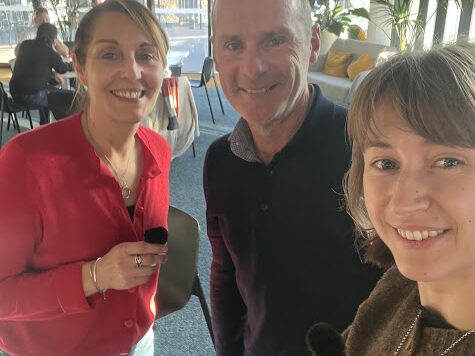
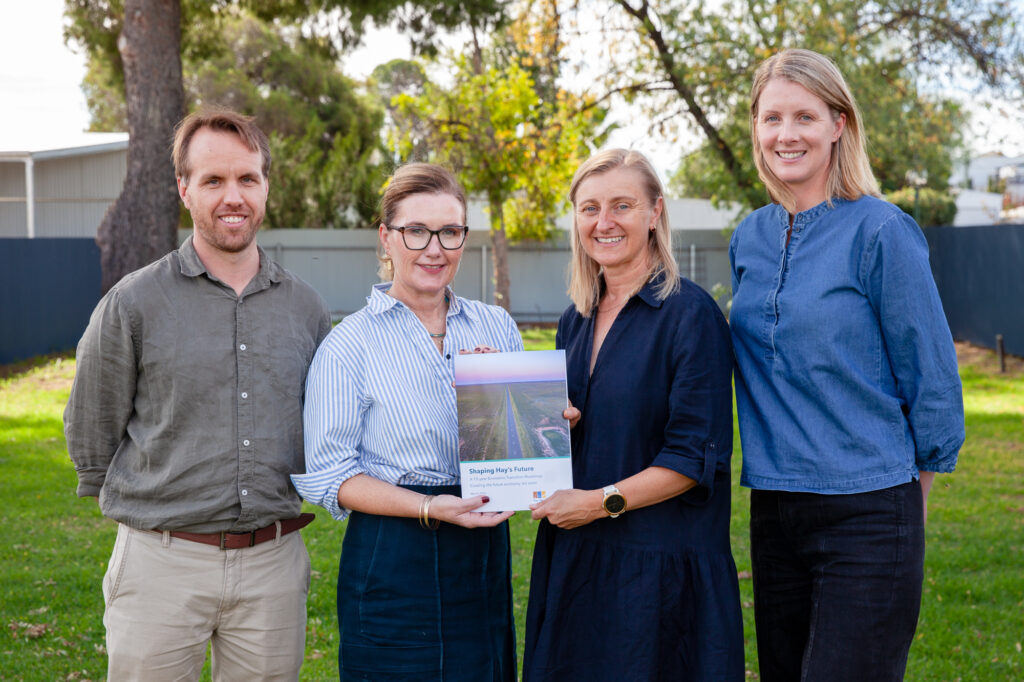
Jacqui (far right) celebrating the launch with (from left) TNE Senior Project Officer Doug Ruuska, Hay Shire Council Economic Development Officer Alison McLean and Hay Shire Council Youth and Economic Development Officer Kylie Brettschneider. 

Our evidence to the NSW REZ inquiry: lessons from the ground 

Energy lead Saideh Kent appeared before the NSW Parliamentary Inquiry into the impact of renewable energy zones on rural and regional communities and industries in late March. It was an opportunity to highlight the great work communities in renewable energy zones are progressing and reinforce the critical role regions play in the development of renewable energy, says Saideh.  

The Next Economy has been working alongside Hay Shire Council in the South West REZ and Uralla Shire Council in the New England REZ for the past two years, and both councils endorsed reports of our work in the fortnight before Saideh appeared. Working closely with councils,Saideh says “you see how they are getting on with development, managing challenges and seeking the best outcomes for their communities”. 

Here Saideh shares some of her reflections…     

What we’re hearing on the ground 

The picture is more positive than the headlines often suggest. Communities are getting on with it, working alongside developers, EnergyCo and government departments to plan for what is coming and find solutions that work for them. We have seen genuine improvements in the NSW planning framework over the past two years, with greater clarity emerging around community engagement, landholder payments and benefit sharing, and EnergyCo’s funding support for local government has made a real difference to what councils can actually do – though they do remain very overstretched. 

Housing is a good example of communities turning a challenge into an opportunity. Both Hay and Uralla are progressing innovative housing solutions with developers and private investors, where short-term workforce demand creates the market conditions for investment in housing that will benefit the community long after construction is complete. 

Community engagement needs to be genuine 

Communities in REZ areas are not short of opportunities to be consulted, but the quality of that engagement matters enormously. People do not want to be asked by eight different project developers how they would like to spend community benefit funds. What they need more of is real involvement in decisions about transport routes, housing and workforce planning, all things that will affect their lives.  

Working in place provides the opportunity to bring all parties to the table to work through challenges and determine what is the best solution for local communities.  In some areas local employment targets are effective, in others, they can add stress to existing workforce shortfalls, so engaging communities in local solutions is so important. 

Local government belongs at the table 

Councils in REZ areas are doing an enormous amount of work.  Coordinating across agencies, planning for cumulative impacts, facilitating community engagement, often holding the process together in ways that are not always visible. The Next Economy supports Hay Shire Council’s call for councils to be recognised as strategic partners in the REZ planning framework, with concurrence required from councils in the development of conditions of consent. This would allow councils’ requirements and policies to be incorporated into the general terms of approval and give communities greater certainty. Continued and enhanced funding for council capability through the development and construction phases will also be essential. 

EnergyCo’s mandate and development outside the REZs 

EnergyCo’s coordination role has been valuable, but its broader authority rests on changeable footing under the current legislation. We would like to see that role clarified and reinforced so it has the ongoing mandate and funding to support communities across the full life of each REZ. I also raised the situation facing councils dealing with development outside the REZ access schemes, where cumulative impacts are just as real, but coordination support is much thinner and called for the REZ access merit criteria to be extended more broadly. 

Nature and local knowledge 

Reflecting on my evidence, an issue I did not get to raise at the inquiry but sees as critical: communities we have engaged with care deeply about the land and want to see nature-positive outcomes from these developments, which is entirely compatible with renewable energy. The University of New England is already undertaking research on biodiversity in solar farms, local farmers are keen to participate in biodiversity offset programs, and there is deep environmental expertise in the region that should be drawn on actively. We support the inquiry’s earlier recommendation calling on the NSW Government to identify ecological protection and restoration priorities for each REZ and encourage developers to contribute to positive regional environmental outcomes. 

What gives me confidence 

What stays with me after two years of this work is how capable these communities are., . Councils are coordinating across agencies, planning for large incoming construction workforces, facilitating community engagement across multiple projects, and doing most of it with constrained resources and a planning framework that has not always kept pace with what is happening on the ground.  

The opportunity on the other side of all this is significant. Better housing, lasting infrastructure, stronger local economies, nature-positive outcomes from development that is done well. But those things do not happen automatically. They take resourcing, coordination, and a framework that treats councils as partners who need support to get the best outcomes for their communities. 

That is ultimately what I wanted to leave the committee with, examples where the real challenges are being addressed by communities, that have done the hard work of showing up, engaging honestly and pushing for something better. 

Saideh at the inquiry with fellow speakers Chris O’Keefe and William Churchill from the Clean Energy Council.
 

Navigating the land sector in 2026

Jacqui Bell leads The Next Economy’s land sector work. In this Q&A, she shares her reflections on a pivotal year for agriculture and land use change, how climate risk, investment and policy began to converge in 2025, and what this means for building fair, resilient and regenerative landbased economies.   

Why is the land sector important to Australia’s economic transition?  

The land sector sits right at the intersection of Australia’s biggest transitions. It’s where climate risk is already being felt most acutely, where adaptation and mitigation must happen together, and where decisions about land use directly shape regional economies, food systems, biodiversity, and community wellbeing.  

Unlike energy or industry, the land sector isn’t one thing. It’s a bundle of economic activities – agriculture, forestry, conservation, carbon, water, mining, infrastructure – all competing for the same finite resources. How land is owned, valued, used and governed determines what’s possible economically, socially, culturally and environmentally.  

As climate impacts intensify and global markets shift, how we use land, as well as value and manage the ecosystem services it provides will increasingly inform whether Australia builds resilience and shared value – or locks in deeper inequities and long-term risk.  

Looking back on 2025, what were the defining points for Australia’s land sector?  

2025 felt like a year where multiple threads finally came together. There was a sense of catch‑up across policy, investment and public conversation about the role the land sector plays in Australia’s transition to net zero and nature‑positive outcomes. Long‑awaited strategies and initiatives began to land, and programs like the CRC for Net Zero Agriculture started to gain more traction, signalling that agriculture and land use were no longer being treated as peripheral to the transition.  

One of the most significant shifts we have seen through our work, is a growing readiness to mainstream more regenerative and climate‑resilient approaches into farming. Twenty years ago, farmers experimenting with regenerative practices were often working against the system. In 2025, we saw the enabling conditions begin to stack up: policy drivers, market signals, climate realities and finance are pointing in the same direction. That alignment as well as other broader socioeconomic factors is creating a real tipping point in willingness to rethink how production systems work across different landscapes.  

At the same time, the year exposed just how slow and fragmented our economic systems still are. There is a lot of innovation happening on farms, in communities and in pockets of investment, but it’s uneven and difficult to scale. Capabilities, ownership structures, planning frameworks and institutional inertia continue to lock in existing patterns of land use, even as the need for change becomes more urgent.  

Climate risk also became much harder to ignore. The National Climate Risk Assessment brought sharper visibility to the conditions landholders and regions will need to endure in coming decades – and, in some parts of Australia, where certain land uses and farming systems may not even be viable long-term.  

Overall, 2025 wasn’t a year of resolution, but it was a year of these shifts (and many others) coming to the surface. The challenges facing the land sector became more visible, the stakes more explicit, and the imperative for coordinated, place‑based and just approaches to land use change much harder to push aside.  

What are the biggest challenges facing Australia’s land sector right now?  

Complexity and cumulative pressure are the defining challenges.  

Landholders and regional communities are dealing with climate impacts, market volatility, policy uncertainty, workforce shortages, rising costs, and rapid land use change – all at the same time. These pressures aren’t additive; they’re compounding.  

Climate risk is no longer theoretical. We’re seeing clearer projections of extreme heat, water scarcity, flood and drought cycles that fundamentally question the long-term viability of some farming systems and, in some places, human habitation. In northern Australia, for example, the growing number of extreme heat days raises real questions about labour, productivity, liveability and safety.  

At the same time, investment and ownership structures are shifting. Institutional investors are becoming more sophisticated about climate risk and land value, enabled by digital technologies and data. That has the potential to drive innovation – but it can also accelerate consolidation, change land use rapidly, and create unintended consequences for regional economies and communities.  

Jacqui talking nature and land use trade-offs at the Better Futures Forum in 2024. 

What does a climate-safe, regenerative and socially-just land sector look like in practice?  

In practice, it’s not a single model – it’s place specific.  

A climate safe land sector integrates mitigation and adaptation, rather than treating them as separate goals. It supports farming systems that are resilient to heat, water variability and extreme events, while restoring soils, biodiversity and natural capital over time. In practice, that looks like more diverse and resilient farm systems, healthier landscapes, and multiple income streams that reward stewardship as well as production.  

A regenerative approach becomes mainstream not just because it’s ‘better’, but because the conditions finally stack up: policy settings, market signals, climate realities and finance are aligning in ways they weren’t 20 years ago. Back then, early adopters were pushing uphill. Today, there’s a genuine tipping point in readiness and willingness to do things differently.  

This isn’t just a shift at the farm level – it’s a broader system transition across supply chains, finance and policy that makes different choices viable at scale.  

Social justice means recognising power and equity: who owns land, who benefits from new markets, who carries risk, and who gets left behind. In the Australian context, it also means recognising and partnering with First Nations land stewards and cultural knowledge. It means designing transitions that support producers to continue producing good food – rather than pushing risk down the supply chain or hollowing out regional communities.  

There are real trade-offs and tensions to navigate, but the direction of travel is now much clearer (albeit still looking very messy)!  

How are farmers, landholders and Traditional Owners already leading this transition?  

A lot of leadership is already happening on the ground, often ahead of policy.  

Farmers have been experimenting with regenerative practices, climate smart production, on-farm business diversification and new business models for decades. What’s changed is the visibility and validation of that work – as well as the growing recognition that adaptation is an economic necessity, not just an environmental choice, and that there are some challenges that are better addressed at a region or landscape scale than at the farm level.  

Traditional Owners are also leading innovation, particularly where land management, cultural knowledge and economic development intersect. Land and Country are the foundations for First Nations economic sovereignty, and there’s huge potential for Indigenousled approaches to land stewardship to deliver economic, cultural and ecological outcomes – if the right structures and capital are in place.  

What we often see, though, is fragmentation: great practice, limited coordination, and insufficient system level support to scale what’s working.  

What policy changes would help speed up the shift to fair and sustainable land use?  

One of the biggest gaps is in planning and coordination.  

Our land use planning systems are no longer fit for purpose. They weren’t designed to manage cumulative impacts, rapid transitions, or competing demands like renewable energy, conservation, food production, infrastructure and critical minerals – all at once.  

The EPBC Act reforms late last year signalled a stronger role for environmental protection and nature positive outcomes through development, which is important. A big question will be how these changes interact with land use, regional economies and cumulative development pressures.  

On their own, regulatory reforms won’t deliver good outcomes. Without integrated planning, clear pathways for development, and genuine engagement with communities, we risk creating more friction and uncertainty on the ground.  

Integrated regional planning could be transformative if done well – bringing these competing uses together in a coordinated way, identifying clear priorities, managing trade-offs deliberately, and setting upfront rules about where development should and shouldn’t occur. Done poorly, it risks entrenching conflict or shifting impacts onto communities without their input. The decisions made – from zoning and go/no go areas to approval pathways – will determine who benefits and who bears the cost of transition.  

More broadly, we need policy that recognises climate adaptation as a core economic function, not an afterthought which aligns investment, land use and community outcomes over the long term. Good policy will require this work to happen with communities, not to them – with early and meaningful involvement in shaping land use decisions.  

Finally, what excites you about this work?  

What excites me is that we’re at a moment where the questions are finally shifting.  

There’s growing recognition that climate risk is a socio-economic issue, that adaptation matters as much as transition, that technology and innovation on farm is just one part of the Ag sectors transition, and that finance and climate investment decisions are driving change across Australia.    

All of these and more are creating greater opportunity and imperative to explore and demonstrate what good economic transitions looks like – and how getting it right in regions and on the ground can support the land sector to shift in a way that helps Australia navigate uncertainty, restores nature, and builds an economy that genuinely serve communities – not just markets.  

Making sense of the ISP 

The ISP runs to hundreds of pages and helps guide energy decisions across the country, yet few people read it. We chatted with climate and energy specialist Franzika Curran to break down its importance. 

The Australian Energy Market Operator’s Integrated System Plan, usually shortened to the “ISP”, is not the kind of document most people would pick up for a casual read. It is a large technical report full of modelling, forecasts and system planning – and it quietly shapes decisions that play out across the country. 

To help unpack what it is and why it matters, we caught up with climate and energy specialist Franziska Curran, who helped contribute to our recent ISP submission and who has spent time sifting through the hundreds of pages of the draft plan. 

Franziska, for people who have never heard of it – what is the Integrated System Plan? 

At its core, the ISP is a very large piece of analysis that asks a fairly simple question: what is the lowest cost way for Australia to meet its future energy needs while also meeting government policy goals? 

To answer that question, the Australian Energy Market Operator draws on years of data, modelling and consultation. It considers how demand might change, what kinds of energy generation are likely to be built, how much transmission will be needed, and how all of that fits together as coal power stations retire and new energy sources come online. 

The result is a long-term plan that outlines what the electricity system could look like over the next two decades, and what infrastructure would likely be needed to support it. 

It does not directly approve or build projects. Instead, it acts more like a map. It shows the pathway that planners, investors and governments are expected to follow when making decisions about new infrastructure. 

If it is a technical planning document, how does it shape what happens in real places? 

A successful energy transition requires a significant amount of new infrastructure. That includes new generation such as wind and solar, as well as the transmission lines that move electricity across the system. 

AEMO has a responsibility to plan for the transmission network needed to support that system and the ISP helps fulfil that role. 

By setting out the direction the system is expected to take, the plan sends signals to investors, network companies and planners about where new infrastructure will likely be required. Those signals then flow through into more detailed planning and investment decisions. 

Over time, those decisions shape what gets built and where. 

What changes when a project is labelled “actionable”? 

Within the ISP, some transmission projects are labelled as “actionable”. 

That label matters as transmission projects cannot progress through the regulatory approvals process unless they are identified as actionable within the plan. In that sense, the ISP acts as a gatekeeper. 

Once a project receives that designation, the project proponent can move into the next stages of regulatory approval and planning. Future versions of the ISP then continue to check that those projects still align with what the electricity system needs. 

Why do regional areas tend to host so much of this infrastructure? 

Much of the renewable energy Australia needs will be built in regional areas, and this is for a number of reasons.  

One reason is the quality of renewable resources. Wind and solar generation tends to be strongest in specific geographic areas. Building projects in places with strong resources allows the system to generate more energy more efficiently. 

Another factor is scale. Large renewable energy projects require significant land and are often built in clusters that make the most of existing or planned transmission infrastructure. 

Concentrating development in areas with strong renewable resources and suitable space can make better use of the network that connects them. If large projects were spread thinly across the entire country, significantly more transmission infrastructure would be needed to connect them all. 

What tends to determine whether this development benefits a community? 

For me, one of the most important factors is supporting local leadership. 

Where communities are actively planning for the future they want and organising around that vision, they are often better placed to shape the opportunities that come with new infrastructure. 

That kind of leadership can help ensure projects align with local development goals and that benefits are captured locally. 

That is also why I think the work of The Next Economy is so important. Taking the time to understand what communities want – and do not want – in  their future, making sure people have access to clear information about what is coming and how decisions are made, and helping communities articulate their priorities. This is so important in ensuring development supports local aspirations rather than working against them. 

What is often misunderstood about the ISP? 

For many people, the ISP can feel quite distant or abstract. It is a large technical document, and it can be easy to dismiss it or criticise it without looking closely at what sits behind it. 

But the plan represents years of analysis, modelling and consultation. It attempts to map out a pathway for a very complex transition, bringing together data about energy demand, infrastructure, technology and policy. 

It may not always make for easy reading, but it is a significant piece of work that plays an important role in shaping how the electricity system evolves over time. 

The final AEMO ISP 2026 is expected to be released in June this year.  

What does ‘good’ look like for our regions in 2026? 

2025 brought with it a rush of policy announcements.  Here at The Next Economy, we’re reflecting on what we’ve learnt through our work with regions and how they can continue to manage change well in 2026 and beyond. 

Last year brought a flurry of action on climate and nature. We saw the release of Australia’s first National Climate Risk Assessment, long-awaited reforms to environmental laws, and new national and state strategies for energy, industry and regional investment – alongside a range of net zero sector plans. What matters now is how these policies are resourced and rolled out in practice, and whether they lead to the kind of meaningful change that regional communities have been calling for.

Regions are often on the frontline of change: whether that’s shifting industry policy, rising climate risk, or new infrastructure investment. They are also home to a wealth of knowledge, capacity and strategic value. From critical minerals to renewable energy zones, from agricultural production to local manufacturing, regional communities are central to many of the systems that shape our economy. 

But while the stakes are high, regional communities are not always given the time, attention or resources they need to engage with and influence these changes. That’s a risk not only for regional wellbeing, but for the success of plans and strategies to transition the Australian economy itself. 

The Next Economy facilitating stakeholder discussions in the Latrobe Valley, a region planning for significant change. These workshops were hosted by the Net Zero Economy Authority and Regional Development Victoria. Credit: Saideh Kent.

What outcomes can development deliver for regional communities when it’s done well? 

Our work is guided by a simple question: what does ‘good’ look like when it comes to managing change in regional communities? Supporting positive change is a shared responsibility. Communities, industry, business, investors and all levels of government each have a role to play. When done well, development builds on local strengths, reflects community priorities, delivers shared benefits, and helps both people and places thrive. 

Through conversations in diverse regions experiencing major economic change, a set of shared economic goals and ideas of what good development might look like has emerged. These include:  

  • A diverse and resilient economy: Long-term resilience depends on diversifying the local industry base, supporting local enterprise, and backing emerging opportunities for a future ready economy – from renewable energy development and the decarbonisation of agriculture, to the adoption of circular economy practices and community wealth building initiatives. 
  • First Nations economic self-determination: Supporting First Nations leadership and decision making, alongside the growth of Indigenous-owned businesses, strengthens economic sovereignty and delivers cultural, environmental and economic benefits.
  • Space for innovation and local knowledge: Transition is not linear. Regions need the time, resources and forums to learn, adapt, and lead – drawing on the experience of communities. 
Doing future visioning with young people in Uralla Shire highlights what they would like development to enable. Credit: Lyndsay Walsh.

How change is managed locally will shape the future of the regions 

None of this is possible without continued investment in the people and processes that make good development possible: local engagement, collaboration, coordination and community leadership. For us, this means spending time in regions, listening deeply, understanding local priorities and concerns, and supporting people to strengthen the skills and confidence they need to lead change over time.

Our experience is that when local leadership and relationships are genuinely valued, regional stakeholders are able to shape decisions and drive outcomes as true partners. This creates stronger opportunities to deliver shared value and achieve positive lasting outcomes.

The Next Economy in South West Queensland, engaging locally to develop a regional transition plan. Credit: Lyndsay Walsh.

Looking forward to the year ahead  

We have repeatedly seen that when communities are properly engaged and supported, they are more than ready to lead. In Mount Isa, local workshops helped bring together council, community and industry to chart a path through the closure of a major mine. In Uralla Shire, community dialogues have shaped the direction of the local renewable energy plan.  

Early, inclusive planning, iterative engagement, access to supportive resources, ongoing dialogue, transparency, and a clear focus on regional wellbeing all help shape stronger outcomes over time. These aren’t new ideas to those working in or with regional communities, but they’re worth repeating and keeping front of mind as change unfolds. We’ll be sharing more reflections on what this looks like in practice in the months ahead.

With so much change already underway, and with regions at different points along their own journeys, we return to our same central questions, and support our regional stakeholders to ask of each other: what does ‘good’ look like for our community, and what will it take for us to get there together?

You can read more about our in-region engagement on this topic in these webstories:  

Training

The Next Economy has trained over 300 people working in environment, climate and social service organisations on how to work effectively with regional communities. This has included members of:

  • Climate Action Network Australia
  • Engineers Declare Network
  • Australian Conservation Foundation
  • Australian Red Cross
  • Brotherhood of St Lawrence
  • Hunter Renewal partners