
To build the better economy we could have in Australia, we need to think differently. Dr Katherine Trebeck, economist and Economic Change lead, is a big fan of predistribution. Here she explains why.
I often use a ‘jigsaw puzzle’ as a metaphor to explain the array of shifts in policy and practice needed to build an economy in service of people and planet. No single piece is sufficient on its own, but together, enough changes have potential to build towards to an economic system that gets things right for people and planet first time around.
To grapple with this array of actions, it can help to loosely cluster the pieces into the four corners of that jigsaw puzzle: the ‘4Ps’ of purpose, prevention, predistribution, and people power.
Here, I want to offer a few notes on the predistribution corner as it is so often missing from the conversation about the economy, with focus instead on taxation and how to better fund programs for those who are impacted by the inequalities built into our current system (‘compensating the losers’ as a report from a US think tank rather bluntly puts it).
Australia used to do fairly well in terms of predistribution (that is, for white, able-bodied males). But no longer; we’ve become an ‘assetocracy’ where access to assets tends to be what shapes peoples’ life chances and life choices.
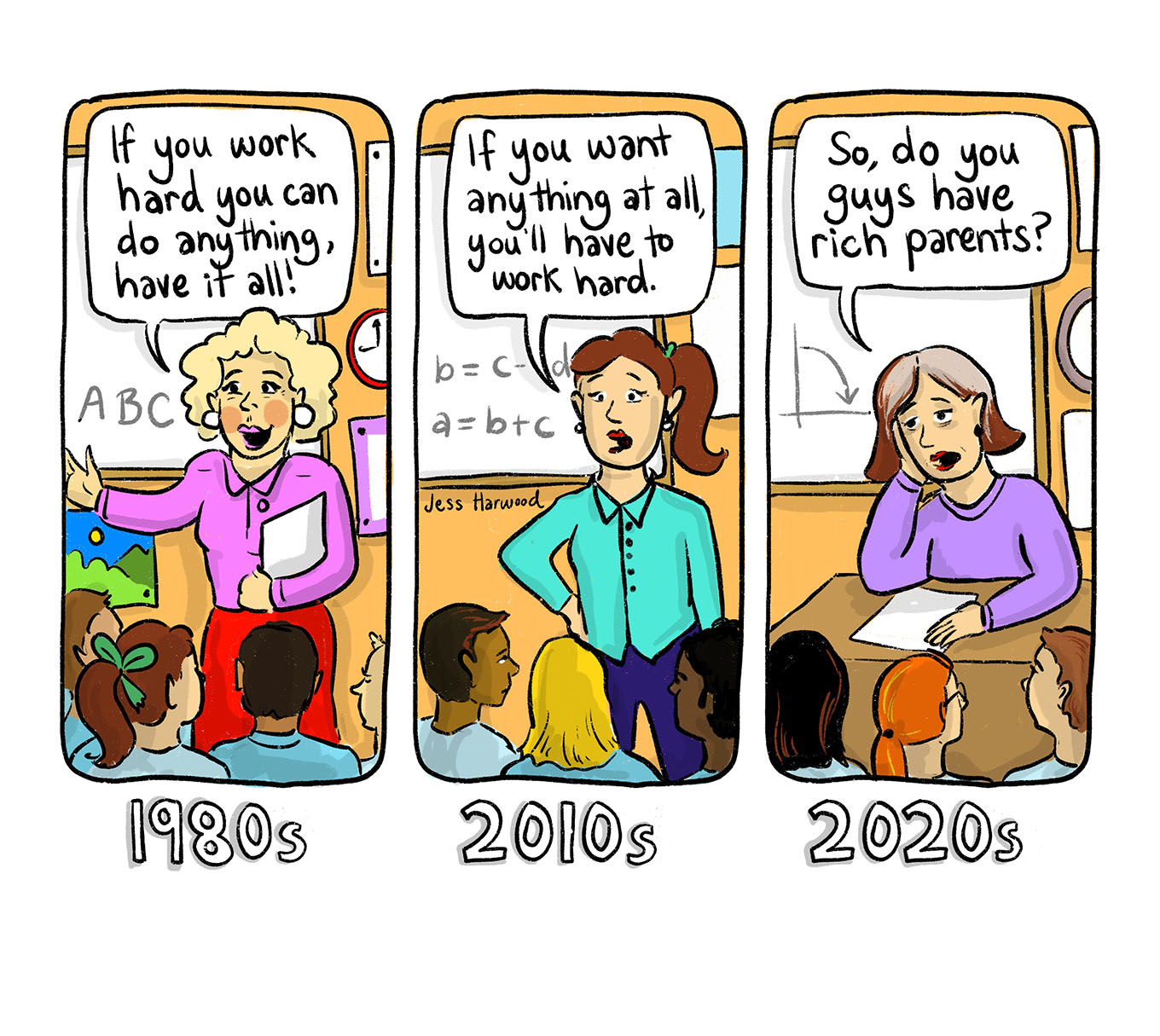
Predistribution is about pre-emption and prevention, and a critical element of upstream change that builds a better economy for all of us.
‘It is not enough to…try to balance the inequalities generated in the market through retrospective tax and transfer. It is necessary to transform and democratise the institutional content of the market economy, rather than just compensate for its inequalities.’ – Gabriella Ramos et al
Origin story
The term predistribution was coined by the American scholar Jacob Hacker who describes it as ‘market reforms that encourage a more equal distribution of economic power and rewards even before government collects taxes or pays out benefits’.
Predistribution’s political moment in the sun came in 2011 when Ed Miliband, then leader of the UK opposition Labour party, was in the audience for a speech that Hacker gave in Oslo. Miliband returned to the UK and – briefly – championed the idea.
But predistribution is one of the most important ideas that should be high on the political agenda. Let’s look at why it matters, what it is, how it plays out in practice, and the implications for policy.
What does predistribution mean?
The essence of the idea of predistribution is ensuring that the market economy does more of the heavy lifting in delivering a more balanced divvying-up of resources. British scholar Martin O’Neill explains it as ‘the particular ways in which the economy can be shaped to disempower the privileged and to empower the disadvantaged’. Its focus is on market mechanisms that determine the distribution of wages, profits, and other flows and stocks of money.
Government comes into the predistribution story via its role in creating and shaping markets so that the results are aligned with public goals: using rules, incentives and other levers to shape market outcomes. This includes boosting (or curtailing) the bargaining power of market players such as workers, employers, and wealth holders.
Therefore, it differs from government using tax and benefits to shape the distribution of economic resources after market outcomes have emerged: this is redistribution.
We’ll come to some specifics in a moment, but you could expect to see predistribution in the form of:
- Strong standards for workers (such as regulation, procurement, support for unions, and living wages).
- Regulation of the financial system and corporate governance; including provisions to stop harmful activities.
- Ensuring more people have a share of capital ownership, including owning businesses via worker or commubity cooperatives.
- Spending to bolster people’s opportunities and bargaining power in the labour market (think education and other public services: so they are not dependent on someone’s income) and groups like unions who can stand up for workers.
- Addressing how affordable certain goods and services are (for example, via price caps, subsidies, or direct provision): rather than only focusing on how much money is in people’s pockets; also being concerned with how far it stretches.
Why it matters
Inequality arises in and can be addressed via two realms. Firstly, what is sometimes called the ‘primary’ realm of work, wages and occupational pensions, and then in the secondary realm comprising taxes and benefits. Predistribution is about action in the primary realm. Here the wages that workers earn are the outcome of ‘a complex process of implicit and explicit bargaining between workers, employers, and (where they exist) unions’: the influence of each compared to the others matters, and is a function of various rules and regulations.
This is of interest to anyone interested in economic inequality because this realm is where the bulk of the balance or imbalance of economic resources arises: the ‘biggest single factor in determining the distribution of market income is the relative shares going to wages on the one hand and to capital incomes (rent, interest, dividends, and capital gains) on the other’.
In Australia, ‘capital gains arising from accumulated wealth have produced large increases in passive, unearned income that have added further to the wealth of the rich‘.
Evidence from around the world bears this out too: in global terms, four fifths of inequality stems from what was going on prior to the government getting involved via tax and transfers, with only one fifth being the result of tax and transfers. The lower levels of inequality in Europe ‘cannot be explained by more equalizing tax and transfer systems… “Predistribution”, not “redistribution,” explains why Europe is less unequal than the United States’, according to Blanchet, Chancel and Gethin.
So, there are a range of reasons which mean that predistribution is worth focusing when thinking about how to achieve a more balanced distribution of economic resources:
- Redistribution is not enough. As Hacker says, taxation and benefit payments ‘cannot do the work on their own’.
- In contrast, predistribution can shift substantial levels of resources, more so than would be possible via taxes and benefits.
- Thus, Hacker talks of predistribution as ‘where the action is’. The problem is that in recent decades, policy decisions of various governments (such as privatisation, deregulation of finance, patent and copyright laws, union rights) have shaped markets in ways that enable more wealth extraction. As a result ‘markets have been shaped in ways that have benefited those at the top far more than those in the middle and bottom’.
- Predistribution, in contrast, does not require government to spend substantial quantities of public money. Instead, in reducing inequality at source governments can generate fiscal savings by reducing the need for spending downstream (on benefits), thus freeing resources to spend elsewhere.
- There are a range of real politik reasons why redistribution is harder to pull off:
- Policies that are about spending (for example welfare payments) are challenging politically given concerns (reasonable or otherwise) about budget deficits and overall debt.
- Governments that do seek to be proactive on the redistribution front often face resistance and even backlash, as Hacker describes. He explains that the wealthiest have a tendency to complain – loudly – about increased taxes on their income and wealth.
- Inequality itself can undermine the political context necessary for government to be able to pursue a tax and spend redistribution agenda.
- On the other hand, it is often easier to harness the ‘political space’ for action on predistribution measures than it is for taxing and benefits provision.
- Finally, although not noted by its original proponents, predistribution also matters because of the growing recognition that economic growth-based agendas are incompatible with keeping the world’s environment within planetary boundaries. Redistribution tends to rely on the economic growth: grow, tax, and spend back via welfare. So taking the science around the environmental limits to growth seriously compels consideration of mechanisms to ensure a good life for more people without having to rely on the grow and redistribute recipe.
Implications for action
Convinced that predistribution is worth getting behind? Superb. What might you want to think about encouraging – or, if you happen to work in the right place in government, actually implementing?
Actions that policy makers need to be prepared to implement to promote predistribution include:
- Support for worker owned cooperatives (for example, via reduced taxes, simplified legislation, and education of ancillary services so they are more supportive of cooperatives).
- Legislation for worker rights and conditions (such as job security, being able to request flexible schedules and access to paid leave for family care).
- Regulations to strengthen the position of trade unions (what Hacker describes as a ‘countervailing power’) and corporate governance that puts workers on company boards.
- Enactment, and enforcement of minimum wages set at the level of living wages.
- Curbing extremes of high pay (for example, increased taxes when CEO to median pay exceeds a certain ratio).
- Broad based service provision that bolsters people’s endowment of human capital (such as decent education, vocational training, and health services).
- Addressing affordability of basic needs (for example, via provision of affordable housing, price caps on important services, and competition policy).
- Support for people who would otherwise struggle in the labour market to access good jobs (perhaps even a job guarantee).
- Regulation of financial markets and promotion of financial stability: for example, of how financial institutions behave (reducing high frequency trades, for instance); shifts in corporate governance; and ensuring capital flows to productive activities (rather than subsidising harmful activities and products).
- Promotion of fair trade.
- Taxation of wealth, in particular unearned wealth.
- Public procurement with social goals in contracts.
Conclusion
Predistribution is a critical lever for generating a more balanced distribution of wealth. It’s an upstream mechanism that heads off inequality before it arises by shaping market outcomes to be fairer, rather than depending on government to even things up once inequality has emerged. There are a range of actions governments and other economic players can take to predistribute economic resources. Now it’s time to start talking about it more and putting the changes in place to make the most of its potential to create the economy we could have!
NB A shorter version of this piece appeared in The Point: https://thepoint.com.au/opinions/260428-redistribution-or-predistribution-another-way-to-think-about-tackling-inequality
Download our printable/shareable resource about Predistribution.
Read ‘The economy we could have’: https://nexteconomy.com.au/work/the-economy-we-could-have-new-paper-out-now/
Check out the series: https://nexteconomy.com.au/work/new-series-building-the-economy-we-could-have/