
Earthworker Cooperative Network gives us a glance into a wellbeing economy in action, where workers build the things we need in a worker-owned factory in Morwell.
When writing ‘The economy we could have’, our Economic Change lead Dr Katherine Trebeck came across countless ‘Lego wins’. These were the examples of a wellbeing economy in action in Australia that we could look to for inspiration on the way forward, even if there aren’t enough of them yet to add up to complete system change.
A great example is in Victoria’s Latrobe Valley, where Earthworker Cooperative, Australia’s first worker-owned factory, operates several enterprises. This includes the Earthworker Energy Manufacturing Coop, which produces heat pumps and solar hot water systems – its function first and foremost: to serve its worker owners.
Earthworker has a vision that brings a wellbeing economy into practice:
“…a world in which people everywhere are able to democratically determine the means of their existence, collectively meeting their needs while recognising our interconnection with each other, other species, and the environment in which we exist.”
Earthworker has expanded to become a network of cooperatives that are committed to sustainability, both in social and environmental terms given the link between environmental harm and social injustice.
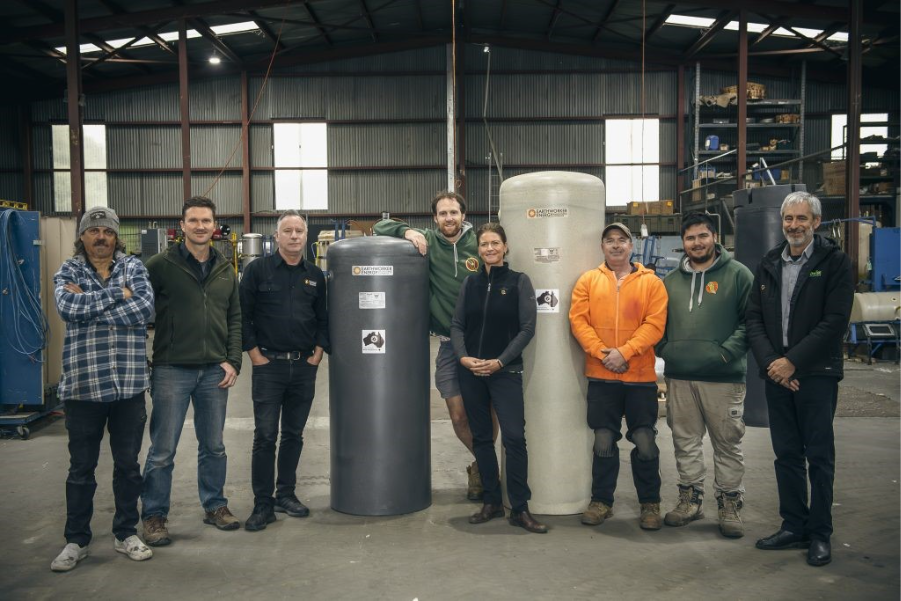
Inside the worker-owned Morwell Factory (Photo contributed by Earthworker for our report)
What co-ops make up the Earthworker network?
- Earthworker Energy Manufacturing Coop: produces new energy technology in Australia’s first worker-owned and run factory in the Latrobe Valley. Based in the Earthworker Morwell factory, it manufactures quality and high-performing stainless steel storage tanks for heat pump and solar hot water systems.
- Earthworker Smart Energy Cooperative helps households improve their home’s thermal efficiency and so their family’s comfort through assessments and draught-proofing. This in turn helps households save money and have more control over their energy use.
- The Earthworker Construction Cooperative provides residential construction, landscaping and maintenance services such as cabinet making, plumbing, pergola building, decking and more. Their motto is ‘Another world is being built’!
- Cooperative Power (CoPower) is an energy retailer jointly created by unions, environmental NGOs, community groups and Earthworker.
There is clearly purpose behind what is being delivered by these cooperatives. Worker ownership is a mechanism of predistribution (as financial wealth goes either to workers or to the enterprise) and of economic democracy that enhances people power. By enhancing energy efficiency and being part of the renewable energy roll out, Earthworker is also helping prevent environmental challenges getting worse. In providing job opportunities to those who might otherwise face unemployment, they prevent the harm of job loss.
So Earthworker speaks to all the ‘4Ps’ of a wellbeing economy in practice: purpose, prevention, predistribution, and people power. It demonstrates what we need more of to build an economy that serves people and planet.

What makes Co-ops part of a wellbeing economy?
A wellbeing economy requires a substantial shift in how the economy is thought about and approached, looking for ways to benefit people and planet rather than profit for the few.
Cooperatives (whether worker-owned co-ops, consumer co-ops such as groceries, or agricultural co-ops) are a great way to do this as they are owned, controlled and run by and for their members, creating economic democracy and a people-powered economy. They are democratically managed by ‘one member, one vote’, meaning everyone has an equal vote.
Co-ops enhance predistribution because surpluses go back to members or the enterprise, so community wealth that stays in the community.
Why Latrobe Valley
The Valley has largely powered Victoria with brown coal for a century. When the coal power stations and State Electricity Commission (SEC) were privatised* in the 1990s, thousands of people lost their jobs and Victorians lost ownership of this essential infrastructure. (*Although since 2024, the SEC has been partially revived as a government-owned renewable energy company, with legislation that specifically protects it from privatisation).
The number of people employed in the power industry dropped from about 11,000 in the late 1980s to about 2,600 in 2001, causing the population to shrink significantly with nine per cent of the region’s residents leaving between 1991 and 1996. (See also The Latrobe Valley, Victim of Industrial Restructuring by Bob Birrell)
Since then, the Valley has experienced high rates of disadvantage. In 2017 French-owned corporation Engie, announced the closure of Hazelwood mine and power station and roughly another 750 jobs were lost.
How did Earthworker seek to address this economic injustice?
The founders of Earthworker could see that the apparent conflict around jobs versus the environment wasn’t the full story and reflected a narrow lens. They recognised that there was a need to work together for just transition in the La Trobe Valley, and there was a dire need to create jobs that were better for workers and jobs that could contribute positively to the local community.
Latrobe is one region where this is necessary, many other regions are also on the frontlines of economic transition that must include solutions that put wellbeing at the core, and the principles of prevention, predistribution, people power and purpose.
Australians are dissatisfied with the status quo and open to rethinking economic priorities that put people first. Earthworker shows a different model of business that can build an economy that works for people and for planet as a foundation, rather than an afterthought.
Resources:
Read our full report: ‘The economy we could have.’
Check out more about Earthworker here.
Find out more about Co-ops at BCCM, the peak body in Australia for Co-ops and Mutuals.