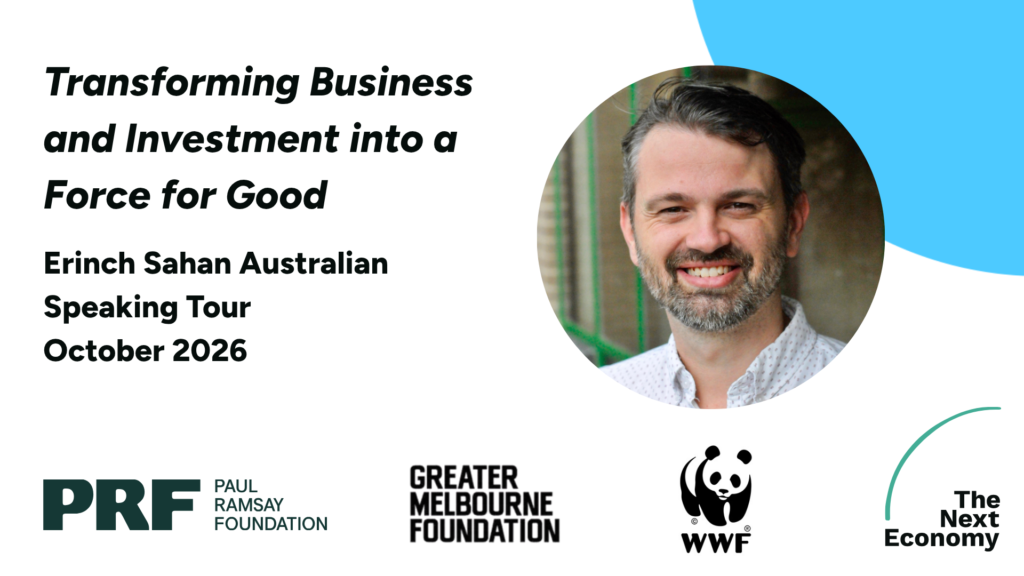
At The Next Economy, we are excited to team up with Erinch Sahan for his Australian tour to share ideas, provocations, and proof of what is possible in the world of business and investment.
Businesses and investment matter in Australia. They have a significant role in shaping economic, ecological, and social outcomes – for good, and sometimes for ill.So how can business and investment ensure that their activities and ways of working contribute to an Australia that future generations will be proud of?
Erinch is a globally renowned thought leader with expertise in business design and investment. Join us to hear from Erinch and widen the discussion about the critical role of business and investment in building the economy we could have. This is a rare opportunity to hear him speak in Australia and not to be missed!
Melbourne:
Transforming Business and Investment into a force for good. Erinch Sahan, with special guests from Regen Melbourne and Social Traders.
Join Erinch in conversation with special guests Tara Anderson, CEO of Social Traders, and Josh Devine, Collaboration and Investment lead at Regen Melbourne.
Together they will explore how Melbourne can become a place where purpose-led business is not the exception, but the new business as usual.
🌍 Hosted by: The Next Economy and Greater Melbourne Foundation with special guests from Regen Melbourne and Social Traders
🎟 Tickets: This event has passed.
Webinar hosted by The Next Economy:
Global lessons, regional opportunities: A special conversation with international thought-leader Erinch Sahan and The Next Economy’s Economic Program Director Katherine Trebeck and Land Program Director Jacqui Bell.
📅 Date: Thursday 8 October 2026, 10-11am, AEDT (9-10am AEST),
🎤Speakers: Erinch Sahan in conversation with Dr Katherine Trebeck and Jacqui Bell
Webinar hosted by ANU Planetary Health Equity Hothouse:
Redesigning business and finance to unlock economic transformations: Australian National University Saving the World Webinar.
📅 Date: Thursday 8th of October, 12.30pm-1.30pm
📍 Location: Online webinar
🎟 Tickets: This event has passed.
Sydney:
What would business look like if it worked for everyone?
Global thought leader Erinch Sahan will share ideas, provocations and real proof of what’s possible – followed by a panel discussion with Melina Morrison, CEO of Business Council of Co-operatives and Mutuals, Dr Belinda Russon, CEO of Tranby Aboriginal Co-operative Ltd, and Nathan Robertson-Ball, Founder of Finding Nature.
📅 Date: Wednesday 14 October, 2026
🕰️ Time: 6–8pm
📍 Location: Blue Gum Hall, Yirranma Place, 262 Liverpool St Darlinghurst
🌍 Hosted by: The Next Economy and Paul Ramsay Foundation
Erinch Sahan is an expert on making business work for good and is not to be missed during his Australian tour this October. Tickets are now available for Erinch’s public events. Find them all here.
Although Erinch Sahan grew up in Sydney, he has spent decades abroad working across academia, civil society, government and business to bring genuine sustainability and long-term thinking to the business community that can build the economy we could have. He currently works to lead the Joseph Rowntree Foundation in their mission to align their £400 million endowment in support of a just and sustainable future.
Supported by The Next Economy, with help from partners at Paul Ramsay Foundation, WWF Australia, and Greater Melbourne Foundation, Erinch is returning to home soil this October to share his expertise, passion and lessons learned along the way. Ahead of his visit, TNE caught up with him to talk all things business and investment and how we can make sure that the business and investment community is a force for good, rather than ill.
The time for a fresh approach is well and truly here and Erinch is wonderfully positioned to bring this vision to Australia.
What have you missed about Australia since you were last here 14 years ago?
There’s a down-to-earth quality about Australia that I miss. I remember that sense of scepticism towards anything that presents itself as too high-and-mighty or ‘elite’. Some might call it tall poppy syndrome.
To me, this is about Australian culture being about not taking yourself too seriously and scrutinising hierarchies. It’s that sense of egalitarianism that I remember coming through in subtle ways.
I didn’t appreciate this dynamic when I lived in Australia, but do now miss this, along with the beaches, eucalyptus and food culture (particularly across the rich multicultural mosaic of suburbs I remember from across Sydney and Melbourne).
We have been exploring predistribution: the idea that we need fairer market outcomes by design, not just redistribution after the fact. From your vantage point in business design, where do companies have the most leverage to predistribute?
Our economies increasingly reward capital more than they reward labour, even where productivity has grown. As a result, I think we need to redesign for two objectives:
Structurally better distribution of upside and profit: Workers and communities benefitting as co-owners and co-governors – as partners alongside financial capital
Operationally better practices: Better wages and working conditions (especially through deeper collaboration with and empowerment of trade unions), and fairer pricing with suppliers and business partners (to enable distributive and regenerative practices across these business partners)
These can create a virtuous cycle, with better designed structures unlocking fairer practices and vice versa. And both together forge deeper partnerships for businesses, drive greater innovation and ultimately lead to more resilient businesses. It is about shared prosperity, purpose beyond extraction of value and true long-termism.
Worker cooperatives and community ownership models keep appearing as examples of businesses that serve place. You’ve seen these up close through the World Fair Trade Organisation (WFTO) and Doughnut Economics Action Lab (DEAL). What are some of the successes you have seen and what makes the difference between a cooperative that genuinely transforms a local economy and one that stays marginal?
Too often cooperatives and other shared ownership models become confined to industries, markets and contexts that have low potential for wealth generation. They are deployed where mainstream capital doesn’t want to flow and operate where margins are slim and commercial viability is an uphill climb.
This is often for good reason, as parts of the economy or market that are ignored by mainstream business and finance can often be vital for a community (e.g. a community shop, a care business that operates where there is high need but low profitability, or a business focused on skilling-up people who need the most support). Or often, these models are used in businesses that are beginning to deliver government services. These are valuable, often essential businesses.
But we need to spread shared ownership models to businesses with high growth prospects too. Imagine if all of Silicon Valley was dominated by businesses owned and governed like Wikipedia? Or if AI was developed through a platform cooperative or steward ownership structure? We could shape the businesses that will shape the world and ensure that the wealth generated is directed in service to life.
There are exciting examples of governments, businesses and investors doing things differently: but they’re often described as ‘niche’ or ‘exceptional’ – we call them ‘Lego wins’ as they’re building blocks of what’s possible. In your experience, what’s holding back the mainstream from adopting these models, and is that barrier shifting?
I find predicting the path to unlock a rapid expansion of distributive and regenerative models is extremely hard, and perhaps impossible.
Is it through government policy that shifts the playing field – e.g. tax breaks to convert business ownership or procurement to genuinely favour such models?
Is it through government regulation of the worst kinds of business practices to ‘level the playing field’ – through pricing of ecological and social harms, deep supply chain regulations, banning of practices that give extractive businesses a cost advantage?
Or is it through pioneering innovations that demonstrate what is possible even in regulatory and financial systems that are stacked against such businesses?
I think the answer is all of the above – everywhere all at once. I think policymakers are emboldened by pioneering action that seems to be gaining momentum in the world of business and finance. It gives them cover against people making the claim that action is anti-business and ‘bad’ for the economy. And pioneers in business and finance are emboldened by a sense that policymakers are interested in a transformation of the economy, and policy-action is around the corner. They don’t want to be left high and dry if they act boldly.
A sense of inevitability is needed to shift structures and cultures. A narrative change. It builds slowly, until it reaches a tipping point of authentic and spreading belief that these ideas are not for the margins, but are beginning to sweep into the mainstream economy.
They are diverse, innovative and designed around the realities of what people need and designed within the realities of this living planet. How all this unfolds, how it is sequenced, and which actions lead to which change… well I don’t know. But I see how all of these trigger each other and put wind in the sails of the deeper narrative shift around how the world of business and finance could be and will be.
Tickets are now available for Erinch’s public events! See all his events and find out more here.
The economic development framework, Community Wealth Building, is receiving increasing attention worldwide after Scotland passed a law that brings the framework to a whole country and our last instalment of ‘Building the economy we could have’ explored the history of the concept and how it works (See our explainer here). To better understand what it looks like in practice for Australia, The Next Economy’s Economic Change Project Officer Josie Foster sat down with Annie Smits and Bill Mithen, Co-CEOs of Neighbourhood Economics to discuss how they’re applying the framework to Norlane and Corio in Victoria.
Their motto? A fair economy isn’t impossible, it’s overdue.
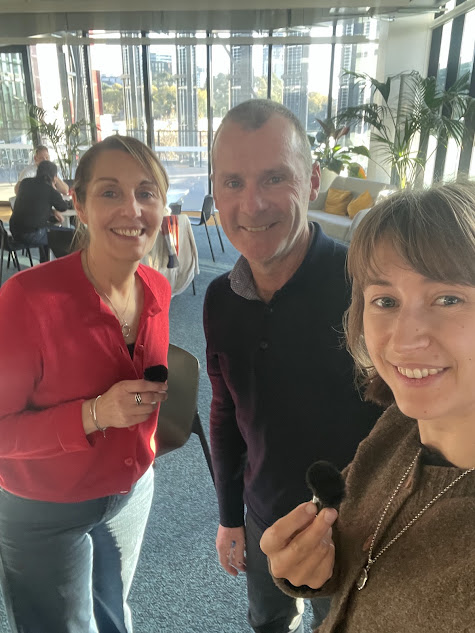
Josie from TNE and Annie and Bill from Neighbourhood Economics
What is Neighborhood Economics all about?
Annie: Neighborhood Economics is committed to places of disadvantage and thinking about those places and re-imagining those places through an economic lens. Part of our theory sits in the idea that places of disadvantage often get looked at through a health lens, or an education lens, or a services lens, but rarely through an economic lens, and if we don’t think about local economies, we won’t shift the conditions of places like Norlane and Corio, which is where we’re working,
Why did you pick Norlane and Corio as the location to pilot Neighborhood Economics?
Bill: Norlane is the most disadvantaged place in the state for Victoria, and Corio is the fourth most. I’ve worked in Geelong for a long time, it’s where I grew up, and I currently live. We both worked in places where disadvantage is prevalent and have seen that things in places of entrenched disadvantage just don’t shift, it doesn’t matter the amount of capital or labour or time or effort that people put in, the conditions stay the same.
Norlane and Corio are two of those places. There’s also been a significant amount of work done in Geelong on entrenched disadvantage, so we feel like starting in a place where the preconditions are already set and organised, made sense.
Can you tell us about the industrial history of Norlane and Corio?
Bill: Norlane and Corio have a story that is similar to lots of places that have been left behind, where they powered the industrial transformation of the Australian economy and the manufacturing part of the Australian economy, and as that has changed over time to become a more services-based economy, these places have often been left behind. They were typically working-class places that had – in Norlane and Corio’s circumstance – large manufacturers; Ford being one. There’s an oil refinery that still exists in Corio [and] International Harvester had their head office there too.
Going back a bit further, there was a whisky distillery as well. There were big manufacturing organisations and businesses that employed lots of people. And as globalisation came in, as trade conditions changed within nations, and tariffs shifted, as a country we really became unviable in those industries, and so they shut down. This meant a whole heap of jobs left with them, and the nature and identity of those suburbs changed forever.
What drew you to Community Wealth Building?
Annie: Community Wealth Building is a practical economic development framework that has five levers that can be pulled to shift the economy in a place. The reason we go to the economy is because fundamentally the economy is the starting point of disadvantage and inequality, and if we don’t start at that place, we won’t get to actually shift the conditions of a place. We’ll do good things for people or with people, but people will remain locked in or locked out of participation in an economy and continue to be left behind.
Bill: The levers are essentially; land, labour, ownership, finance and procurement. So that’s using land for local benefit, having a finance system that supports local institutions and local organisations, doing more socially beneficial procurement, having greater plurality or democratic ownership and having a just labour market.
Annie: One of the other things within Neighbourhood Economics that Bill and I talk about all the time is what we call “our matters” – the things that matter in economic development that have been left out of how we talk about local economies. They are democratic ownership, shared value, distributed power, and human connection.
Democratic ownership is important because if we don’t go to the heart of ownership – who owns what and how wealth is concentrated – we will never push back on this sense of extraction and wealth accumulation.
Shared value goes to this sense of whoever creates value in the system is rewarded at that place, including the environment and First Peoples. Distributed power, which sits right alongside democratic ownership, is how do we distribute power and decision making differently and closer to the action or the people. Then human connection – if we’re well connected as human beings and see ourselves in the other, it’s less likely that I’m going to extract from you or take from you in inappropriate ways.
How has this idea been received in the local area?
Bill: We’ve just released a suite of reports, and in the production of those we’ve talked to lots of people. We talked to just under 20 business owners in Norlane and Corio, from very small corner shops and retail stores to large manufacturing businesses. We’ve spoken with nine “anchor” institutions – these are larger organisations that have economic power and can really control the economic trajectory of a place. We sat down and interviewed nine CEOs of those organisations, and then we also had these kitchen table conversations with about 40 odd residents of Norlane and Corio to really understand what life’s like and how the economy actually works and what they experience in the day-to-day life.
Community Wealth Building is not necessarily new for Geelong, because there’ve been organisations and people have talked about it for a little while, although it’s having a bit of a moment. There is a good sense of goodwill from those bigger organisations and civic and business leaders to try and do something, and this is another reason why we chose Norlane and Corio. What they’re not sure about is what to do and so to have a framework that is different – and there’s an acknowledgement that we have to do something different – that has got some proven capability internationally, there’s a bit of interest and excitement about that. Harnessing that and turning intention into action is going to be part of our trajectory.
Who is responsible for making community wealth building happen?
Annie: All levels of government, but it can’t be left to just one. What we’re finding is that there’s lone voices within government that are supportive, and that will hopefully grow momentum. At all levels of government, there is conversation around the fact that we need to shift things around how our economy functions. Sometimes other groups are using the term “wellbeing economy”, which is not exactly the same, but it’s parallel and heading in the same direction.
Bill: The connection with the wellbeing economy is important. The way I articulate it or see it is that a wellbeing economy is the thing we need. We need an economy that places wellbeing at the centre. How you do that is through using the framework of community wealth building. There is more to it than that, but that’s one of the reasons why we chose Community Wealth Building, because it’s really practical.
Annie: We would say also that there’s this sense at all levels of government it can’t just be left to local councils, it can’t just be left to federal government, it can’t just be left to state government, and it’s not just Treasury, or it’s not just the Premier’s office. It’s got to be across government that there’s a buy-in on this, and it’s really interesting that, like, in Victoria, for example, that the Victorian Department of Health and VicHealth have really led the conversation around wellbeing and the connection of wellbeing and economy and a healthy functioning economy. So, this doesn’t just sit with Treasury, or with the economic and finance people; it sits right across government and at all levels of government and other places as well.
What are you hearing from some of the people who may have been left behind economically?
Bill: A range of things. Mostly ambition. The people we spoke to want all the same things that we all want. There were stories of neighbours connecting with each other and helping each other and supporting each other. There were stories of regeneration and people finding a place to be in Norlane and Corio that was really helpful to them. But there were also heaps of other stories that aren’t anywhere near as positive. These were about the difficulties of unemployment and the fact that systems – disability, employment, health, housing or otherwise – almost feel like they’re actively working against their well-being rather than trying to support them. But people were incredibly grateful to be heard, which was humbling.
What would you like to see happen to bring community wealth building to areas in Australia?
Bill: Community Wealth Building is still relatively unknown, which is a challenge, so the more people that know about it the better. One of the things we talk about is: what stopped Community Wealth Building from becoming either the dominant or a dominant practice of economic development? What are the barriers to it? Probably the biggest barrier is the status quo of power. How you break and shift that is really difficult. But people knowing about it, what it is and what it isn’t, is really important. People seeing that it actually is an economic development framework that is legitimate and reasonable, and can work, and is able to be used to build people’s wealth and their wellbeing is really important that it’s not just a fringe idea. It can be done by mainstream economic development. It’s just a choice.
And your final thoughts?
Bill: The big thing about Community Wealth Building for me at the moment is that it’s so much more than three words that you put in a sentence, even though that’s how many people will understand it. It’s actually an economic development framework that has five levers that you need to pull and shift and change all at the same time. There’s a lot of work in it, and we will do ourselves a great disservice if we don’t hold ourselves true and focus on exactly what it is.
Annie: I agree. For Bill and I in creating Neighbourhood Economics, part of our frustration was that both of us had done a fair amount of work in economic development, and we probably potentially worked in one, a single lever, but then found the frustration of ‘why hasn’t this shifted something’, and so the really important piece is that we’re pulling multiple levers to reimagine local economies.
At The Next Economy, we are excited to team up with Erinch Sahan for his Australian tour to share ideas, provocations, and proof of what is possible in the world of business and investment.
Businesses and investment matter in Australia. They have a significant role in shaping economic, ecological, and social outcomes – for good, and sometimes for ill.So how can business and investment ensure that their activities and ways of working contribute to an Australia that future generations will be proud of?
Erinch is a globally renowned thought leader with expertise in business design and investment. Join us to hear from Erinch and widen the discussion about the critical role of business and investment in building the economy we could have.
Who is Erinch Sahan?
Growing up in Sydney in the 1980s and 1990s to Turkish immigrant parents, he began his professional life in the corporate sector, and from there, has increasingly focused on making businesses a positive force in the world.
His experience is varied: he has been CEO of the World Fair Trade Organization, a senior associate at the Cambridge Institute for Sustainability Leadership, and recently the Business and Enterprise Lead at Doughnut Economics Action Lab. He is currently leading the investment portfolio at the UK’s Joseph Rowntree Foundation (JRF), driving its move to mission-related investing.
TNE’s Economic Change Program Director, Dr Katherine Trebeck, has worked with Erinch over the years and is constantly inspired by his ability to question what business can do and how it needs to change to enhance its positive impact. She describes him as “not just one of the boldest thinkers in business design, but someone who shares incredible case studies and stories of innovative business leaders delivering tangible impact”.
Earthworker Cooperative Network gives us a glance into a wellbeing economy in action, where workers build the things we need in a worker-owned factory in Morwell.
When writing ‘The economy we could have’, our Economic Change lead Dr Katherine Trebeck came across countless ‘Lego wins’. These were the examples of a wellbeing economy in action in Australia that we could look to for inspiration on the way forward, even if there aren’t enough of them yet to add up to complete system change.
A great example is in Victoria’s Latrobe Valley, where Earthworker Cooperative, Australia’s first worker-owned factory, operates several enterprises. This includes the Earthworker Energy Manufacturing Coop, which produces heat pumps and solar hot water systems – its function first and foremost: to serve its worker owners.
Earthworker has a vision that brings a wellbeing economy into practice:
“…a world in which people everywhere are able to democratically determine the means of their existence, collectively meeting their needs while recognising our interconnection with each other, other species, and the environment in which we exist.”
Earthworker has expanded to become a network of cooperatives that are committed to sustainability, both in social and environmental terms given the link between environmental harm and social injustice.
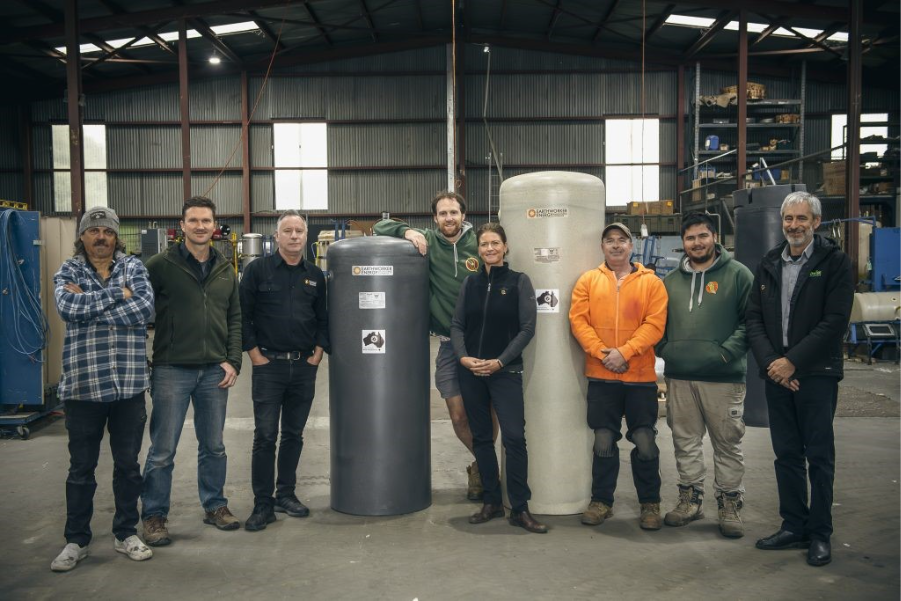
Inside the worker-owned Morwell Factory (Photo contributed by Earthworker for our report)
What co-ops make up the Earthworker network?
Earthworker Energy Manufacturing Coop: produces new energy technology in Australia’s first worker-owned and run factory in the Latrobe Valley. Based in the Earthworker Morwell factory, it manufactures quality and high-performing stainless steel storage tanks for heat pump and solar hot water systems.
Earthworker Smart Energy Cooperative helps households improve their home’s thermal efficiency and so their family’s comfort through assessments and draught-proofing. This in turn helps households save money and have more control over their energy use.
The Earthworker Construction Cooperative provides residential construction, landscaping and maintenance services such as cabinet making, plumbing, pergola building, decking and more. Their motto is ‘Another world is being built’!
Cooperative Power (CoPower) is an energy retailer jointly created by unions, environmental NGOs, community groups and Earthworker.
There is clearly purpose behind what is being delivered by these cooperatives. Worker ownership is a mechanism of predistribution (as financial wealth goes either to workers or to the enterprise) and of economic democracy that enhances people power. By enhancing energy efficiency and being part of the renewable energy roll out, Earthworker is also helping prevent environmental challenges getting worse. In providing job opportunities to those who might otherwise face unemployment, they prevent the harm of job loss.
So Earthworker speaks to all the ‘4Ps’ of a wellbeing economy in practice: purpose, prevention, predistribution, and people power. It demonstrates what we need more of to build an economy that serves people and planet.
Earthworker’s logo, showing symbols of the Australian environmental and labour movements.
What makes Co-ops part of a wellbeing economy?
A wellbeing economy requires a substantial shift in how the economy is thought about and approached, looking for ways to benefit people and planet rather than profit for the few.
Cooperatives (whether worker-owned co-ops, consumer co-ops such as groceries, or agricultural co-ops) are a great way to do this as they are owned, controlled and run by and for their members, creating economic democracy and a people-powered economy. They are democratically managed by ‘one member, one vote’, meaning everyone has an equal vote.
Co-ops enhance predistribution because surpluses go back to members or the enterprise, so community wealth that stays in the community.
Why Latrobe Valley
The Valley has largely powered Victoria with brown coal for a century. When the coal power stations and State Electricity Commission (SEC) were privatised* in the 1990s, thousands of people lost their jobs and Victorians lost ownership of this essential infrastructure. (*Although since 2024, the SEC has been partially revived as a government-owned renewable energy company, with legislation that specifically protects it from privatisation).
Since then, the Valley has experienced high rates of disadvantage. In 2017 French-owned corporation Engie, announced the closure of Hazelwood mine and power station and roughly another 750 jobs were lost.
How did Earthworker seek to address this economic injustice?
The founders of Earthworker could see that the apparent conflict around jobs versus the environment wasn’t the full story and reflected a narrow lens. They recognised that there was a need to work together for just transition in the La Trobe Valley, and there was a dire need to create jobs that were better for workers and jobs that could contribute positively to the local community.
Latrobe is one region where this is necessary, many other regions are also on the frontlines of economic transition that must include solutions that put wellbeing at the core, and the principles of prevention, predistribution, people power and purpose.
Australians are dissatisfied with the status quo and open to rethinking economic priorities that put people first. Earthworker shows a different model of business that can build an economy that works for people and for planet as a foundation, rather than an afterthought.
Australia’s economy may appear strong on the surface, but beneath the bonnet lie deep structural challenges: from rising inequality and insecure work to ecological breakdown. These demand more than piecemeal fixes; they need upstream economic transformation.
Our Economic Change lead, Dr Katherine Trebeck, alongside Josh Devine from Regen Melbourne, hosted a workshop at Progress 2026 on going upstream for this economic transformation. Progress is the largest social justice conference in Australia, with more than 1,500 people attendees, 140 speakers from across the world and 60 sessions on how to win the change we need for people and planet. Here are some insights from the workshop.
Katherine Trebeck and Josh Devine from Regen Melbourne at Progress 2026.
The roots of the problems
The workshop opened with a provocative question from Frances Moore Lappé: “Why are we collectively creating a world that none of us as individuals actually want?”
Using upstream thinking, which is where attendees traced these symptoms to deeper economic roots rather than just looking downstream at the problems this system creates, they came up with the causes of these issues. These included corporate capture, extractive production systems, property as investment rather than shelter, deunionisation, and incentives that prioritise profits over social benefits.
The vision: naming the world we want
Rather than spending all our time on the problems of today, the group also imagined alternatives to our current economic system. Drawing inspiration from Regen Melbourne, Indigenous wisdom, and The Next Economy’s regional research, participants named what a better economy needed to deliver: dignity, fairness, connection, and ecological care.
“Lego wins” as glimmers of light
The workshop celebrated existing examples of positive change, what we refer to as ‘Lego wins’, the instances of what we need more of to build the economy we could have. Examples of these wins pointed to by the participants included:
Community ownership: Hepburn Wind, energy co-ops, housing cooperatives
Food systems: Oz Harvest, food co-ops, farmers markets, Buy Nothing groups
Environmental action: Kelp farming, native nurseries, rooftop solar uptake
Social infrastructure: Community gardens, third spaces, community toy and tool libraries
Policy wins: Social procurement policies, minimum rental standards, Medicare
These examples demonstrate that alternative economic models are already emerging across Australia.
Dominant mindsets
Yet these ‘Lego wins’ are not yet adding up to systemic change at the scale and pace needed. Pervasive myths and assumptions lock policy into inadequate downstream efforts. Some of these myths and assumptions called out by workshop participants include:
Productivity leading to higher living standards for everyone
Fiscal responsibility being more important than environmental stewardship
Humans are primarily selfish and competitive (homo economicus)
Welfare as a ‘burden’ rather than social good
Economics is a science with hard, unchangeable rules
Rising inequality, insecure work and ecological breakdown reveal deep structural problems in Australia’s economy that demand more than piecemeal fixes. ‘The economy we could have’ workshop showed that these issues are not inevitable — they’re the result of choices shaped by power and values — and that alternative economic models are already emerging across the country.
Read the report‘The economy we could have’ for more details on where we can go to from here.
📢 Stay tuned: In the coming months, we’ll be releasing a series that dives deeper into the glimmers of light we see in Australia for building ‘The economy we could have’.
Jacqui Bell leads The Next Economy’s land sector work. In this Q&A, she shares her reflections on a pivotal year for agriculture and land use change, how climate risk, investment and policy began to converge in 2025, and what this means for building fair, resilient and regenerative landbased economies.
Why is the land sector important to Australia’s economic transition?
The land sector sits right at the intersection of Australia’s biggest transitions. It’s where climate risk is already being felt most acutely, where adaptation and mitigation must happen together, and where decisions about land use directly shape regional economies, food systems, biodiversity, and community wellbeing.
Unlike energy or industry, the land sector isn’t one thing. It’s a bundle of economic activities – agriculture, forestry, conservation, carbon, water, mining, infrastructure – all competing for the same finite resources. How land is owned, valued, used and governed determines what’s possible economically, socially, culturally and environmentally.
As climate impacts intensify and global markets shift, how we use land, as well as value and manage the ecosystem services it provides will increasingly inform whether Australia builds resilience and shared value – or locks in deeper inequities and long-term risk.
Looking back on 2025, what were the defining points for Australia’s land sector?
2025 felt like a year where multiple threads finally came together. There was a sense of catch‑up across policy, investment and public conversation about the role the land sector plays in Australia’s transition to net zero and nature‑positive outcomes. Long‑awaited strategies and initiatives began to land, and programs like the CRC for Net Zero Agriculture started to gain more traction, signalling that agriculture and land use were no longer being treated as peripheral to the transition.
One of the most significant shifts we have seen through our work, is a growing readiness to mainstream more regenerative and climate‑resilient approaches into farming. Twenty years ago, farmers experimenting with regenerative practices were often working against the system. In 2025, we saw the enabling conditions begin to stack up: policy drivers, market signals, climate realities and finance are pointing in the same direction. That alignment as well as other broader socioeconomic factors is creating a real tipping point in willingness to rethink how production systems work across different landscapes.
At the same time, the year exposed just how slow and fragmented our economic systems still are. There is a lot of innovation happening on farms, in communities and in pockets of investment, but it’s uneven and difficult to scale. Capabilities, ownership structures, planning frameworks and institutional inertia continue to lock in existing patterns of land use, even as the need for change becomes more urgent.
Climate risk also became much harder to ignore. The National Climate Risk Assessment brought sharper visibility to the conditions landholders and regions will need to endure in coming decades – and, in some parts of Australia, where certain land uses and farming systems may not even be viable long-term.
Overall, 2025 wasn’t a year of resolution, but it was a year of these shifts (and many others) coming to the surface. The challenges facing the land sector became more visible, the stakes more explicit, and the imperative for coordinated, place‑based and just approaches to land use change much harder to push aside.
What are the biggest challenges facing Australia’s land sector right now?
Complexity and cumulative pressure are the defining challenges.
Landholders and regional communities are dealing with climate impacts, market volatility, policy uncertainty, workforce shortages, rising costs, and rapid land use change – all at the same time. These pressures aren’t additive; they’re compounding.
Climate risk is no longer theoretical. We’re seeing clearer projections of extreme heat, water scarcity, flood and drought cycles that fundamentally question the long-term viability of some farming systems and, in some places, human habitation. In northern Australia, for example, the growing number of extreme heat days raises real questions about labour, productivity, liveability and safety.
At the same time, investment and ownership structures are shifting. Institutional investors are becoming more sophisticated about climate risk and land value, enabled by digital technologies and data. That has the potential to drive innovation – but it can also accelerate consolidation, change land use rapidly, and create unintended consequences for regional economies and communities.
Jacqui talking nature and land use trade-offs at the Better Futures Forum in 2024.
What does a climate-safe, regenerative and socially-just land sector look like in practice?
In practice, it’s not a single model – it’s place specific.
A climate safe land sector integrates mitigation and adaptation, rather than treating them as separate goals. It supports farming systems that are resilient to heat, water variability and extreme events, while restoring soils, biodiversity and natural capital over time. In practice, that looks like more diverse and resilient farm systems, healthier landscapes, and multiple income streams that reward stewardship as well as production.
A regenerative approach becomes mainstream not just because it’s ‘better’, but because the conditions finally stack up: policy settings, market signals, climate realities and finance are aligning in ways they weren’t 20 years ago. Back then, early adopters were pushing uphill. Today, there’s a genuine tipping point in readiness and willingness to do things differently.
This isn’t just a shift at the farm level – it’s a broader system transition across supply chains, finance and policy that makes different choices viable at scale.
Social justice means recognising power and equity: who owns land, who benefits from new markets, who carries risk, and who gets left behind. In the Australian context, it also means recognising and partnering with First Nations land stewards and cultural knowledge. It means designing transitions that support producers to continue producing good food – rather than pushing risk down the supply chain or hollowing out regional communities.
There are real trade-offs and tensions to navigate, but the direction of travel is now much clearer (albeit still looking very messy)!
How are farmers, landholders and Traditional Owners already leading this transition?
A lot of leadership is already happening on the ground, often ahead of policy.
Farmers have been experimenting with regenerative practices, climate smart production, on-farm business diversification and new business models for decades. What’s changed is the visibility and validation of that work – as well as the growing recognition that adaptation is an economic necessity, not just an environmental choice, and that there are some challenges that are better addressed at a region or landscape scale than at the farm level.
Traditional Owners are also leading innovation, particularly where land management, cultural knowledge and economic development intersect. Land and Country are the foundations for First Nations economic sovereignty, and there’s huge potential for Indigenousled approaches to land stewardship to deliver economic, cultural and ecological outcomes – if the right structures and capital are in place.
What we often see, though, is fragmentation: great practice, limited coordination, and insufficient system level support to scale what’s working.
What policy changes would help speed up the shift to fair and sustainable land use?
One of the biggest gaps is in planning and coordination.
Our land use planning systems are no longer fit for purpose. They weren’t designed to manage cumulative impacts, rapid transitions, or competing demands like renewable energy, conservation, food production, infrastructure and critical minerals – all at once.
The EPBC Act reforms late last year signalled a stronger role for environmental protection and nature positive outcomes through development, which is important. A big question will be how these changes interact with land use, regional economies and cumulative development pressures.
On their own, regulatory reforms won’t deliver good outcomes. Without integrated planning, clear pathways for development, and genuine engagement with communities, we risk creating more friction and uncertainty on the ground.
Integrated regional planning could be transformative if done well – bringing these competing uses together in a coordinated way, identifying clear priorities, managing trade-offs deliberately, and setting upfront rules about where development should and shouldn’t occur. Done poorly, it risks entrenching conflict or shifting impacts onto communities without their input. The decisions made – from zoning and go/no go areas to approval pathways – will determine who benefits and who bears the cost of transition.
More broadly, we need policy that recognises climate adaptation as a core economic function, not an afterthought which aligns investment, land use and community outcomes over the long term. Good policy will require this work to happen with communities, not to them – with early and meaningful involvement in shaping land use decisions.
Finally, what excites you about this work?
What excites me is that we’re at a moment where the questions are finally shifting.
There’s growing recognition that climate risk is a socio-economic issue, that adaptation matters as much as transition, that technology and innovation on farm is just one part of the Ag sectors transition, and that finance and climate investment decisions are driving change across Australia.
All of these and more are creating greater opportunity and imperative to explore and demonstrate what good economic transitions looks like – and how getting it right in regions and on the ground can support the land sector to shift in a way that helps Australia navigate uncertainty, restores nature, and builds an economy that genuinely serve communities – not just markets.
Australia’s economy has delivered prosperity for some, but left many behind. The divides in housing, health, income and opportunity are widening — and they’re not inevitable. They’re the result of decisions, shaped by values and power.
It doesn’t have to be this way.
Across Australia and around the world, communities are already building alternatives — from cooperative energy projects and regenerative food systems to new legal frameworks and circular design. These examples show that change is not only possible: it’s already happening.
In this one-hour session, The Next Economy CEO Lizzie Webb joins lead author Katherine Trebeck to unpack insights from The Economy We Could Have — a new paper that looks under the bonnet of the Australian economy and reveals how we can move beyond isolated ‘Lego wins’ toward a wellbeing economy that prioritises dignity, fairness, connection and ecological care.
📅 Date: Thursday, 12pm AEST (1PM AEDT), 4 December 2025
📍 Location: Online
🎟 Tickets: This event has already happened – watch the video below!
🎤 Speakers: The Next Economy CEO Lizzie Webb in conversation with lead author Katherine Trebeck.
Australia’s economy looks strong on the surface, but behind the averages lie deep divides in housing, work, health and opportunity. Our new paper, The Economy We Could Have, asks what our economy is really designed to do, who it is working for, and how it can support people’s wellbeing.
Australia is at a pivotal moment. While headline statistics suggest strong performance, looking under the bonnet of these numbers reveals widening divides in housing, health, income, and opportunity. Rising inequality and climate disruption demand a closer look at our economic system: what is it designed to do – and who benefits?
The Economy We Could Have explores how Australia’s economic story has shifted over the decades, the divides created along the way, and the alternatives already being built. It sets out practical steps for governments, enterprises and communities to move beyond isolated “Lego wins” and instead embed a wellbeing economy – one that puts dignity, fairness, connection and ecological care at its centre.
As lead author, Katherine Trebeck, puts it:
Transformational change is possible. Australia has done it before – from Medicare to minimum wages – and we can do it again.
The challenge
The paper traces Australia’s shift from predistribution – fair wages and public investment – to a model marked by precariousness, asset accumulation, and financial advantage for a few. It also highlights how system-compliant fixes and short-term crisis responses can stall deeper progress.
One in seven Australians live in poverty. Many face insecure work, unaffordable homes and stretched services that respond to crisis rather than prevent it. These outcomes are not inevitable. They are the result of decisions – shaped by values and power – that have concentrated advantage for some and shifted risks onto others.
The alternatives
The good news that is change is possible. The economy is a human-made system, and it can be redesigned. Across the country, communities are already showing what that momentum for change is growing. Australians are increasingly dissatisfied with the status quo and open to rethinking economic priorities.
One promising framework is the wellbeing economy, which according to the Wellbeing Economy Alliance can deliver the following needs:
There are plenty of examples of these goals already being delivered in practice:
Earthworker Cooperative (Latrobe Valley, VIC)
Australia’s first worker-owned factory, producing solar hot water systems to serve its worker-owners.
Food Connect Shed (Brisbane, QLD):
A cooperative food enterprise owned by 500+ ‘careholders’, rooted in equity and regeneration.
Marlinja Power Project (NT):
Community-installed solar panels and battery storage enabling near energy self-sufficiency – an example of climate resilience.
Governments are beginning to respond. The Federal Government’s Measuring What Matters statement is expanding how national success is defined, incorporating indicators for health, sustainability, and social cohesion. In Victoria, the Early Intervention Investment Framework is embedding preventative health and social approaches into budget decisions, valuing long-term wellbeing over short-term fixes.
Australia’s future depends on whether we can move beyond piecemeal reforms to embrace systemic change. By learning from community-led initiatives and adopting frameworks like the wellbeing economy, we can build a more inclusive, resilient, and caring society – one that works for everyone.
Regional Councils play a critical role in ensuring renewable energy development is fair, well managed and delivers lasting local value. Drawing on our work with regions, The Next Economy is mapping how Councils contribute at each stage of the development pathway to secure long-term community benefits.
Lisa Lumsden, Senior Project Officer facilitating group discussion with local government leaders at the Regional Leaders Summit, Newcastle August 2025.
We know our place really well and we put our communities at the forefront of our decisions
Council participant at the inaugural Regional Leaders Summit, August 2025, Newcastle
Councils across Australia are being pragmatic and strategic about renewable energy development in their region – focussing on what they can do to make the most of the situation, to minimise impacts and leverage the potential for the long-term local outcomes they want.
So, what is involved in achieving that?
In short – A lot.
Drawing on work in regions such as Uralla and Hay as well as recent workshops at the Regional Leaders Summit and Gippsland New Energy Conference, The Next Economy has developed insights into the activities Councils are implementing to improve the outcomes of renewable energy development and create shared strategic value across Australia.
In mapping these over the last few months the following two groups of Council activities have emerged:
1. Development Pathway Activities: These capture the types of actions Councils can take at different stages of the renewable energy project development pathway to:
ensure community participation and development that is shaped by local knowledge and priorities;
manage unwanted impacts on the community, local infrastructure, environment and local economy, and;
facilitate development in a way that creates lasting value.
The development pathway mapping helps to answer questions such as:
What community engagement activities, plans and documents help Councils demonstrate they are representing their region, and at what stage of the renewable energy development pathway should that work happen?
What service and infrastructure upgrades – from roads and housing to water and waste – need to be prioritised to minimise local disruptions, development delays, and to leverage improved long term infrastructure outcomes for the community?
Timing is a critical factor for these activities, with many needing to be addressed, at or before, different points along the renewable energy development pathway (spanning pre-feasibility, through to construction, operation and end of life).
2. Foundational Council Activities – These arethe essential, ongoing work that underpins the Development Pathway Activities and help to form part of the enabling environment for strong regional partnerships through development. The foundations include:
Capacity and capability building
Leadership, coordination and collaboration
Advocacy and inclusion
Regular, clear and honest communication and engagement with the community
Lisa Lumsden, Senior Project Officer, notes:
Councils can and are contributing to local outcomes from renewable energy development…these insights highlight how critical it is to resource Councils and regional leaders appropriately.
The Next Economy is continuing to bring these insights together, working with regional leaders and Councils to get feedback and explore how best to share them – both to highlight the solutions being pioneered locally and to inspire and support other regions across Australia grappling with similar changes and opportunities.
Between February and June 2023, The Next Economy explored a range of perspectives among Latrobe Valley community leaders with regards to the energy transition.
The project involved hosting a series of interviews and workshops that engaged 31 community members, including First Nations people and young people, people from the multicultural community, grassroots environment groups, small businesses and the social service sector.
The report makes visible the wealth of experiences, insights and knowledge that exists in communities across the region and demonstrates how the local community can be a valuable partner in working towards good transition outcomes for the Latrobe Valley region.
The main project finding is that community members see a range of potential benefits from the energy transition, beyond job creation and Australia’s national decarbonisation agenda. If managed well, the transition could provide opportunities to transform the systems that underpin society, the regional economy, and people’s relationship with the local environment.
The key themes presented in the report are:
Socio-economic disadvantage, equity issues and liveability
Community Participation
Institutional capacity and good governance
Environmental protection, remediation and rehabilitation
First Nations leadership
New energy development
Regional economic development
Workforce development
To find out more, download a copy of the What Next? Community Perspectives on the Energy Transition in the Latrobe Valley.
We recently made a submission to the senate enquiry into the closure of the Hazelwood and Yallourn power stations in Victoria. This submission responds to the three points listed in the inquiry Terms of Reference, outlined below:
(a) impact of the closure of the Hazelwood Power Station on the economy and jobs of the Latrobe Valley, and the success or otherwise of economic recovery efforts to date;
(b) expected economic impacts of the proposed closure of Yallourn Power Station in 2028 and options the State Government can pursue to offset the loss of more than 1,000 direct jobs from the plant, as well as associated contractors;
(c) success or otherwise of the Latrobe Valley Authority (LVA) to help the region transition, in light of the decline of funding made available to the LVA over successive State Budgets.
The Next Economy has trained over 300 people working in environment, climate and social service organisations on how to work effectively with regional communities. This has included members of: