
The economic development framework, Community Wealth Building, is receiving increasing attention worldwide after Scotland passed a law that brings the framework to a whole country and our last instalment of ‘Building the economy we could have’ explored the history of the concept and how it works (See our explainer here). To better understand what it looks like in practice for Australia, The Next Economy’s Economic Change Project Officer Josie Foster sat down with Annie Smits and Bill Mithen, Co-CEOs of Neighbourhood Economics to discuss how they’re applying the framework to Norlane and Corio in Victoria.
Their motto? A fair economy isn’t impossible, it’s overdue.
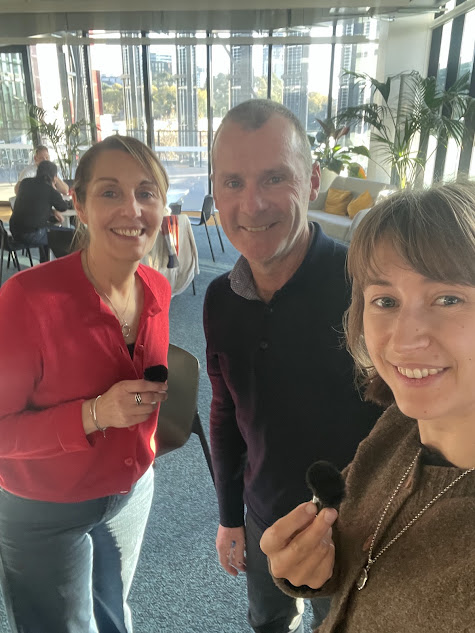
What is Neighborhood Economics all about?
Annie: Neighborhood Economics is committed to places of disadvantage and thinking about those places and re-imagining those places through an economic lens. Part of our theory sits in the idea that places of disadvantage often get looked at through a health lens, or an education lens, or a services lens, but rarely through an economic lens, and if we don’t think about local economies, we won’t shift the conditions of places like Norlane and Corio, which is where we’re working,
Why did you pick Norlane and Corio as the location to pilot Neighborhood Economics?
Bill: Norlane is the most disadvantaged place in the state for Victoria, and Corio is the fourth most. I’ve worked in Geelong for a long time, it’s where I grew up, and I currently live. We both worked in places where disadvantage is prevalent and have seen that things in places of entrenched disadvantage just don’t shift, it doesn’t matter the amount of capital or labour or time or effort that people put in, the conditions stay the same.
Norlane and Corio are two of those places. There’s also been a significant amount of work done in Geelong on entrenched disadvantage, so we feel like starting in a place where the preconditions are already set and organised, made sense.
Can you tell us about the industrial history of Norlane and Corio?
Bill: Norlane and Corio have a story that is similar to lots of places that have been left behind, where they powered the industrial transformation of the Australian economy and the manufacturing part of the Australian economy, and as that has changed over time to become a more services-based economy, these places have often been left behind. They were typically working-class places that had – in Norlane and Corio’s circumstance – large manufacturers; Ford being one. There’s an oil refinery that still exists in Corio [and] International Harvester had their head office there too.
Going back a bit further, there was a whisky distillery as well. There were big manufacturing organisations and businesses that employed lots of people. And as globalisation came in, as trade conditions changed within nations, and tariffs shifted, as a country we really became unviable in those industries, and so they shut down. This meant a whole heap of jobs left with them, and the nature and identity of those suburbs changed forever.
What drew you to Community Wealth Building?
Annie: Community Wealth Building is a practical economic development framework that has five levers that can be pulled to shift the economy in a place. The reason we go to the economy is because fundamentally the economy is the starting point of disadvantage and inequality, and if we don’t start at that place, we won’t get to actually shift the conditions of a place. We’ll do good things for people or with people, but people will remain locked in or locked out of participation in an economy and continue to be left behind.
Bill: The levers are essentially; land, labour, ownership, finance and procurement. So that’s using land for local benefit, having a finance system that supports local institutions and local organisations, doing more socially beneficial procurement, having greater plurality or democratic ownership and having a just labour market.
Annie: One of the other things within Neighbourhood Economics that Bill and I talk about all the time is what we call “our matters” – the things that matter in economic development that have been left out of how we talk about local economies. They are democratic ownership, shared value, distributed power, and human connection.
Democratic ownership is important because if we don’t go to the heart of ownership – who owns what and how wealth is concentrated – we will never push back on this sense of extraction and wealth accumulation.
Shared value goes to this sense of whoever creates value in the system is rewarded at that place, including the environment and First Peoples. Distributed power, which sits right alongside democratic ownership, is how do we distribute power and decision making differently and closer to the action or the people. Then human connection – if we’re well connected as human beings and see ourselves in the other, it’s less likely that I’m going to extract from you or take from you in inappropriate ways.
How has this idea been received in the local area?
Bill: We’ve just released a suite of reports, and in the production of those we’ve talked to lots of people. We talked to just under 20 business owners in Norlane and Corio, from very small corner shops and retail stores to large manufacturing businesses. We’ve spoken with nine “anchor” institutions – these are larger organisations that have economic power and can really control the economic trajectory of a place. We sat down and interviewed nine CEOs of those organisations, and then we also had these kitchen table conversations with about 40 odd residents of Norlane and Corio to really understand what life’s like and how the economy actually works and what they experience in the day-to-day life.
Community Wealth Building is not necessarily new for Geelong, because there’ve been organisations and people have talked about it for a little while, although it’s having a bit of a moment. There is a good sense of goodwill from those bigger organisations and civic and business leaders to try and do something, and this is another reason why we chose Norlane and Corio. What they’re not sure about is what to do and so to have a framework that is different – and there’s an acknowledgement that we have to do something different – that has got some proven capability internationally, there’s a bit of interest and excitement about that. Harnessing that and turning intention into action is going to be part of our trajectory.
Who is responsible for making community wealth building happen?
Annie: All levels of government, but it can’t be left to just one. What we’re finding is that there’s lone voices within government that are supportive, and that will hopefully grow momentum. At all levels of government, there is conversation around the fact that we need to shift things around how our economy functions. Sometimes other groups are using the term “wellbeing economy”, which is not exactly the same, but it’s parallel and heading in the same direction.
Bill: The connection with the wellbeing economy is important. The way I articulate it or see it is that a wellbeing economy is the thing we need. We need an economy that places wellbeing at the centre. How you do that is through using the framework of community wealth building. There is more to it than that, but that’s one of the reasons why we chose Community Wealth Building, because it’s really practical.
Annie: We would say also that there’s this sense at all levels of government it can’t just be left to local councils, it can’t just be left to federal government, it can’t just be left to state government, and it’s not just Treasury, or it’s not just the Premier’s office. It’s got to be across government that there’s a buy-in on this, and it’s really interesting that, like, in Victoria, for example, that the Victorian Department of Health and VicHealth have really led the conversation around wellbeing and the connection of wellbeing and economy and a healthy functioning economy. So, this doesn’t just sit with Treasury, or with the economic and finance people; it sits right across government and at all levels of government and other places as well.
What are you hearing from some of the people who may have been left behind economically?
Bill: A range of things. Mostly ambition. The people we spoke to want all the same things that we all want. There were stories of neighbours connecting with each other and helping each other and supporting each other. There were stories of regeneration and people finding a place to be in Norlane and Corio that was really helpful to them. But there were also heaps of other stories that aren’t anywhere near as positive. These were about the difficulties of unemployment and the fact that systems – disability, employment, health, housing or otherwise – almost feel like they’re actively working against their well-being rather than trying to support them. But people were incredibly grateful to be heard, which was humbling.
What would you like to see happen to bring community wealth building to areas in Australia?
Bill: Community Wealth Building is still relatively unknown, which is a challenge, so the more people that know about it the better. One of the things we talk about is: what stopped Community Wealth Building from becoming either the dominant or a dominant practice of economic development? What are the barriers to it? Probably the biggest barrier is the status quo of power. How you break and shift that is really difficult. But people knowing about it, what it is and what it isn’t, is really important. People seeing that it actually is an economic development framework that is legitimate and reasonable, and can work, and is able to be used to build people’s wealth and their wellbeing is really important that it’s not just a fringe idea. It can be done by mainstream economic development. It’s just a choice.
And your final thoughts?
Bill: The big thing about Community Wealth Building for me at the moment is that it’s so much more than three words that you put in a sentence, even though that’s how many people will understand it. It’s actually an economic development framework that has five levers that you need to pull and shift and change all at the same time. There’s a lot of work in it, and we will do ourselves a great disservice if we don’t hold ourselves true and focus on exactly what it is.
Annie: I agree. For Bill and I in creating Neighbourhood Economics, part of our frustration was that both of us had done a fair amount of work in economic development, and we probably potentially worked in one, a single lever, but then found the frustration of ‘why hasn’t this shifted something’, and so the really important piece is that we’re pulling multiple levers to reimagine local economies.
Find out more and about Neighbourhood Economics: https://neighbourhoodeconomics.org.au/
Check out our series, ‘Building the economy we could have’ for more.