This instalment of ‘Building the economy we could have’ explores Community Wealth Building and how this approach can bring health and social benefits while building resilient communities to better weather turbulent times.
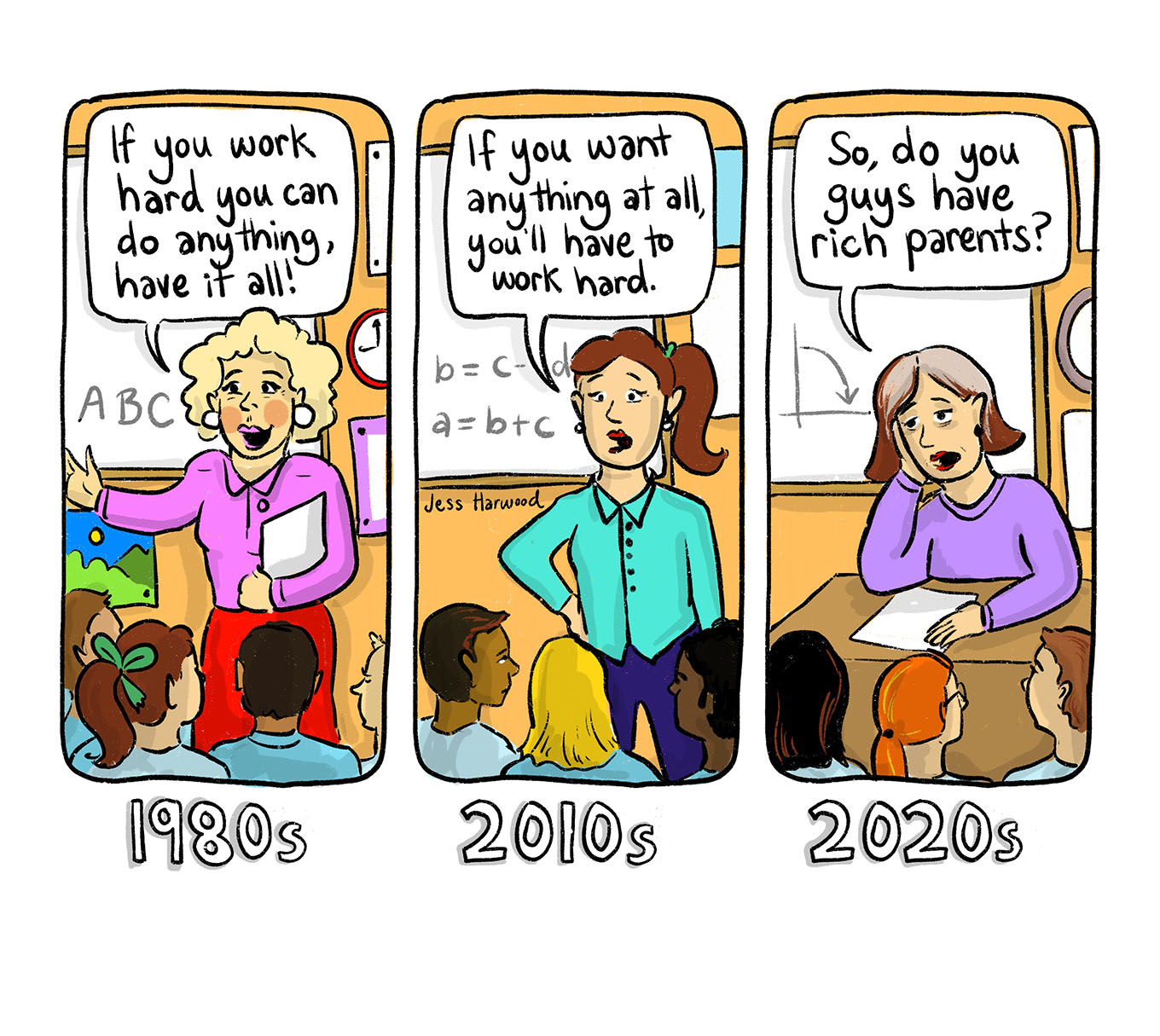
A decade ago, one in twenty Australians rated their life satisfaction as very low. Today it’s one in ten: nearly 2.2 million people now living below what statisticians call the “wellbeing poverty line. It happened while the economy, by its official scorecard, kept growing. But growing for who?
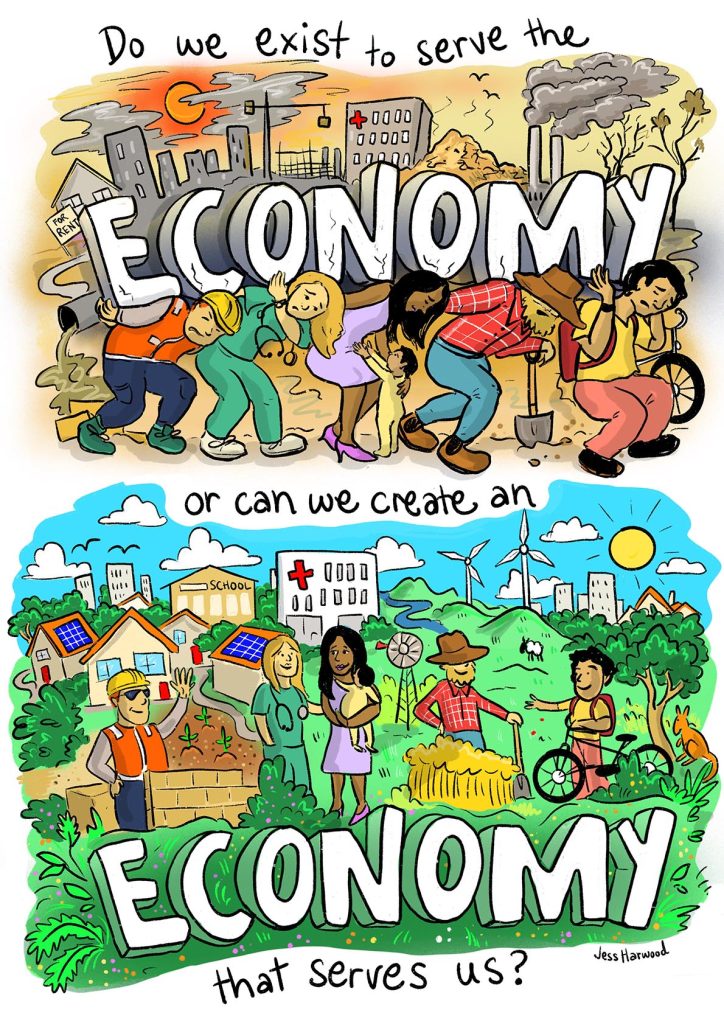
It’s clear Australians want healthy and thriving local economies that work for people and our environment, not profit alone and a different approach is needed to make sure wealth is shared and kept locally.
It’s in this environment that the economic development strategy of Community Wealth Building has started attracting increasing interest. But what is it? And what can it offer us here in Australia?
What is Community Wealth Building?
Community Wealth Building is an alternative to the trickle-down assumptions of a growth-first model of economic development. It puts people at the centre of the decisions made, with a focus on predistribution of wealth, ownership and resources, making sure it is designed from the start to genuinely work for people and provide long-term, lasting changes in the economy, addressing the root causes of inequality and poverty (See Predistribution).
There are five main pillars that guide Community Wealth Building:
- Progressive procurement of goods and services 💸 (Spending): Using anchor institutions, such as local government and big employers like hospitals, universities and other public institutions, to harness their procurement to bolster local supply chains and support local business development, spending, and investment.
- Fair employment and just labour markets 👷♀️(Workforce): Using these same anchor institutions and worker-owned cooperatives to ensure employment practices and wages are fair, pay a living wage and create more opportunities for equitable and local economic participation and control over work.
- Socially productive use of land and property 🏡(Land and property): Public land and property assets are used to create shared wealth for people, bringing local land and development under community control.
- Making financial power work for local places 🏦 (Finance): Wealth and savings are harnessed and reinvested for the local community using public and community banks and credit unions as well as targeting superannuation investments.
- Plural ownership of the economy ♻️ (Inclusive ownership): The promotion of different business ownership models to build wealth for local communities, such as cooperatives, social enterprises, public ownership.
History
Community Wealth Building emerged as an economic development model in 2005, through the work of The Democracy Collaborative, who describe themselves as an ‘Action-oriented Think-Do Tank’ in Cleveland, USA and in the work of The Centre for Local Economic Strategies (CLES) in the UK.
Community Wealth Building came about from the desire to create economic democracy and a path forward that built fairness into the model of our economic system, inspired by the Civil Rights movement and the New Deal in the US as well as successful worker cooperatives such as Mondragon Corporation in Spain.
The Cleveland and Preston models
In 2008, Evergreen Cooperatives was set up to bring Community Wealth Building from concept to reality in Cleveland, with Evergreen’s founders and local ‘anchor institutions’ helping to set up worker-owned cooperatives with the aim of creating high-quality jobs, making neighbourhoods vibrant and sharing economic ownership with the community.
Evergreen acquired small and mid-sized businesses, converting them to employee ownership, creating living wage jobs, training new employee owners and then providing ongoing business support to the worker cooperative. Evergreen Coops now include a commercial laundry, insulation services and a coffee roastery and cafes.
Across the Atlantic in the north of England, following the Global Financial Crisis of 2007/2008, Preston Council was facing severe cuts to the budget after the loss of over a billion pounds in government grants. The business-as-usual approach would have been to slash council services and supports, pushing more people into poverty and economic disadvantage without doing anything to support people to have employment and options for good quality jobs.
However, a Preston City Council representative attended an event in London with The Democracy Collaborative and one of their co-founders, Ted Howard. Ted was then invited to Preston to discuss Community Wealth Building, and from there, Preston worked to implement the pillars of Community Wealth Building via local anchor institutions.
In 2025, they celebrated ten years of the ‘Preston Model’, with outcomes that clearly demonstrated how aligning the economy with local need can be a mechanism to deal with other problems such as mental health, life satisfaction and wages.
In fact, The Lancet, the world-renowned medical journal, studied the model and found a reduced prevalence of depression, lowered antidepressant prescriptions, and improved life satisfaction. Plus, it raised the median wage 11 percent!
Preston proves something that most of us would have an idea about already: that a thriving local economy that keeps wealth flowing in the community provides economic improvements as well as health and wider societal benefits.
It also proves that an approach to mental health without addressing some of the root causes, such as economic insecurity and poverty, will simply be treating the symptoms, allowing the problems to continue (See Lifestyle Drift, The Economy We Could Have, Upstream Briefing)
Scotland brings the idea to life across a whole country
Scotland has recently passed a groundbreaking piece of legislation that introduces the benefits of Community Wealth Building across an entire country. The Community Wealth Building Act requires Ministers to publish a Community Wealth Building statement setting out the measures they intend to take to implement the pillars. Across Scotland, local authorities (local governments) will work with relevant public bodies to create and implement action plans for their area.
Neil McInroy, a leading expert working with CLES and The Democracy Collective who has also been an advisor to the Scottish Government on Community Wealth Building, states that the power of this is that it moves Community Wealth Building from something that is optional or opt-in, to something that is system-wide.
What is the potential for Australia?
Many regions in Australia are starting to ask how they can look at economic development differently, including those in which we have worked such as Hay in NSW and south west Queensland. The economic blueprint we worked on with the South West Queensland Regional Organisation of Councils, includes a possible first Community Wealth Building step: meeting with key anchor institutions in Roma to identify spending or contracts they could commit to prioritising local suppliers or First Nations organisations.
In Geelong, Annie Smits and Bill Mithen from Neighbourhood Economics are working to bring the concept to life in a place hit hard by previous waves of economic change where resources left. Norlane and Corio, two suburbs of Geelong, were once home to the Ford factory and auto industry, and today are two of the most disadvantaged communities in Australia.
Neighbourhood Economics joined with SGS Economics & Planning to launch a suite of new reports in May this year, including Community Wealth Building: What will it take? This report explores what’s standing in the way of adopting Community Wealth Building as a model of local economic development in Australia.
Other Australian Community Wealth Building activity includes:
- The City of Sydney, which released a discussion paper at the end of 2021 as a first step in the policy development process
- SGS Economics & Planning prepared a working paper on how Community Wealth Building could benefit Melbourne’s eastern region or the Victorian Government and the Eastern Region Group of Councils in 2024.
- The Paul Ramsey Foundation is exploring Community Wealth Building and the potential of place-based approaches.
- Hawkesbury Chamber of Commerce are also exploring the potential.
Our next instalment in this series will be an interview with Bill and Annie from Neighbourhood Economics on their work in Geelong and what is needed to bring Community Wealth Building to life in Australia.
Check out our series, ‘Building the economy we could have’ for more.