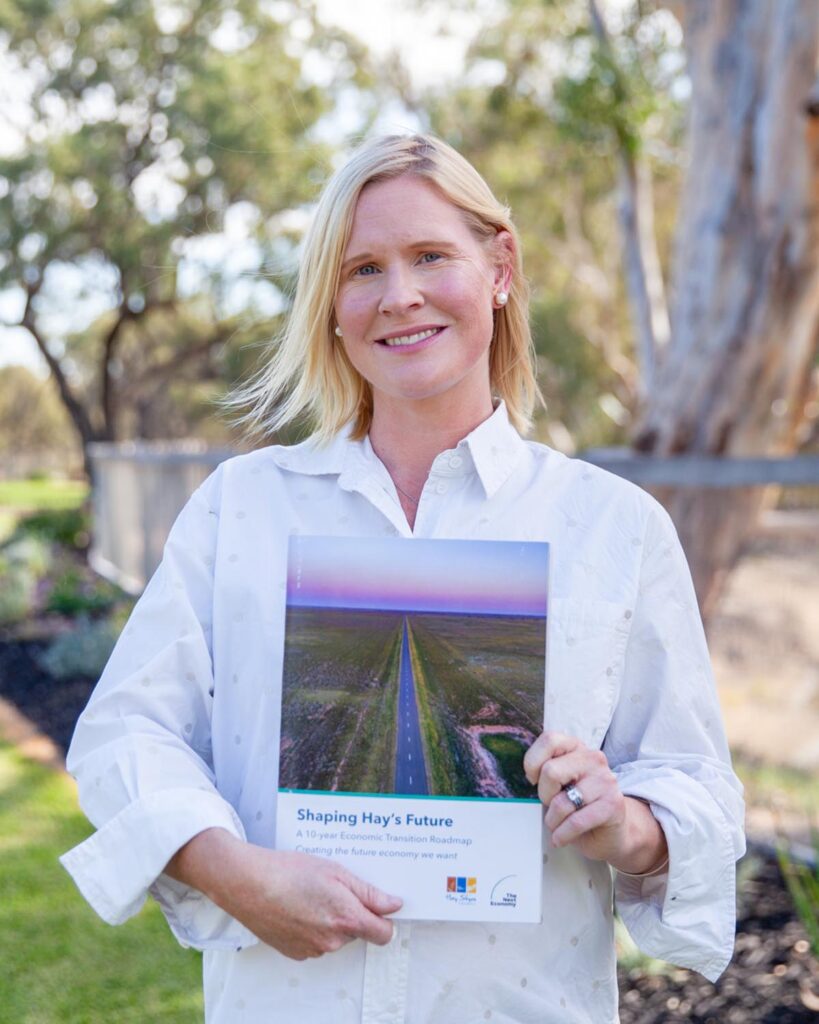
The Hay Economic Transition Roadmap is a practical, locally driven plan designed to strengthen the regional economy, build on agricultural and transport advantages and secure long-term local benefits from renewable energy developments underway.
Developed by the community and convened by Hay Shire Council with support from The Next Economy, it brings together community, business, industry and governments around a common direction for coordinated action.
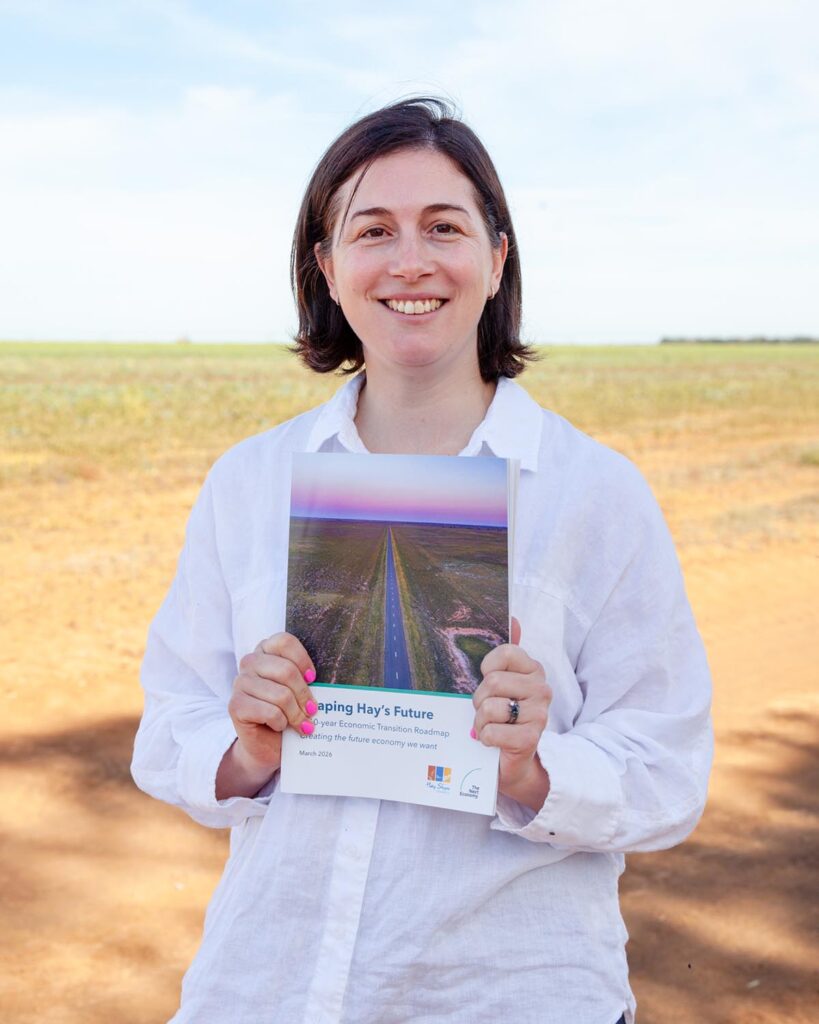
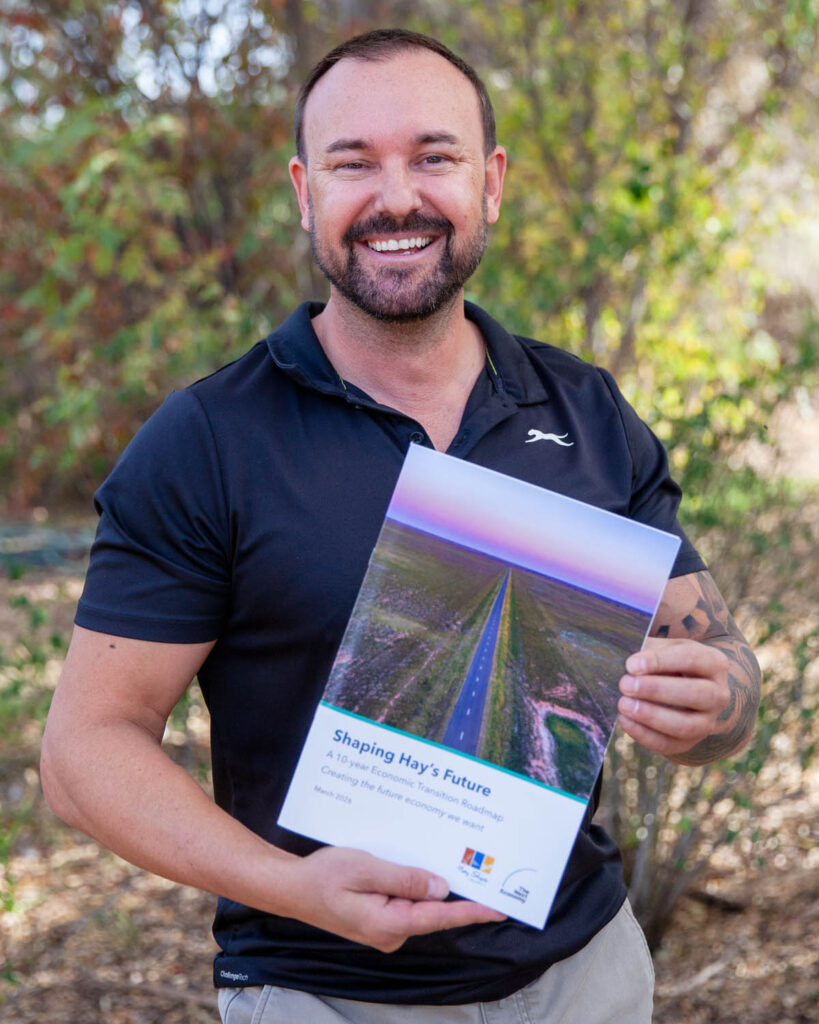
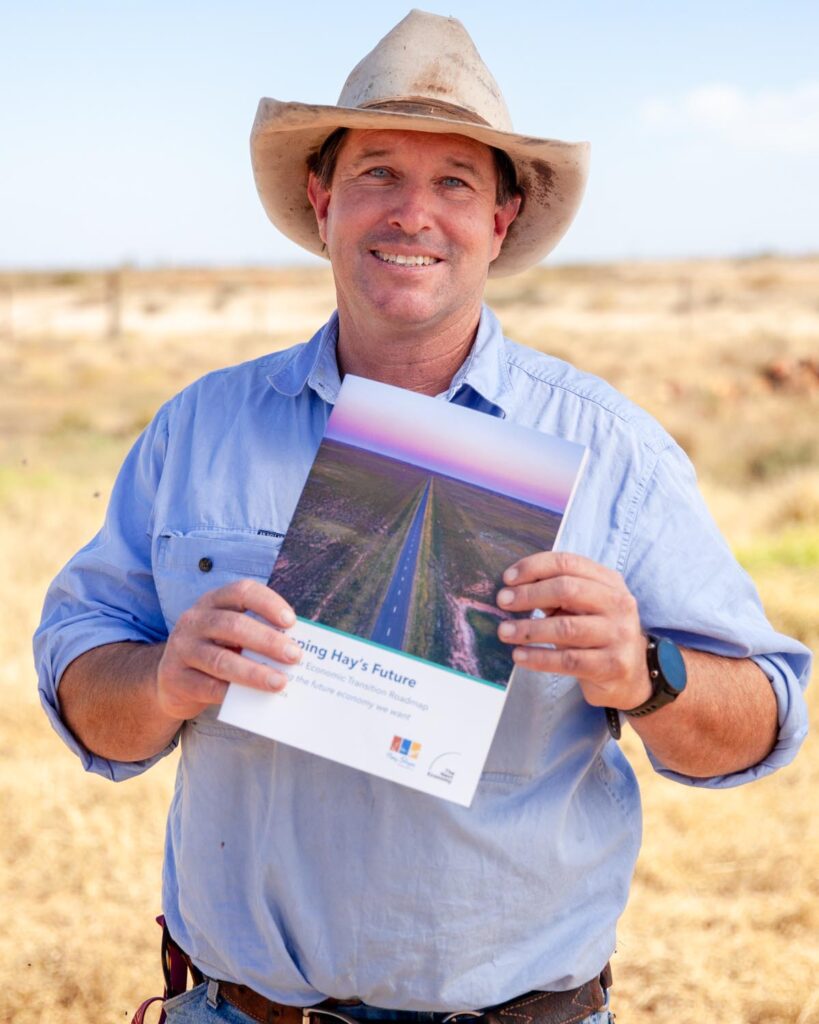
In April, we got to catch up with a few of the Hay community members who contributed to the Roadmap, and to hear what they had to say about the opportunities, challenges and momentum already building on the ground.
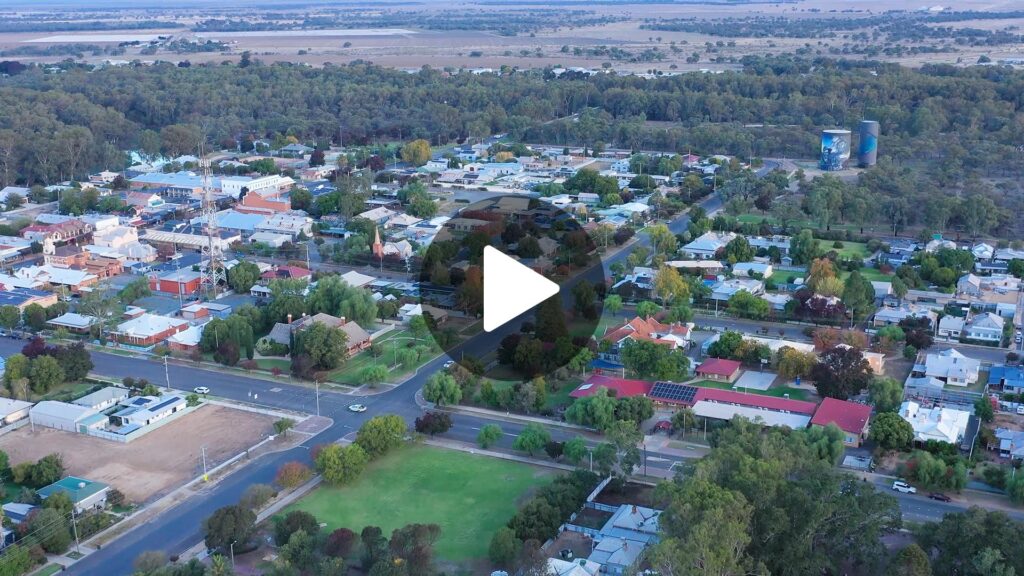
Check out our main Roadmap video, then dive into what members of the Hay community had to say below.
“We’re looking at what we can do that uses renewable energy to generate things that our farm and local industry need. A part of that is looking at a hydrogen plant.”
“The roadmap is important to Hay because it secures Hay’s future. Knowing that there’s jobs and opportunities for future generations. We’ve got to keep up with the times and Hay has to do that as well.”
– Gary Brown, business owner, Hay Newsagency and Alpha1 Property
“The Roadmap will help support our endeavours in agriculture here, because if we can bring secondary income to a lot of these primary production properties it gives us the benefit of having a sound other income stream.”
“Hay’s history to date has been on predominately agriculture returns. Now going forward we’ve got that opportunity to pick up secondary industry … If the region wins, then we all win together and that’s a great outcome.”
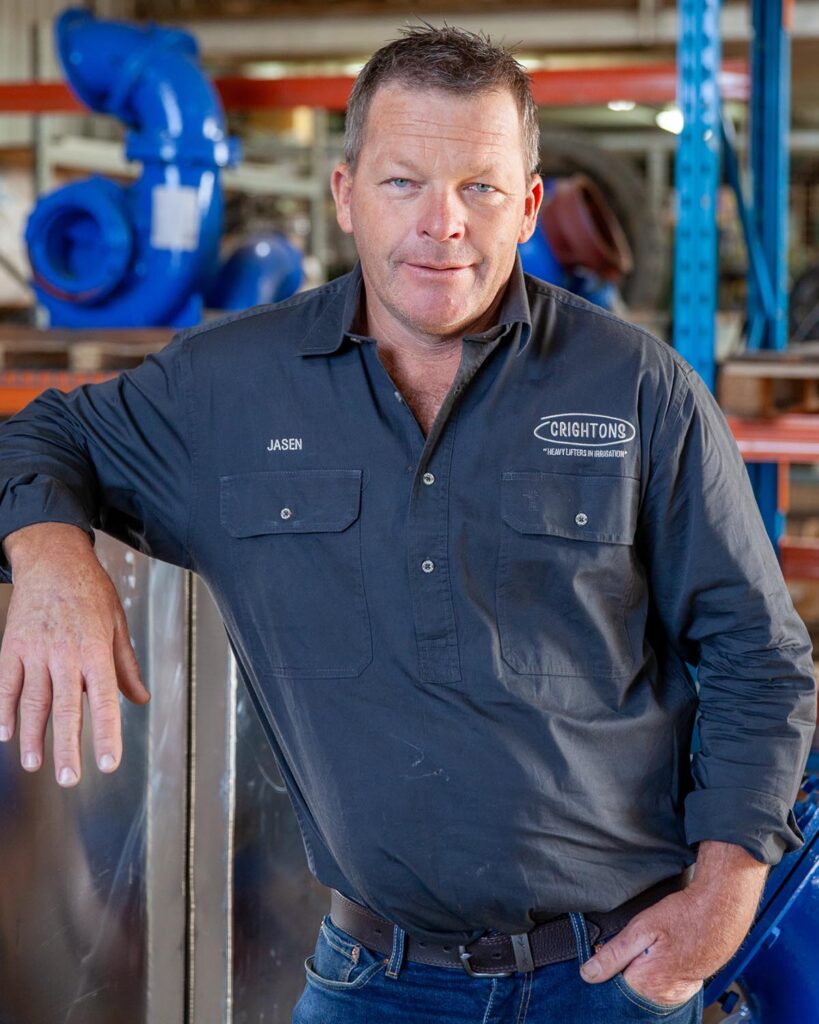
– Jasen Crighton, Owner and Operator, Crighton Engineering
“The roadmap has been really important to see some of those opportunities in agriculture, and I think if we have another opportunity to embrace an industry that might be able to safeguard us from some of the highs and lows that the ag community faces then we should embrace it.”
Visit Hay Shire Council’s economic development page for more information about the region, the Roadmap and how to get in touch with Alison McLean, Executive Manager, Economic Development, Tourism and Energy for opportunities.
TNE program director Jacqui Bell joined economic development practitioners from across NSW this week to explore what a wellbeing economy looks like in practice – and what the Hay community’s approach to transition can teach the rest of us.
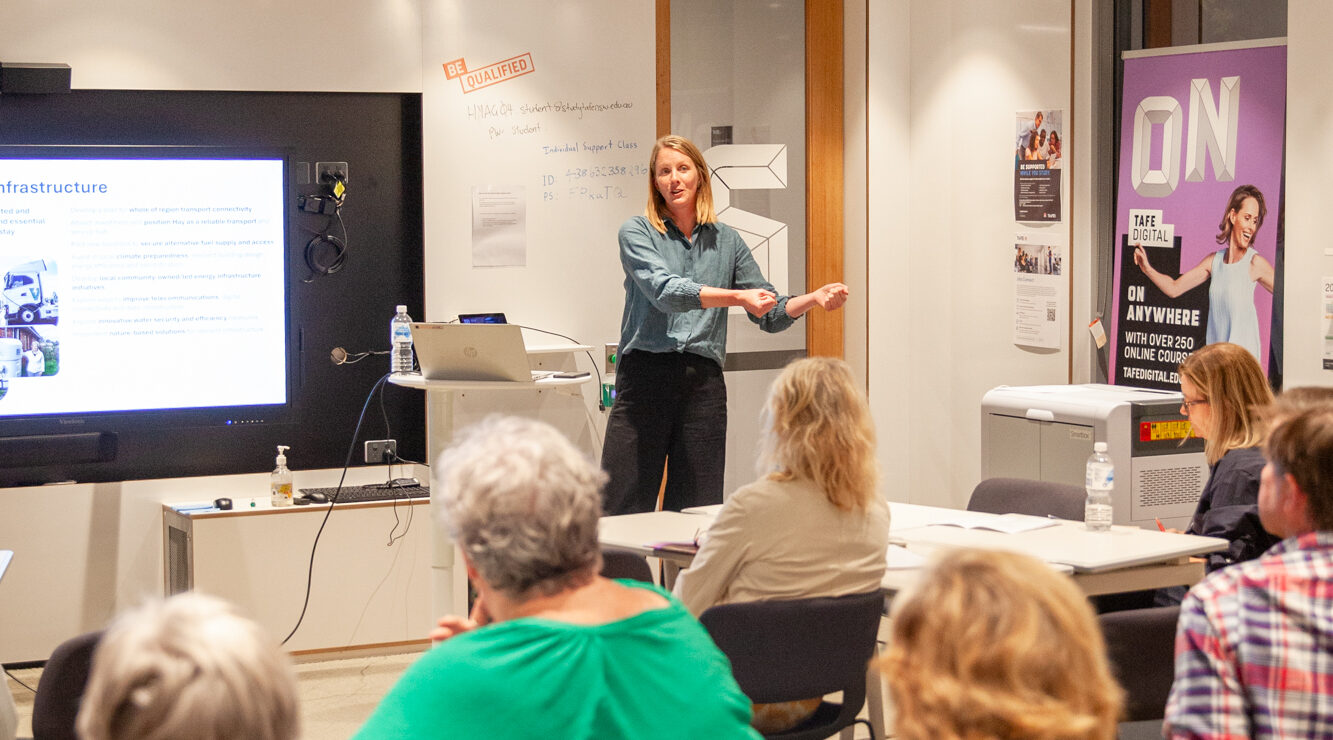
Earlier this week, TNE program director Jacqui Bell presented to economic development practitioners from across NSW local and state government at the Department of Primary Industries and Regional Development’s 2026 Regional Economic Development and Investment Attraction event.
Her session took a slightly sideways look at the economy: exploring what a wellbeing economy looks like and grounding this big-picture conversation in the practical work Hay Shire Council and the Hay community have been doing to think differently about economic change.
Across the broader event, a clear theme emerged: councils and regions are navigating increasingly complex conditions, from renewable energy development and industrial growth to shifting investment patterns, housing pressures, workforce demands, infrastructure constraints, planning system challenges and community cohesion. The scale, pace and constant state of flux are making it increasingly difficult for regions to manage change, plan strategically and act with confidence.
Local government is deep in the trenches of this work – trying to govern and lead through overlapping economic transitions, often with limited resources, unreasonable timeframes and imperfect information.
For us, this points to the need to rethink approaches to economic development: to redefine what “good” looks like, work with regions rather than doing development to them, and build from each place’s unique strengths, local economic system dynamics and advantages.
As Jacqui noted: “For many regions, maybe the question is no longer ‘how do we get certainty?’ or ‘how do we attract investment?’ but instead: ‘how do we organise early enough to manage the downstream impacts of our current economic system, while addressing upstream drivers and shaping new opportunities to create value?’”
“In a world where certainty is harder to come by, the challenge is not waiting for perfect conditions. It is building the local knowledge, capability and confidence to navigate uncertainty – and shape development in ways that leave regions stronger for the long term.
“As we shared in our session, the economy is not fixed. It is shaped by decisions, values, institutions and power – and it can be redesigned.”
There were many bright sparks and wonderful examples of “Lego wins” shared across the two days, says Jacqui. With the right support, local governments are well placed to do this reimagining and drive the change we need to see – building economies that better serve people, places and planet.
Last week the Hay Economic Transition Roadmap was launched in Hay with the people who brought it to life – Hay Shire Council and around 30 of the 250 community members who contributed in one way or another over three years of deep engagement. This roadmap isn’t just a document; it’s a genuine expression of what the community wants for its future, and we’re so excited to have supported its development and have it out in the world.
Led by Hay Shire Council with support from The Next Economy, the Roadmap brings together local knowledge, priorities and practical actions to guide the next decade of economic change – building on Hay’s strengths and preparing for what’s coming. It is designed to align investment with community aspirations and catalyse coordinated, collective action for change – with the community in the driver’s seat.
We sat down with our Land Program Director Jacqui Bell to talk about what she’s learned over the past couple of years and what this means for how we think about regional economic transitions.
Why are region-wide economic transition plans needed?
Communities like Hay are navigating compounding pressures all at once – things like housing shortages, workforce gaps, industry shifts and climate exposure. Band-aids on broken systems won’t cut it. We need upstream change that builds on local strengths and focuses on practical solutions that respond to the unique characteristics of a place. That is, change that generates value locally – not simply chasing narrow national targets or technology mandates.
Working at the regional level connects the dots between sectors and industries to tackle challenges and create new opportunities in ways no single farm, business or government agency can do alone. In agricultural regions like Hay for example, regional planning and coordination creates the enabling environment for local businesses and farmers to ‘move’ and explore new partnerships, de-risk innovation and diversify on-farm income.
For new industry proponents, a regional plan signals where opportunity exists and how shared value can be created – and in many cases, collaboration with regional stakeholders is what makes the business case for investment stack up. For farmers, it enables economies of scale, de-risked investment, opportunities to lower external inputs and new business activities that simply aren’t viable farm by farm. We see examples of this already in efforts to get good outcomes for nature – where working at a regional level, not a farm level sometimes makes a lot more sense.
Regional collaboration isn’t always straightforward – but there are organisations working out how to do it well, helping landholders, residents and Councils find the mechanisms and models to sustain this work over the long term.
So, what does this look like in practice?
Hay sits in the South West Renewable Energy Zone, a real opportunity for the region if managed well. The Roadmap process is already delivering results. From housing solutions, new agricultural industries, expanded childcare, and two renewable energy projects progressing with broad community support.
There are many more opportunities emerging. For example, offtake industries – businesses that take locally-produced energy and use it productively – preferably for the benefit of local industries and businesses. Think freight, fuel, and fertilisers. A sustainable fertiliser business using renewable energy is already under establishment, with regional producers committed to buying at the scale needed to make it viable.
And it’s not just new businesses. Existing ones are adapting too. A local engineering firm is moving into water infrastructure for energy projects – a specialisation with applications well beyond Hay.
This isn’t just aspiration –the momentum is real and work is happening already on the ground.
Jacqui shares the final Roadmap with community members at the launch in late April.
What’s the role of Local Government in all this?
Council plays an important role – facilitation, convening, connecting the dots, building the appetite for change, countering misinformation etc. Support for renewable energy development in a region like Hay didn’t happen because of some national campaign – it was because of the rigorous and ongoing communication and engagement that Council facilitated, the discussions they brought together, the open door they had to proponents, community, businesses.
Why is community involvement important?
When local people are involved and are part of a group behind a vision and supported to be champions of economic change, momentum builds. We could see this in real time last week, when one of our working group members shared how they’ve been talking to a local organisation about progressing an action in the Roadmap. This is where the magic happens – community starts to talk, and action is sparked.
Why is regional work like the Hay Roadmap important?
Regional work matters – it is the connective tissue that holds the regional economic system together and helps each individual component move in the right direction. It’s also critical for sectoral transitions – to understand how characteristics of a place shape or hinder the big shifts that are needed, such as the decarbonisation of agriculture, for instance.
The work in Hay is important because it tells a strong and compelling story about what good regional development and economic transitions can look like across Australia. Communities facing big shifts – new energy, industry change, climate pressure and workforce gaps are increasingly deciding to shape their own futures rather than wait. The ones doing it well are planning ahead, building on local strengths, and asking the right questions: What are we transitioning to? What does good development look like here? How do we make sure benefits flow locally?
Hay is one of the clearest examples of what this looks like when it’s done well, and the lessons here matter well beyond one town
But a Roadmap is just a document, isn’t it?
People sometimes roll their eyes at the thought of another planning document, but for The Next Economy, the document is simply the artefact – the process, the engagement, the coordination and local capacity building is what creates change and builds momentum for new partnerships, new opportunities and community leadership of the future.
That said, the pride that the Hay community feel for the Roadmap, and the value they see it provides them is huge. This was again demonstrated by the conversations we were part of and feedback we received from local people during our visit to Hay last week when we launched the Roadmap with the community. Having a document like this provides a strong signal to investors, collaborators and government. It’s something that everyone in the region can point to demonstrate the work they’ve done, the direction they’re heading, their priorities and what doing business in Hay looks like.
The number of queries we and the region have had even after the soft launch of the Roadmap last week is testimony to its power. The Roadmap sends a signal that Hay is a strategic partner to change with people that have the mindsets and willingness to explore opportunities and create shared value.
So, what should we take out of all of this?
Hay has and is doing something genuinely impressive – a community of this size taking the initiative to plan ahead, build consensus, and deliver real outcomes. It’s a clear example of what responsible development and economic transitions managed well can looks like across Australia. For other regions to go the distance, they need the same meaningful engagement and real backing, including funded local coordination roles that turn good plans into lasting outcomes.
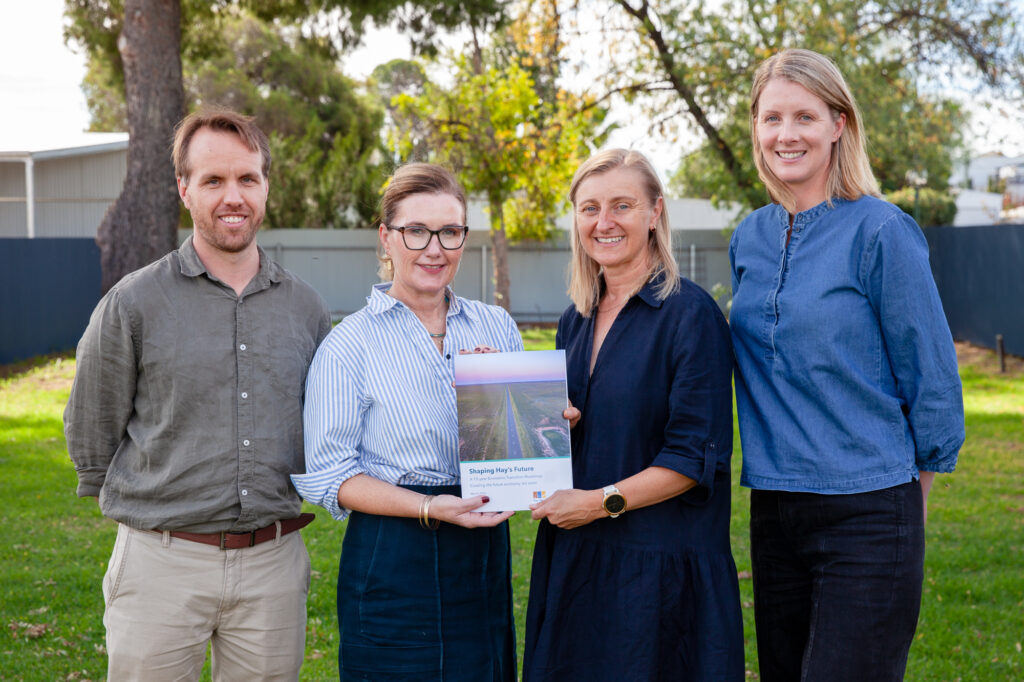
Jacqui (far right) celebrating the launch with (from left) TNE Senior Project Officer Doug Ruuska, Hay Shire Council Economic Development Officer Alison McLean and Hay Shire Council Youth and Economic Development Officer Kylie Brettschneider.
The Hay Region Economic Transition Roadmap demonstrate how regional Australian communities can shape their own economic futures. The Next Economy has been proud to work with the Hay Shire Council and the local community to develop a sequenced, practical pathway for economic growth.
Why Hay is leading the way
Located at a strategic intersection of renewable energy zones and key transport routes, Hay is acting early to ensure change happens with the community, not to it. The Roadmap focuses on:
Local leadership: Building on rural enterprise and natural resources.
Strategic levers: Seven accelerator actions to increase regional capacity, including dedicated coordinators for housing and workforce development.
Shared value: Creating conditions for industry and government to align with community-defined priorities.
This project demonstrates what is possible when local insights are backed by strong collaboration. Hay is ready, the momentum is real, and the invitation is open for collaborators to join us in unlocking the full impact of this vision.
Energy lead Saideh Kent appeared before the NSW Parliamentary Inquiry into the impact of renewable energy zones on rural and regional communities and industries in late March. It was an opportunity to highlight the great work communities in renewable energy zones are progressing and reinforce the critical role regions play in the development of renewable energy, says Saideh.
The Next Economy has been working alongside Hay Shire Council in the South West REZ and Uralla Shire Council in the New England REZ for the past two years, and both councils endorsed reports of our work in the fortnight before Saideh appeared. Working closely with councils,Saideh says “you see how they are getting on with development, managing challenges and seeking the best outcomes for their communities”.
Here Saideh shares some of her reflections…
What we’re hearing on the ground
The picture is more positive than the headlines often suggest. Communities are getting on with it, working alongside developers, EnergyCo and government departments to plan for what is coming and find solutions that work for them. We have seen genuine improvements in the NSW planning framework over the past two years, with greater clarity emerging around community engagement, landholder payments and benefit sharing, and EnergyCo’s funding support for local government has made a real difference to what councils can actually do – though they do remain very overstretched.
Housing is a good example of communities turning a challenge into an opportunity. Both Hay and Uralla are progressing innovative housing solutions with developers and private investors, where short-term workforce demand creates the market conditions for investment in housing that will benefit the community long after construction is complete.
Community engagement needs to be genuine
Communities in REZ areas are not short of opportunities to be consulted, but the quality of that engagement matters enormously. People do not want to be asked by eight different project developers how they would like to spend community benefit funds. What they need more of is real involvement in decisions about transport routes, housing and workforce planning, all things that will affect their lives.
Working in place provides the opportunity to bring all parties to the table to work through challenges and determine what is the best solution for local communities. In some areas local employment targets are effective, in others, they can add stress to existing workforce shortfalls, so engaging communities in local solutions is so important.
Local government belongs at the table
Councils in REZ areas are doing an enormous amount of work. Coordinating across agencies, planning for cumulative impacts, facilitating community engagement, often holding the process together in ways that are not always visible. The Next Economy supports Hay Shire Council’s call for councils to be recognised as strategic partners in the REZ planning framework, with concurrence required from councils in the development of conditions of consent. This would allow councils’ requirements and policies to be incorporated into the general terms of approval and give communities greater certainty. Continued and enhanced funding for council capability through the development and construction phases will also be essential.
EnergyCo’s mandate and development outside the REZs
EnergyCo’s coordination role has been valuable, but its broader authority rests on changeable footing under the current legislation. We would like to see that role clarified and reinforced so it has the ongoing mandate and funding to support communities across the full life of each REZ. I also raised the situation facing councils dealing with development outside the REZ access schemes, where cumulative impacts are just as real, but coordination support is much thinner and called for the REZ access merit criteria to be extended more broadly.
Nature and local knowledge
Reflecting on my evidence, an issue I did not get to raise at the inquiry but sees as critical: communities we have engaged with care deeply about the land and want to see nature-positive outcomes from these developments, which is entirely compatible with renewable energy. The University of New England is already undertaking research on biodiversity in solar farms, local farmers are keen to participate in biodiversity offset programs, and there is deep environmental expertise in the region that should be drawn on actively. We support the inquiry’s earlier recommendation calling on the NSW Government to identify ecological protection and restoration priorities for each REZ and encourage developers to contribute to positive regional environmental outcomes.
What gives me confidence
What stays with me after two years of this work is how capable these communities are., . Councils are coordinating across agencies, planning for large incoming construction workforces, facilitating community engagement across multiple projects, and doing most of it with constrained resources and a planning framework that has not always kept pace with what is happening on the ground.
The opportunity on the other side of all this is significant. Better housing, lasting infrastructure, stronger local economies, nature-positive outcomes from development that is done well. But those things do not happen automatically. They take resourcing, coordination, and a framework that treats councils as partners who need support to get the best outcomes for their communities.
That is ultimately what I wanted to leave the committee with, examples where the real challenges are being addressed by communities, that have done the hard work of showing up, engaging honestly and pushing for something better.
Saideh at the inquiry with fellow speakers Chris O’Keefe and William Churchill from the Clean Energy Council.
Land Sector Program Lead Jacqui Bell ponders what freight decarbonisation means for regional Australia off the back of a commercial vehicle decarbonisation summit at Parliament House.
Our Land Sector Program Lead Jacqui Bell attended Freight Forward summit on commercial vehicle decarbonisation at Parliament House on 30 March 2026, hosted by Energy Futures Foundation. This event could not have been timelier, as we grapple with fuel security as a nation. It’s also deeply relevant to our work with regional communities here at The Next Economy.
Jacqui heard how Australia imports 90% of our transportation fuel and moves more freight per person than any other country. She also learnt that 98% of businesses in Australia’s freight transport system are owned by small to medium businesses, 2% by owned by large corporate freight and logistics operators. Those big businesses have the power to send signals down the supply chains to make the transition work, but those signals must be backed by investment, education and support to shift.
Jacqui at Parliament House on Monday
Here are some more of Jacqui’s reflections post-summit about what she heard and what this might mean for our work with regional communities.
I’m really curious about the “lopsided economics of transport” (to quote Transport Workers Union National Secretary Michael Kaine). While large logistics companies move a significant share of Australia’s freight through linehaul networks, the system relies heavily on small and medium operators (think local businesses and independent drivers) to complete last-mile delivery and provide regional coverage from depot to door/gate. They make up around 98% of freight businesses in Australia and are critical to how the freight system actually functions. These businesses are embedded within large supply chains, not separate from them. Additionally in many regions there are more unlikely suspects that will be affected by the sector transition – think the farmer who owns machinery and trucks or the locally owned and managed service station which plays a role similar but different to the local pub.
Australia’s freight and logistics system in Australia is important for regional Australia and communities. Australia’s freight system in many cases keep regional economies moving, and are critical to the viability of local industries and businesses and local spend. Changes in this sector aren’t going to just impact the trucks we see on the road or how and where they charge to ‘refuel’, sectoral change in technology, ownership, power and system design have the potential to create a ripple effect or more likely a tsunami of impacts for other regional communities, local businesses and industries, regional economies and serviceability across more rural and remote parts of Australia. Not to mention have significant implications for other sectors in transition such as energy.
There are practical challenges for freight decarbonisation in regional Australia. Much of our local infrastructure, like roads and bridges, are no longer fit-for purpose for the future transport and freight system we need to transition well. There’s also questions about energy access including poles and wire infrastructure, which is not reliable or extensive enough to provide energy where it is going to be needed. There’s the fragmentation of the industry between technologies, ownership, scale and size. And that’s not to mention the practicalities of dealing with digitisation of machinery, and their serviceability etc. We hear of farmers who are stockpiling trucks and machinery because malfunctioning digital systems in machines are too disruptive for day-to-day operations.
While there are challenges, there are also opportunities. Regions like Hay in NSW could be partners for investment; they have space for microgrids, potential for their own energy production (e.g., wind turbines) and the region is already strategically located on major trucking routes. How do we support a region like Hay to establish its own charging and servicing infrastructure and move away from providers just ‘coming in over’, doing their own thing and taking spend out of the local economy?
We need regional voices. They need to be in the room and around the table of these conversations to make sure that workers, and small to medium business owners and regional agencies are part of the process and involved in shaping the solutions.
This conversation goes beyond reducing emissions. Freight is one of the biggest vulnerabilities to our nation’s economy, and its decarbonisation is also about building resilience.
The transition of the sector is probably going to require a mix of technologies. It’s not just electrification of vehicles, but there may also be discrete roles for green hydrogen and biofuels in some cases (although the jury seems still a bit out on this). It is a question of the right mix – the right trucks for the right segments.
Ultimately, this is not a technical challenge; this is a socioecological challenge. The technology is here for decarbonisation of freight and many commercial vehicles are due to be changed over. This is an implementation challenge. Some stats suggest we are in a ‘window of opportunity’ where a large number of vehicles are due to be upgraded in the next 5 years; the push is to shift from diesel to EV now. While there is a high upfront capital price, ongoing fuel prices make the shift favourable. Panels from Woolworths, Fortescue, and IKEA, for instance, noted that the business case (for transition) stacked up even with pre-crisis prices. But how do we support this to happen? There was a lot of talk about misinformation, knowledge, and understanding.
There’s a big question around the overall design of the system. Air Vice-Marshal John Blackburn, former Deputy Chief of the Air Force, current Chair, Institute for Integrated Economic Research Australia made this point, noting we appear to be arguing the components. There was also much discussion about charging infrastructure, the need for it, how to roll it out and who owns and accesses it. What will this mean for the majority of small to medium businesses that need to use that infrastructure?
My final take home is that there is different work that needs to be done in this moment. We need to navigate through this crisis, making sure that we don’t lock ourselves into something we can’t easily undo. And then we need to get realistic about a ‘funded’ transition that is fair, sustainable, keeps people safe, keeps the industry viable, and supports regional communities and economies.
Questions I’m still thinking about:
What happens to small ‘Ma and Pa’ independent fuel stations who play such an important role in regional communities?
How do we take care of society of our people and places as we transition so we continue to be a place that we want to live, where prosperity is shared?
How are people in the sector thinking about these social elements of this challenge and transition?
How can regions whose economies rely a large part on freight and logistics to keep their economy going, be a part of this conversation about enabling infrastructure and system redesign?
If transport comes to a standstill and/or if it shifts into a totally different system that locks out local businesses and operators, how do we prepare communities and build the socioeconomic conditions and capacity required to endure and adapt?
If most freight and logistics companies are run and owned by small to medium business owners around Australia, how do we support that system to move in a way that doesn’t involve carrying the cost burden of change without having a share in the rewards of moving?
Jacqui Bell leads The Next Economy’s land sector work. In this Q&A, she shares her reflections on a pivotal year for agriculture and land use change, how climate risk, investment and policy began to converge in 2025, and what this means for building fair, resilient and regenerative landbased economies.
Why is the land sector important to Australia’s economic transition?
The land sector sits right at the intersection of Australia’s biggest transitions. It’s where climate risk is already being felt most acutely, where adaptation and mitigation must happen together, and where decisions about land use directly shape regional economies, food systems, biodiversity, and community wellbeing.
Unlike energy or industry, the land sector isn’t one thing. It’s a bundle of economic activities – agriculture, forestry, conservation, carbon, water, mining, infrastructure – all competing for the same finite resources. How land is owned, valued, used and governed determines what’s possible economically, socially, culturally and environmentally.
As climate impacts intensify and global markets shift, how we use land, as well as value and manage the ecosystem services it provides will increasingly inform whether Australia builds resilience and shared value – or locks in deeper inequities and long-term risk.
Looking back on 2025, what were the defining points for Australia’s land sector?
2025 felt like a year where multiple threads finally came together. There was a sense of catch‑up across policy, investment and public conversation about the role the land sector plays in Australia’s transition to net zero and nature‑positive outcomes. Long‑awaited strategies and initiatives began to land, and programs like the CRC for Net Zero Agriculture started to gain more traction, signalling that agriculture and land use were no longer being treated as peripheral to the transition.
One of the most significant shifts we have seen through our work, is a growing readiness to mainstream more regenerative and climate‑resilient approaches into farming. Twenty years ago, farmers experimenting with regenerative practices were often working against the system. In 2025, we saw the enabling conditions begin to stack up: policy drivers, market signals, climate realities and finance are pointing in the same direction. That alignment as well as other broader socioeconomic factors is creating a real tipping point in willingness to rethink how production systems work across different landscapes.
At the same time, the year exposed just how slow and fragmented our economic systems still are. There is a lot of innovation happening on farms, in communities and in pockets of investment, but it’s uneven and difficult to scale. Capabilities, ownership structures, planning frameworks and institutional inertia continue to lock in existing patterns of land use, even as the need for change becomes more urgent.
Climate risk also became much harder to ignore. The National Climate Risk Assessment brought sharper visibility to the conditions landholders and regions will need to endure in coming decades – and, in some parts of Australia, where certain land uses and farming systems may not even be viable long-term.
Overall, 2025 wasn’t a year of resolution, but it was a year of these shifts (and many others) coming to the surface. The challenges facing the land sector became more visible, the stakes more explicit, and the imperative for coordinated, place‑based and just approaches to land use change much harder to push aside.
What are the biggest challenges facing Australia’s land sector right now?
Complexity and cumulative pressure are the defining challenges.
Landholders and regional communities are dealing with climate impacts, market volatility, policy uncertainty, workforce shortages, rising costs, and rapid land use change – all at the same time. These pressures aren’t additive; they’re compounding.
Climate risk is no longer theoretical. We’re seeing clearer projections of extreme heat, water scarcity, flood and drought cycles that fundamentally question the long-term viability of some farming systems and, in some places, human habitation. In northern Australia, for example, the growing number of extreme heat days raises real questions about labour, productivity, liveability and safety.
At the same time, investment and ownership structures are shifting. Institutional investors are becoming more sophisticated about climate risk and land value, enabled by digital technologies and data. That has the potential to drive innovation – but it can also accelerate consolidation, change land use rapidly, and create unintended consequences for regional economies and communities.
Jacqui talking nature and land use trade-offs at the Better Futures Forum in 2024.
What does a climate-safe, regenerative and socially-just land sector look like in practice?
In practice, it’s not a single model – it’s place specific.
A climate safe land sector integrates mitigation and adaptation, rather than treating them as separate goals. It supports farming systems that are resilient to heat, water variability and extreme events, while restoring soils, biodiversity and natural capital over time. In practice, that looks like more diverse and resilient farm systems, healthier landscapes, and multiple income streams that reward stewardship as well as production.
A regenerative approach becomes mainstream not just because it’s ‘better’, but because the conditions finally stack up: policy settings, market signals, climate realities and finance are aligning in ways they weren’t 20 years ago. Back then, early adopters were pushing uphill. Today, there’s a genuine tipping point in readiness and willingness to do things differently.
This isn’t just a shift at the farm level – it’s a broader system transition across supply chains, finance and policy that makes different choices viable at scale.
Social justice means recognising power and equity: who owns land, who benefits from new markets, who carries risk, and who gets left behind. In the Australian context, it also means recognising and partnering with First Nations land stewards and cultural knowledge. It means designing transitions that support producers to continue producing good food – rather than pushing risk down the supply chain or hollowing out regional communities.
There are real trade-offs and tensions to navigate, but the direction of travel is now much clearer (albeit still looking very messy)!
How are farmers, landholders and Traditional Owners already leading this transition?
A lot of leadership is already happening on the ground, often ahead of policy.
Farmers have been experimenting with regenerative practices, climate smart production, on-farm business diversification and new business models for decades. What’s changed is the visibility and validation of that work – as well as the growing recognition that adaptation is an economic necessity, not just an environmental choice, and that there are some challenges that are better addressed at a region or landscape scale than at the farm level.
Traditional Owners are also leading innovation, particularly where land management, cultural knowledge and economic development intersect. Land and Country are the foundations for First Nations economic sovereignty, and there’s huge potential for Indigenousled approaches to land stewardship to deliver economic, cultural and ecological outcomes – if the right structures and capital are in place.
What we often see, though, is fragmentation: great practice, limited coordination, and insufficient system level support to scale what’s working.
What policy changes would help speed up the shift to fair and sustainable land use?
One of the biggest gaps is in planning and coordination.
Our land use planning systems are no longer fit for purpose. They weren’t designed to manage cumulative impacts, rapid transitions, or competing demands like renewable energy, conservation, food production, infrastructure and critical minerals – all at once.
The EPBC Act reforms late last year signalled a stronger role for environmental protection and nature positive outcomes through development, which is important. A big question will be how these changes interact with land use, regional economies and cumulative development pressures.
On their own, regulatory reforms won’t deliver good outcomes. Without integrated planning, clear pathways for development, and genuine engagement with communities, we risk creating more friction and uncertainty on the ground.
Integrated regional planning could be transformative if done well – bringing these competing uses together in a coordinated way, identifying clear priorities, managing trade-offs deliberately, and setting upfront rules about where development should and shouldn’t occur. Done poorly, it risks entrenching conflict or shifting impacts onto communities without their input. The decisions made – from zoning and go/no go areas to approval pathways – will determine who benefits and who bears the cost of transition.
More broadly, we need policy that recognises climate adaptation as a core economic function, not an afterthought which aligns investment, land use and community outcomes over the long term. Good policy will require this work to happen with communities, not to them – with early and meaningful involvement in shaping land use decisions.
Finally, what excites you about this work?
What excites me is that we’re at a moment where the questions are finally shifting.
There’s growing recognition that climate risk is a socio-economic issue, that adaptation matters as much as transition, that technology and innovation on farm is just one part of the Ag sectors transition, and that finance and climate investment decisions are driving change across Australia.
All of these and more are creating greater opportunity and imperative to explore and demonstrate what good economic transitions looks like – and how getting it right in regions and on the ground can support the land sector to shift in a way that helps Australia navigate uncertainty, restores nature, and builds an economy that genuinely serve communities – not just markets.
The Next Economy and Hay Shire Council have been working side by side with the local community to better understand how Hay’s economy works today and what it will take to secure a stronger future. Over the past year, more than 240 residents, businesses and stakeholders have shared their perspectives through workshops, interviews and conversations.
The result is the newly published Early Insights Paper, which explores Hay’s unique economy, the challenges it faces, and the opportunities already emerging.
A deeply connected local economy
What makes Hay distinctive is not just its agricultural base or strategic location on trade and tourism routes, but the way economic and social life is deeply interconnected. From local producers sharing transport runs, to volunteers stepping in where services are scarce, Hay’s resilience depends on people and relationships as much as dollars and cents.
Turning pressure into opportunity
The final Roadmap will highlight clear areas where focused action can turn pressure into opportunity. Housing, for example, has emerged as one of the most urgent challenges. Council and partners are already exploring innovative approaches such as transitioning worker accommodation into permanent housing – a practical step that can help meet short-term needs while leaving a lasting benefit for the region.
Grounded in local identity
Alison McLean, Executive Manager for Economic Development and Tourism at Hay Shire Council, puts it simply:
Without this groundwork, there’s a risk of defaulting to what everyone else does. We are not Wagga, we are not Griffith – we have our very own unique economy, threats and opportunities.
From insights to action
This paper is an important milestone, but it is also part of a broader process of engagement and real-time action being taken to manage change across the region. Over the coming months, Council and The Next Economy will continue to work with the community to refine priorities, test solutions and activate partnerships across housing, primary production innovation, workforce development and industry diversification.
In the heart of NSW’s Riverina region, the town of Hay is asking big questions about its future.
Over a week in April, The Next Economy met with more than 30 local landholders, business owners, and community leaders to explore how the regional economy works—and how it can adapt to the challenges and opportunities ahead.
“We’re working with the Hay community to build a rich picture of the local economy—how it operates, who’s involved, and what’s needed to make it more resilient and future-ready,” says Jacqui Bell, Project Lead at The Next Economy.
This work is part of a broader effort to co-develop a regional economic roadmap—a guide to help Hay navigate dynamic social, environmental, and economic change. The process is grounded in local knowledge and shaped by the lived experience of those who call the region home.
This work follows on from the development of a set of principles for successful renewable energy development in Hay (in partnership with Re-Alliance), and the Regional Resilience Plan (in partnership with TNE and the Australian Resilience Centre) in Hay over the past two years.
Asking the Right Questions
The conversations in Hay are centred around a series of powerful questions:
What does our economy look like, and why does it work the way it does?
What trends—local and global—are shaping our future?
What can we do together that we can’t do alone?
How do we ensure that the wealth generated here benefits the whole community?
These questions are helping to surface both the strengths and vulnerabilities of the region’s economy, and to identify opportunities for collective action.
A Sector Under Pressure
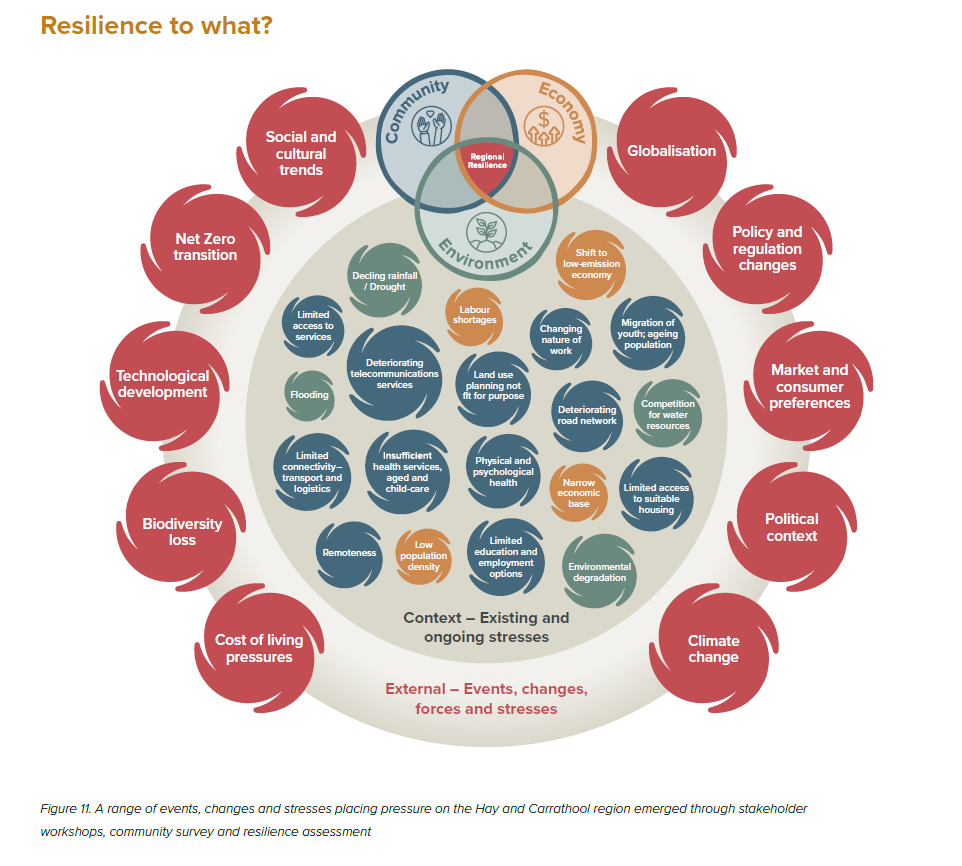
Hay, like many regional communities, is facing cascading pressures: rising costs of living, workforce shortages, climate impacts, and uncertainty around the energy transition. These challenges are compounded by confusing policy signals and complex market mechanisms—particularly in the agriculture and land sectors.
“There’s growing interest from global markets and investors in low-emissions, nature-positive products,” says Jacqui. “But those signals often aren’t reaching producers on the ground—or they’re too weak or confusing to drive meaningful change.”
This disconnect is contributing to scepticism and fatigue in communities already being asked to take on significant risk to address climate change and biodiversity loss.
No One-Size-Fits-All
The Next Economy’s work in Hay reinforces a key insight: context matters. A one-size-fits-all approach to agricultural transition won’t work in Australia. Each region has its own assets, challenges, and aspirations.
“How transitions are managed locally will shape the future of entire regions,” Jacqui explains. “Strategic planning and coordination are essential—not just to respond to change, but to shape it in ways that are fair, effective, and grounded in place.”
What’s Next
The roadmap being developed with the Hay community will help guide investment, policy, and local action. It’s part of a growing movement across regional Australia—where communities are stepping up to lead the transition to a climate-safe, regenerative, and socially just economy.
“This isn’t just about adapting to change,” says Jacqui. “It’s about creating the conditions for communities to thrive in the next economy.”
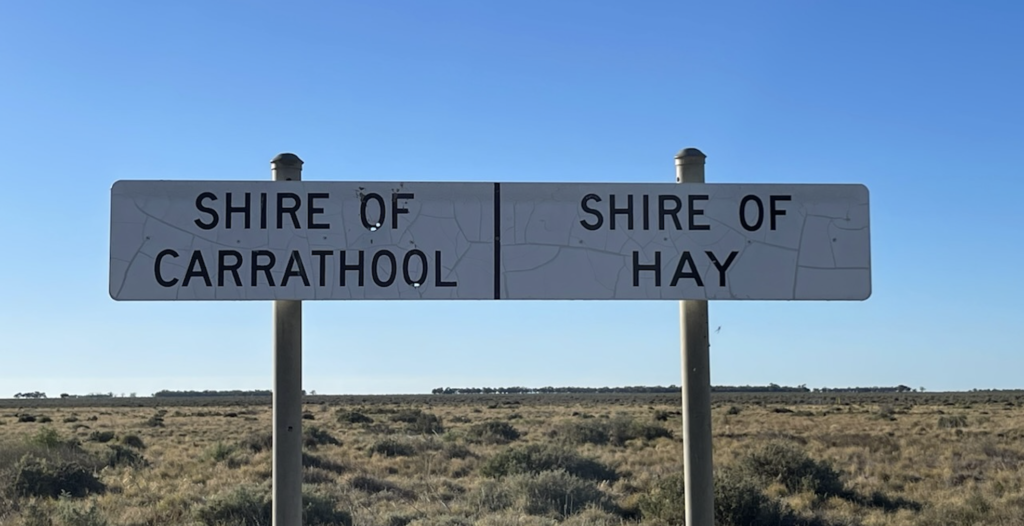
This week, the Hay and Carrathool Shire Councils launched the Hay and Carrathool Regional Drought Resilience Plan. The Plan is designed to identify strategic focus areas and priority actions to strengthen regional resilience. Convened by both councils, the Plan is the result of an extensive seven-month collaboration involving more than 300 community members, industry representatives, and government stakeholders.
The Plan envisions a future where, by 2035, the communities of Hay and Carrathool are equipped to navigate climate, environmental, social, and economic challenges while remaining strong, connected, and vibrant. It sets out a strategic path for ensuring safe and thriving places to live, work, and raise future generations.
Hay Shire Mayor, Carol Oataway, acknowledged the immense community effort behind the Plan and the commitment of local people to shaping their future.
“This level of community engagement reflects the leadership and strengths of this vibrant region and demonstrates the passion that local people have for its future,”
Carol Oataway, Mayor of Hay Shire
With five core strategies—Inclusive & Empowered Communities, Future Ready Businesses, Reimagined Care Economy, Placemaking with Purpose, and Coordinated Action for Climate Resilient Economic Development—the Plan identifies 26 priority actions, each with partners to lead and drive progress.
Key actions include setting up community hubs where people can connect, working groups so businesses can “share” employees, innovative ways to provide care to groups that need it, an initiative to collect and use environmental data, a housing strategy, and a roadmap to diversify and strengthen the regional economy.
Already, the Plan has sparked action across the community. To really bring its vision to life, collaboration between local government, businesses, and residents will be essential in addressing risks and capturing emerging opportunities.
“We’re the ones who know what our region needs… State and federal governments need to support regionally led solutions like ours.”
Carol Oataway, Mayor of Hay Shire
The Next Economy and the Australian Resilience Centre worked with the Hay and Carrathool Shire Councils and local communities to deliver the Plan. It has been developed as part of the Regional Drought Resilience Planning Program, which is jointly funded by the Australian Government and NSW Government under the Future Drought Fund.
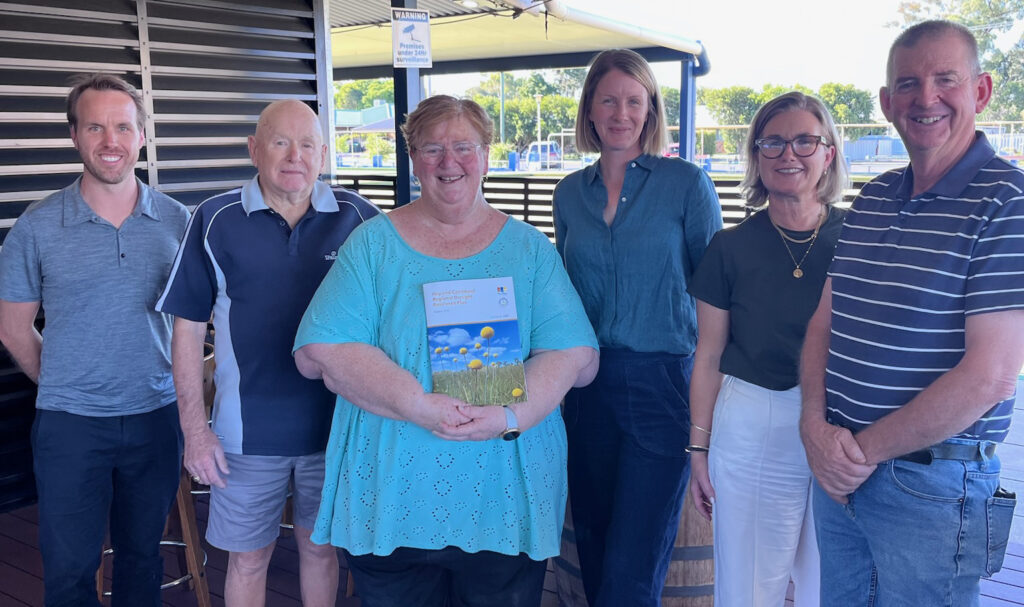
Hay Shire Councillors John Perry and Geoff Chapman, along with Mayor Carol Oataway and Alison McLean, Executive Manager for Economic Development and Tourism, are pictured with Jacqui Bell and Doug Ruuska from The Next Economy.
More than 80 primary producers and community members joined both Hay and Carrathool shire councils and The Next Economy (TNE) at a series of workshops to explore barriers and opportunities for strengthening community resilience and driving good economic development in the region.
Situated within Australia’s renowned ‘food bowl’ in the Riverina region of southwest New South Wales, the Hay and Carrathool Shire communities boast a rich legacy in agriculture and primary production.
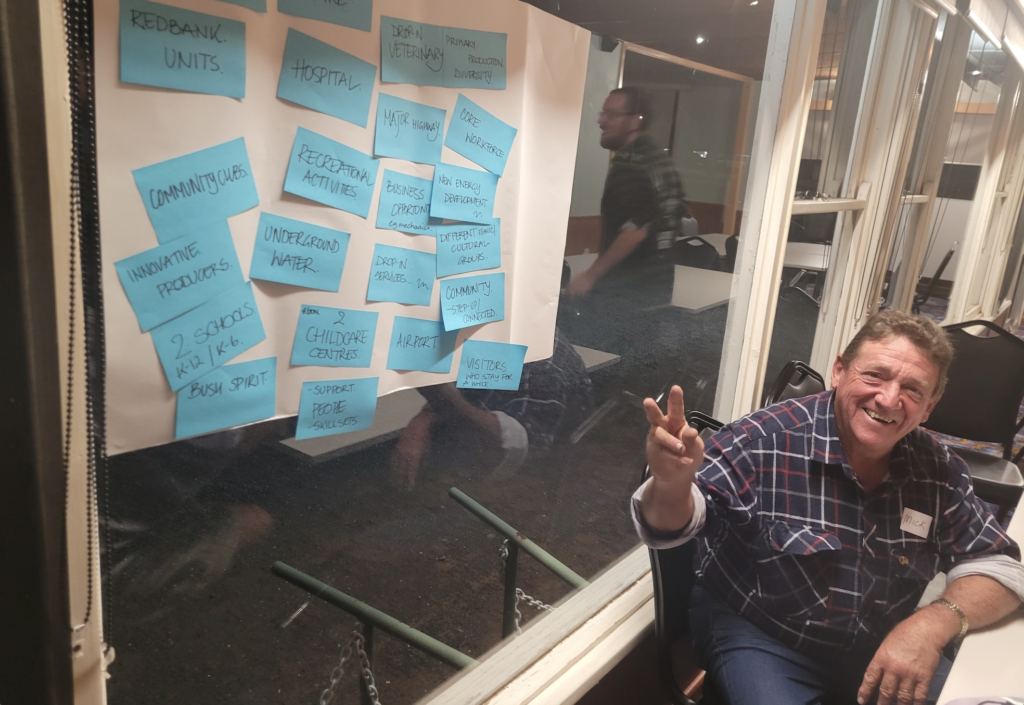
The five workshops, held between 8 and 12 April 2024, brought together representatives from local businesses, community organisations, community services and primary production to identify what makes the region work now as well as opportunities and potential directions for good regional development that drives a strong, vibrant and climate resilient future.
Feedback from workshop participants included:
It was great to see so many community members turn up and be involved.
and
It was good to feel like community members are important in decision making.
The workshops marked the official start of extensive community engagement activities as part of Hay and Carrathool Shire Councils’ development of the 10-year Resilient Economy Roadmap initiative.
The Roadmap will outline practical actions councils, business, industries and communities can take over the next decade to diversify their economies while building resilience in the face of change and disruption. This includes economic, social, cultural and environmental resilience.
The project comes at a pivotal moment for the region as communities navigate a range of growing challenges and disruptions, including rising living costs, climate impacts from recent flood events to prolonged droughts, and the impact of the decarbonisation of global supply chains.
Jacqui Bell, TNE’s Land Use Director, said:
“These communities have a golden opportunity to stay strong now and into the future. To do that, they’re coming together to identify how to overcome barriers, diversify economies and build resilience.
“The level of engagement with the Roadmap project demonstrates the region has a network of strategic local leaders and champions who are passionate about their communities, economy and the future of the region.
“Community members, business owners and representatives from the primary production industry we’ve engaged with so far are constantly adapting and innovating in response to changes in the local climate and global economy. It was great to see such overwhelming interest in working collaboratively to shape the region’s future.”
The Resilient Economy Roadmap initiative is a collaboration between Hay and Carrathool Shire councils, The Next Economy, The Australian Resilience Centre, and communities across the region. Running from March to October 2024, it is funded jointly by the Australian Government and NSW’s Future Drought Fund and is part of the Regional Drought Resilience Planning Program.
To stay up to date on the project, follow the Resilient Economy Roadmap Facebook page. For further project information, please contact j.bell@nexteconomy.com.au