Building the economy we could have: Predistribution

To build the better economy we could have in Australia, we need to think differently. Dr Katherine Trebeck, economist and Economic Change lead, is a big fan of predistribution. Here she explains why. 

I often use a ‘jigsaw puzzle’ as a metaphor to explain the array of shifts in policy and practice needed to build an economy in service of people and planet. No single piece is sufficient on its own, but together, enough changes have potential to build towards to an economic system that gets things right for people and planet first time around. 

To grapple with this array of actions, it can help to loosely cluster the pieces into the four corners of that jigsaw puzzle: the ‘4Ps’ of purpose, prevention, predistribution, and people power. 

Here, I want to offer a few notes on the predistribution corner as it is so often missing from the conversation about the economy, with focus instead on taxation and how to better fund programs for those who are impacted by the inequalities built into our current system (‘compensating the losers’ as a report from a US think tank rather bluntly puts it). 

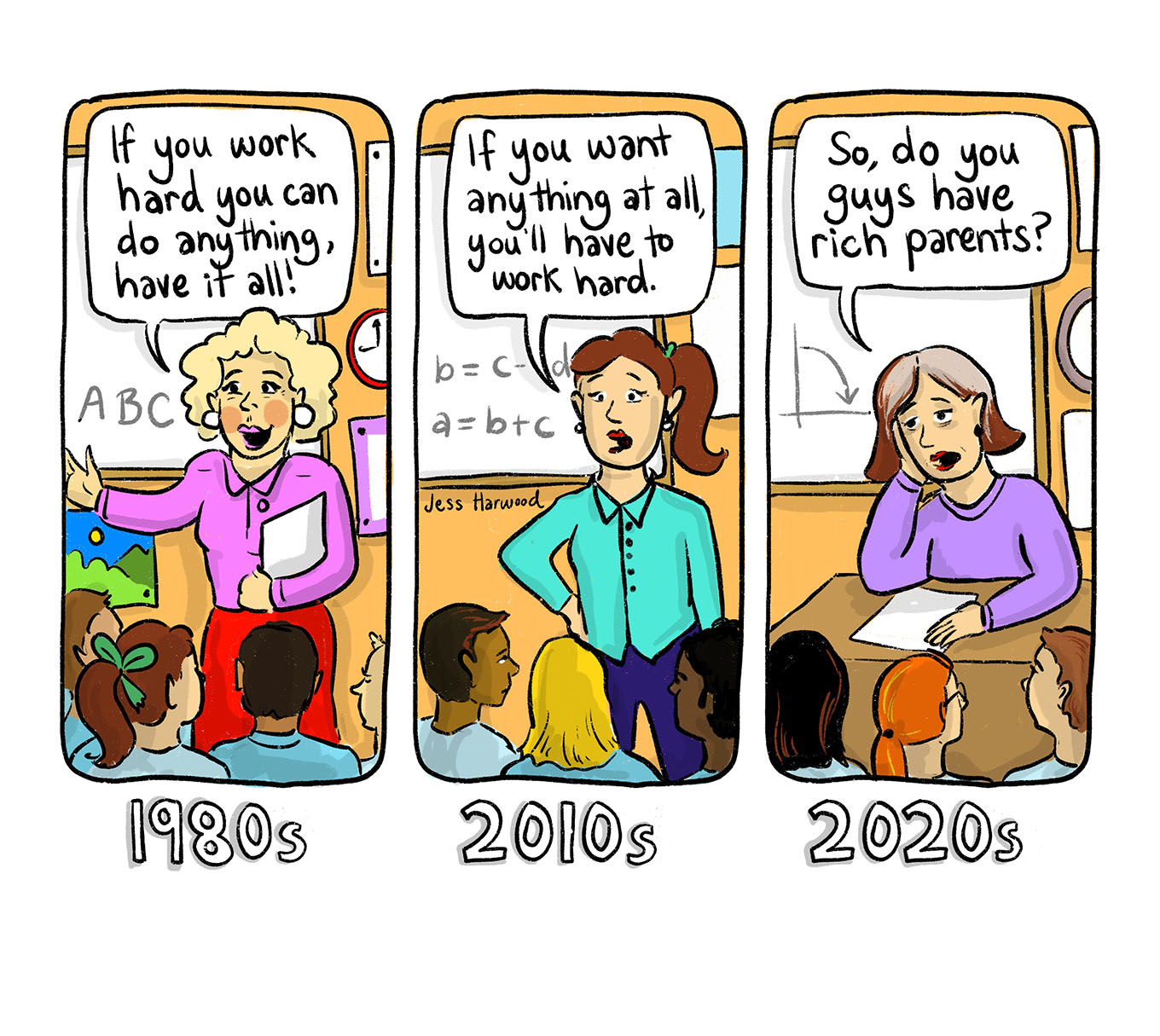
Australia used to do fairly well in terms of predistribution (that is, for white, able-bodied males). But no longer; we’ve become an ‘assetocracy’ where access to assets tends to be what shapes peoples’ life chances and life choices.

Credit: Jess Harwood, for The Next Economy

Predistribution is about pre-emption and prevention, and a critical element of upstream change that builds a better economy for all of us.  

‘It is not enough to…try to balance the inequalities generated in the market through retrospective tax and transfer. It is necessary to transform and democratise the institutional content of the market economy, rather than just compensate for its inequalities.’ – Gabriella Ramos et al 

Origin story 

The term predistribution was coined by the American scholar Jacob Hacker who describes it as ‘market reforms that encourage a more equal distribution of economic power and rewards even before government collects taxes or pays out benefits’.  

Predistribution’s political moment in the sun came in 2011 when Ed Miliband, then leader of the UK opposition Labour party, was in the audience for a speech that Hacker gave in Oslo. Miliband returned to the UK and – briefly – championed the idea. 

But predistribution is one of the most important ideas that should be high on the political agenda. Let’s look at why it matters, what it is, how it plays out in practice, and the implications for policy. 

What does predistribution mean? 

The essence of the idea of predistribution is ensuring that the market economy does more of the heavy lifting in delivering a more balanced divvying-up of resources. British scholar Martin O’Neill explains it as ‘the particular ways in which the economy can be shaped to disempower the privileged and to empower the disadvantaged’. Its focus is on market mechanisms that determine the distribution of wages, profits, and other flows and stocks of money.  

Government comes into the predistribution story via its role in creating and shaping markets so that the results are aligned with public goals: using rules, incentives and other levers to shape market outcomes. This includes boosting (or curtailing) the bargaining power of market players such as workers, employers, and wealth holders.  

Therefore, it differs from government using tax and benefits to shape the distribution of economic resources after market outcomes have emerged: this is redistribution.  

We’ll come to some specifics in a moment, but you could expect to see predistribution in the form of:  

  • Strong standards for workers (such as regulation, procurement, support for unions, and living wages). 
  • Regulation of the financial system and corporate governance; including provisions to stop harmful activities.  
  • Ensuring more people have a share of capital ownership, including owning businesses via worker or commubity cooperatives. 
  • Spending to bolster people’s opportunities and bargaining power in the labour market (think education and other public services: so they are not dependent on someone’s income) and groups like unions who can stand up for workers. 
  • Addressing how affordable certain goods and services are (for example, via price caps, subsidies, or direct provision): rather than only focusing on how much money is in people’s pockets; also being concerned with how far it stretches. 

Why it matters 

Inequality arises in and can be addressed via two realms. Firstly, what is sometimes called the ‘primary’ realm of work, wages and occupational pensions, and then in the secondary realm comprising taxes and benefits. Predistribution is about action in the primary realm. Here the wages that workers earn are the outcome of ‘a complex process of implicit and explicit bargaining between workers, employers, and (where they exist) unions’: the influence of each compared to the others matters, and is a function of various rules and regulations. 

This is of interest to anyone interested in economic inequality because this realm is where the bulk of the balance or imbalance of economic resources arises: the ‘biggest single factor in determining the distribution of market income is the relative shares going to wages on the one hand and to capital incomes (rent, interest, dividends, and capital gains) on the other’.  

In Australia, ‘capital gains arising from accumulated wealth have produced large increases in passive, unearned income that have added further to the wealth of the rich‘.  

Evidence from around the world bears this out too: in global terms, four fifths of inequality stems from what was going on prior to the government getting involved via tax and transfers, with only one fifth being the result of tax and transfers. The lower levels of inequality in Europe ‘cannot be explained by more equalizing tax and transfer systems… “Predistribution”, not “redistribution,” explains why Europe is less unequal than the United States’, according to Blanchet, Chancel and Gethin.  

So, there are a range of reasons which mean that predistribution is worth focusing when thinking about how to achieve a more balanced distribution of economic resources: 

  • Redistribution is not enough. As Hacker says, taxation and benefit payments ‘cannot do the work on their own’. 
  • Predistribution, in contrast, does not require government to spend substantial quantities of public money. Instead, in reducing inequality at source governments can generate fiscal savings by reducing the need for spending downstream (on benefits), thus freeing resources to spend elsewhere.  
  • There are a range of real politik reasons why redistribution is harder to pull off:  
  • Policies that are about spending (for example welfare payments) are challenging politically given concerns (reasonable or otherwise) about budget deficits and overall debt.  
  • Governments that do seek to be proactive on the redistribution front often face resistance and even backlash, as Hacker describes. He explains that the wealthiest have a tendency to complain – loudly – about increased taxes on their income and wealth.  
  • On the other hand, it is often easier to harness the ‘political space’ for action on predistribution measures than it is for taxing and benefits provision. 
  • Finally, although not noted by its original proponents, predistribution also matters because of the growing recognition that economic growth-based agendas are incompatible with keeping the world’s environment within planetary boundaries. Redistribution tends to rely on the economic growth: grow, tax, and spend back via welfare. So taking the science around the environmental limits to growth seriously compels consideration of mechanisms to ensure a good life for more people without having to rely on the grow and redistribute recipe

Implications for action  

Convinced that predistribution is worth getting behind? Superb. What might you want to think about encouraging – or, if you happen to work in the right place in government, actually implementing? 

Actions that policy makers need to be prepared to implement to promote predistribution include

  • Support for worker owned cooperatives (for example, via reduced taxes, simplified legislation, and education of ancillary services so they are more supportive of cooperatives). 
  • Legislation for worker rights and conditions (such as job security, being able to request flexible schedules and access to paid leave for family care). 
  • Regulations to strengthen the position of trade unions (what Hacker describes as a ‘countervailing power’) and corporate governance that puts workers on company boards. 
  • Enactment, and enforcement of minimum wages set at the level of living wages. 
  • Curbing extremes of high pay (for example, increased taxes when CEO to median pay exceeds a certain ratio). 
  • Broad based service provision that bolsters people’s endowment of human capital (such as decent education, vocational training, and health services). 
  • Addressing affordability of basic needs (for example, via provision of affordable housing, price caps on important services, and competition policy). 
  • Support for people who would otherwise struggle in the labour market to access good jobs (perhaps even a job guarantee). 
  • Regulation of financial markets and promotion of financial stability: for example, of how financial institutions behave (reducing high frequency trades, for instance); shifts in corporate governance; and ensuring capital flows to productive activities (rather than subsidising harmful activities and products). 
  • Promotion of fair trade. 
  • Public procurement with social goals in contracts. 

Conclusion  

Predistribution is a critical lever for generating a more balanced distribution of wealth. It’s an upstream mechanism that heads off inequality before it arises by shaping market outcomes to be fairer, rather than depending on government to even things up once inequality has emerged. There are a range of actions governments and other economic players can take to predistribute economic resources. Now it’s time to start talking about it more and putting the changes in place to make the most of its potential to create the economy we could have! 

NB A shorter version of this piece appeared in The Point: https://thepoint.com.au/opinions/260428-redistribution-or-predistribution-another-way-to-think-about-tackling-inequality  

Download our printable/shareable resource about Predistribution.

Read ‘The economy we could have’: https://nexteconomy.com.au/work/the-economy-we-could-have-new-paper-out-now/

Check out the series: https://nexteconomy.com.au/work/new-series-building-the-economy-we-could-have/

New series: ‘Building the economy we could have’

‘Building the economy we could have’ – A series of ideas, case studies and concepts exploring how we move to an economy that works for people and planet. 

Australia’s future depends on whether we can move beyond piecemeal reforms to embrace systemic change. 

Last year, we released The Economy We Could Have – a paper that looks under the bonnet of Australia’s economy: rising inequality, the erosion of the ‘fair go’, but also a story of hope. Of momentum growing across the country, and of enterprises and communities already leading the way. 

The response was one of excitement, speaking to a deep desire for transformative economic change rather than the same old, tired recipes. Now, with Australia facing new economic pressures including an oil crisis, the impetus to act is greater.  

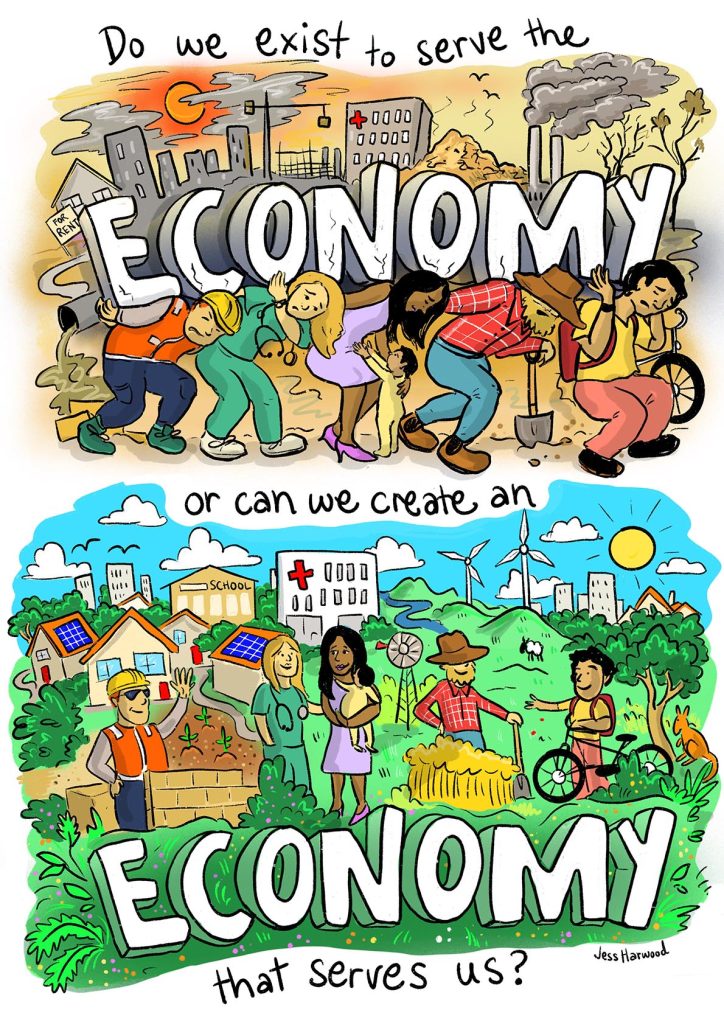
Cartoon by Jess Harwood for The Next Economy

So, we are doubling down. The ideas that politicians and decision makers reach for in a crisis matter. We want those ideas to be the ones that put wellbeing at the centre: dignity, purpose, participation, fairness, and nature. As a foundation, rather than an afterthought.  

That’s where our new series comes in. 

Building The Economy We Could Have explores the ideas, case studies and concepts that show how we get there. Right now, there are many isolated or ‘Lego wins’, the examples that show what can be done better, yet scattered and disconnected. We are turning our focus to see these as building blocks: things worth doing more of, and connecting across the country. 

We’ll share examples that show another way is possible and outline the potential of wellbeing economic concepts in practice, with case studies, explainers, interviews, and of course drawing on our work in regional communities looking to build resilient and thriving communities through times of change. ‘ 

The series includes:  

  • Explainers on wellbeing economy concepts and how they are showing up in Australia 
  • Case studies of enterprises, communities and policy makers doing differently 
  • Australian history showing we have charted different approaches before 
  • Interviews with people bringing fresh ideas and approaches. 

We are excited to uplift the work that is steadily charting the way forward, drawing on Australian’s strengths as people who back their neighbours, champion local ideas, and have a long track record of showing the world what policies that work for people and planet can look like.  

This series is a starting point for deeper thinking and conversation. We’d love to hear what resonates, or what we are missing. Contact us here.

Read our first case study:

Read our first explainer:

Building the economy we could have: Earthworker Cooperative Network

Earthworker Cooperative Network gives us a glance into a wellbeing economy in action, where workers build the things we need in a worker-owned factory in Morwell. 

When writing ‘The economy we could have’, our Economic Change lead Dr Katherine Trebeck came across countless ‘Lego wins’. These were the examples of a wellbeing economy in action in Australia that we could look to for inspiration on the way forward, even if there aren’t enough of them yet to add up to complete system change.  

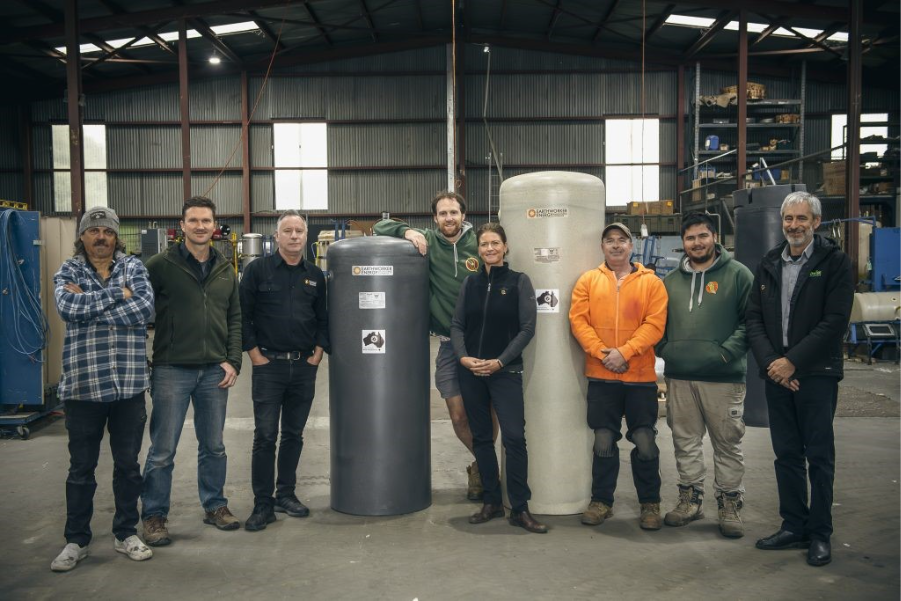
A great example is in Victoria’s Latrobe Valley, where Earthworker Cooperative, Australia’s first worker-owned factory, operates several enterprises. This includes the Earthworker Energy Manufacturing Coop, which produces heat pumps and solar hot water systems – its function first and foremost: to serve its worker owners. 

Earthworker has a vision that brings a wellbeing economy into practice: 

“…a world in which people everywhere are able to democratically determine the means of their existence, collectively meeting their needs while recognising our interconnection with each other, other species, and the environment in which we exist.” 

Earthworker has expanded to become a network of cooperatives that are committed to sustainability, both in social and environmental terms given the link between environmental harm and social injustice. 

Inside the worker-owned Morwell Factory (Photo contributed by Earthworker for our report) 

What co-ops make up the Earthworker network? 

  • Earthworker Energy Manufacturing Coop: produces new energy technology in Australia’s first worker-owned and run factory in the Latrobe Valley. Based in the Earthworker Morwell factory, it manufactures quality and high-performing stainless steel storage tanks for heat pump and solar hot water systems. 
  • Earthworker Smart Energy Cooperative helps households improve their home’s thermal efficiency and so their family’s comfort through assessments and draught-proofing. This in turn helps households save money and have more control over their energy use. 
  • The Earthworker Construction Cooperative provides residential construction, landscaping and maintenance services such as cabinet making, plumbing, pergola building, decking and more. Their motto is ‘Another world is being built’!  

There is clearly purpose behind what is being delivered by these cooperatives. Worker ownership is a mechanism of predistribution (as financial wealth goes either to workers or to the enterprise) and of economic democracy that enhances people power. By enhancing energy efficiency and being part of the renewable energy roll out, Earthworker is also helping prevent environmental challenges getting worse. In providing job opportunities to those who might otherwise face unemployment, they prevent the harm of job loss. 

So Earthworker speaks to all the ‘4Ps’ of a wellbeing economy in practice: purpose, prevention, predistribution, and people power. It demonstrates what we need more of to build an economy that serves people and planet. 

Earthworker’s logo, showing symbols of the Australian environmental and labour movements. 

What makes Co-ops part of a wellbeing economy? 

A wellbeing economy requires a substantial shift in how the economy is thought about and approached, looking for ways to benefit people and planet rather than profit for the few. 

Cooperatives (whether worker-owned co-ops, consumer co-ops such as groceries, or agricultural co-ops) are a great way to do this as they are owned, controlled and run by and for their members, creating economic democracy and a people-powered economy. They are democratically managed by ‘one member, one vote’, meaning everyone has an equal vote.   

Co-ops enhance predistribution because surpluses go back to members or the enterprise, so community wealth that stays in the community.  

Why Latrobe Valley 

The Valley has largely powered Victoria with brown coal for a century. When the coal power stations and State Electricity Commission (SEC) were privatised* in the 1990s, thousands of people lost their jobs and Victorians lost ownership of this essential infrastructure. (*Although since 2024, the SEC has been partially revived as a government-owned renewable energy company, with legislation that specifically protects it from privatisation).

The number of people employed in the power industry dropped from about 11,000 in the late 1980s to about 2,600 in 2001, causing the population to shrink significantly with nine per cent of the region’s residents leaving between 1991 and 1996. (See also The Latrobe Valley, Victim of Industrial Restructuring by Bob Birrell) 

Since then, the Valley has experienced high rates of disadvantage. In 2017 French-owned corporation Engie, announced the closure of Hazelwood mine and power station and roughly another 750 jobs were lost. 

How did Earthworker seek to address this economic injustice? 

The founders of Earthworker could see that the apparent conflict around jobs versus the environment wasn’t the full story and reflected a narrow lens. They recognised that there was a need to work together for just transition in the La Trobe Valley, and there was a dire need to create jobs that were better for workers and jobs that could contribute positively to the local community. 

Latrobe is one region where this is necessary, many other regions are also on the frontlines of economic transition that must include solutions that put wellbeing at the core, and the principles of prevention, predistribution, people power and purpose.

Australians are dissatisfied with the status quo and open to rethinking economic priorities that put people first. Earthworker shows a different model of business that can build an economy that works for people and for planet as a foundation, rather than an afterthought.

Resources:

Read our full report: ‘The economy we could have.’

Check out more about Earthworker here.

Find out more about Co-ops at BCCM, the peak body in Australia for Co-ops and Mutuals.

Building the economy we could have: insights from Progress 2026   

Australia’s economy may appear strong on the surface, but beneath the bonnet lie deep structural challenges: from rising inequality and insecure work to ecological breakdown. These demand more than piecemeal fixes; they need upstream economic transformation.    

Our Economic Change lead, Dr Katherine Trebeck, alongside Josh Devine from Regen Melbourne, hosted a workshop at Progress 2026 on going upstream for this economic transformation. Progress is the largest social justice conference in Australia, with more than 1,500 people attendees, 140 speakers from across the world and 60 sessions on how to win the change we need for people and planet. Here are some insights from the workshop. 

Katherine Trebeck and Josh Devine from Regen Melbourne at Progress 2026.

The roots of the problems 

The workshop opened with a provocative question from Frances Moore Lappé: “Why are we collectively creating a world that none of us as individuals actually want?” 

Participants identified numerous downstream challenges facing Australians today, including:  

  • Housing unaffordability  
  • Climate-driven bushfires  
  • Indigenous land loss  
  • Loneliness and mental ill-health  
  • Youth crime and family violence  
  • Wealth inequality and poverty  
  • Misinformation and rising fascism.  

Using upstream thinking, which is where attendees traced these symptoms to deeper economic roots rather than just looking downstream at the problems this system creates, they came up with the causes of these issues. These included corporate capture, extractive production systems, property as investment rather than shelter, deunionisation, and incentives that prioritise profits over social benefits.  

The vision: naming the world we want  

Rather than spending all our time on the problems of today, the group also imagined alternatives to our current economic system. Drawing inspiration from Regen Melbourne, Indigenous wisdom, and The Next Economy’s regional research, participants named what a better economy needed to deliver: dignity, fairness, connection, and ecological care.  

“Lego wins” as glimmers of light  

The workshop celebrated existing examples of positive change, what we refer to as ‘Lego wins’, the instances of what we need more of to build the economy we could have. Examples of these wins pointed to by the participants included:  

  • Community ownership: Hepburn Wind, energy co-ops, housing cooperatives  
  • Food systems: Oz Harvest, food co-ops, farmers markets, Buy Nothing groups  
  • Environmental action: Kelp farming, native nurseries, rooftop solar uptake  
  • Social infrastructure: Community gardens, third spaces, community toy and tool libraries  
  • Policy wins: Social procurement policies, minimum rental standards, Medicare  

These examples demonstrate that alternative economic models are already emerging across Australia.  

Dominant mindsets  

Yet these ‘Lego wins’ are not yet adding up to systemic change at the scale and pace needed. Pervasive myths and assumptions lock policy into inadequate downstream efforts. Some of these myths and assumptions called out by workshop participants include:  

  • Productivity leading to higher living standards for everyone  
  • Fiscal responsibility being more important than environmental stewardship  
  • Humans are primarily selfish and competitive (homo economicus)  
  • Welfare as a ‘burden’ rather than social good  
  • Economics is a science with hard, unchangeable rules  
  • Capitalism is superior to democracy  

Steps for action  

As the workshop finished, participants were invited to share examples of work that offered vehicles for working on economic system change. Organisations mentioned as potential partners and outlets included WEAll AustraliaRewiring Australia, Common Cause, and Energy Consumers Australia.  

Rising inequality, insecure work and ecological breakdown reveal deep structural problems in Australia’s economy that demand more than piecemeal  fixes. ‘The economy we could have’ workshop showed that these issues are not inevitable — they’re the result of choices shaped by power and values — and that alternative economic models are already emerging across the country. 

Read the report ‘The economy we could have’ for more details on where we can go to from here. 

📢 Stay tuned: In the coming months, we’ll be releasing a series that dives deeper into the glimmers of light we see in Australia for building ‘The economy we could have’.  

The Economy We Could Have – Webinar

Australia’s economy has delivered prosperity for some, but left many behind. The divides in housing, health, income and opportunity are widening — and they’re not inevitable. They’re the result of decisions, shaped by values and power. 

It doesn’t have to be this way. 

Across Australia and around the world, communities are already building alternatives — from cooperative energy projects and regenerative food systems to new legal frameworks and circular design. These examples show that change is not only possible: it’s already happening. 

In this one-hour session, The Next Economy CEO Lizzie Webb joins lead author Katherine Trebeck to unpack insights from The Economy We Could Have — a new paper that looks under the bonnet of the Australian economy and reveals how we can move beyond isolated ‘Lego wins’ toward a wellbeing economy that prioritises dignity, fairness, connection and ecological care. 

📅 Date: Thursday, 12pm AEST (1PM AEDT), 4 December 2025 

📍 Location: Online 

🎟 Tickets:  This event has already happened – watch the video below!

🎤 Speakers: The Next Economy CEO Lizzie Webb in conversation with lead author Katherine Trebeck.  

🔗 Explore the paper here

Watch the video